
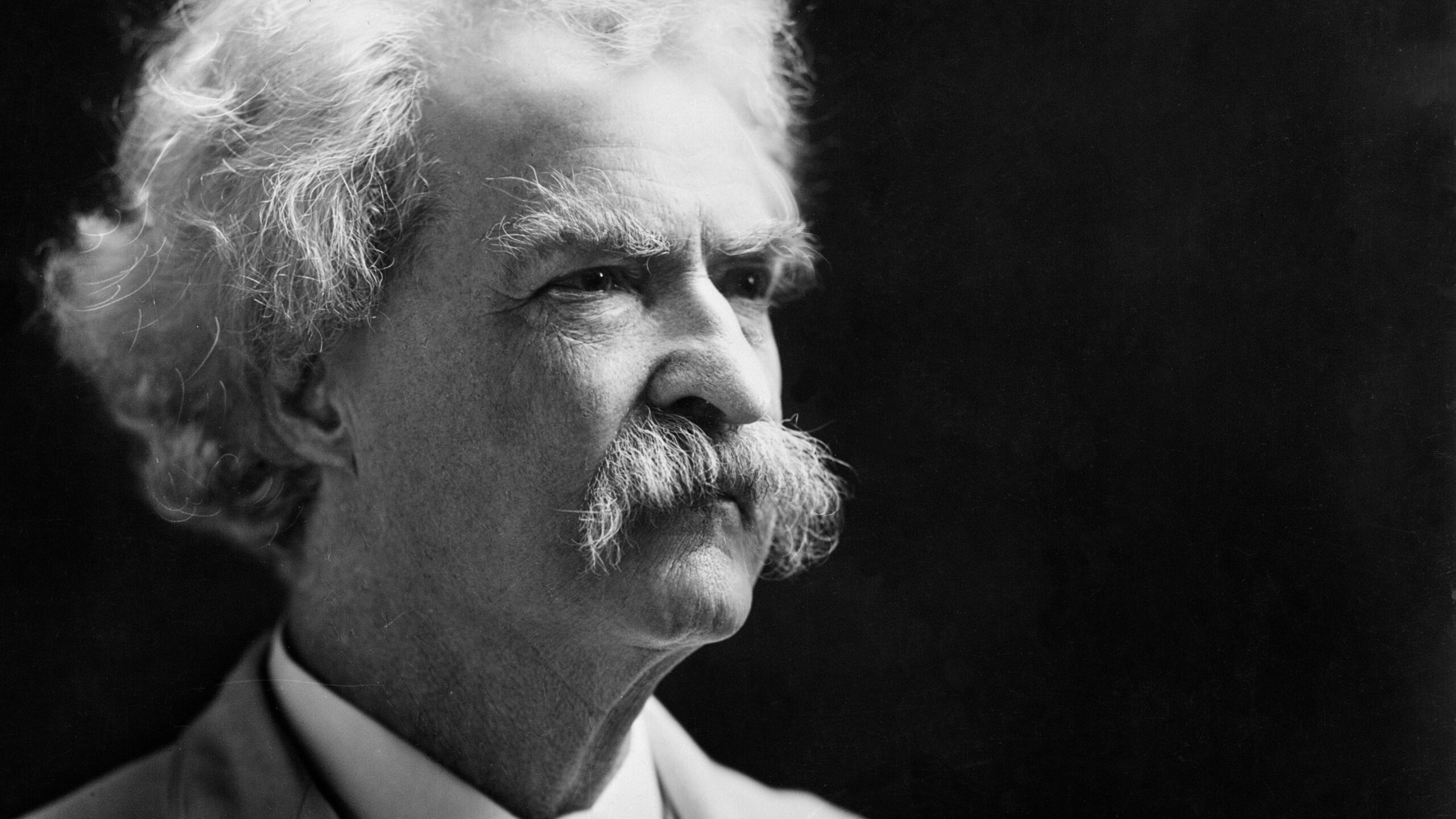
Mark Twain, born Samuel Clemens, shares a notable coincidence with Halley’s Comet: He was born in 1835 when the comet was visible from Earth and died in 1910, the year the comet returned on the eve of his death. Twain himself famously remarked, noting in 1909 as his health began to weaken, “I came in with Halley’s Comet. It is coming again next year, and I expect to go out with it.” He might have enjoyed a few more years if he had not smoked an average of fifteen cigars a day. When his doctor warned him he should quit, he compromised, saying, “I will only smoke one cigar at a time.”
Mark Twain is perhaps America’s greatest humorist and best-known writer, both here and abroad. His literary production is prodigious: over thirty books, countless articles and essays, and a huge volume of correspondence. Ron Chernow’s recent biography Mark Twain clocks in at 1,200 pages, but upon completion, the reader may wish for more. Twain’s was an extraordinary life, both more luminescent and darker than most of us have known. Chernow explains, “Our contemporary recollection of Mark Twain—mostly a sketchy memory of the Adventures of Tom Sawyer, Adventures of Huckleberry Finn, and Life on the Mississippi—doesn’t begin to encompass” his life.
Twain’s Luminescence
He was born Samuel Clemens and never changed his given name or surname; rather, beginning in 1863, he adopted “Mark Twain” as his nom de plume at age twenty-seven. The adopted name is a phrase taken from his early career as a steamboat pilot and was used to indicate water depth. “Mark twain” means the depth is two fathoms, or twelve feet, which is considered a safe depth for steamboat navigation.
If his writing was prodigious, it is because he was a prodigy. He never went to college but was a voracious reader across many disciplines and could hold forth on anything from Egyptian history to astronomy. After eleven years in Europe, he was a polyglot, speaking both French and German. He counted among his many admirers and friends G. K. Chesterton, Woodrow Wilson, Helen Keller, and many others in the US and Europe.
Twain wrote masterpieces that unfolded American life for a domestic and international readership.
Though his hometown of Hannibal was a hotbed of pro-slavery sentiment, Twain grew out of his prejudice so that, Chernow writes, “no other white American writer in the nineteenth century engaged so fully with the Black community or saw its culture as so central to our national experience.” Twain marveled at the malleability of the individual conscience:
It shows that that strange thing, the conscience . . . can be trained to approve any wild thing you want it to approve if you begin its education early & stick to it.
This flies in the face of modern belief that the conscience, if it exists at all, is inviolate: If someone asserts he is following his conscience, all discussion must stop. Twain’s view does follow, however, Thomas Aquinas’s teaching that one’s conscience is binding—but not when the conscience is in error (Summa theologiae 1-2.19.5–6).
If ever there were a soulmate, Twain’s wife, Livy, served that office. He proposed to her three times before she accepted. His training as a riverboat captain did not render him sufficiently genteel for polite society, the position Livy’s wealthy family occupied. It was a challenge, then, to win her affection and her family’s acceptance, as he had to convince her religious family not only of his character but of his religious sentiments. Adopting that spiritual veneer succeeded, though over time it wore off and he returned to his anti-religious instincts that grew ever more vicious as he aged, especially after Livy predeceased him. Nonetheless, he adored Livy, and she adored him despite his serious faults.
Twain wrote masterpieces that unfolded American life for a domestic and international readership. The Adventures of Tom Sawyer is often paired with The Adventures of Huckleberry Finn in the American imagination. The latter is one of the most powerful anti-slavery novels ever written, as good as—if not better than—Uncle Tom’s Cabin. Likewise, it is difficult to refute the contention of The Tragedy of Pudd’nhead Wilson that the fictitious inferiority of the black race is a deceit promoted by social conditioning. Twain sponsored Richard Greener, an apprentice in law in Washington, a student at Yale, and the first black graduate of Harvard. On Christmas morning of 1885, Greener was invited to dine with the dean of Yale but had to decline, lacking the proper attire. Twain wrote to the dean in the interest of subsidizing Greener,
We have ground the manhood out of them, & the shame is ours, not theirs; & we should pay for it. . . . I would like to know what the cost is, so that I may send 6, 12, or 24 months’ board, as the size of the bill may determine.
Chernow notes, “Twain had devised his own form of racial reparations,” a practice he would continue. Later in life, he invited his black butler, George Griffin, to accompany him on a visit to the editorial offices of Century Magazine in New York City. They became an object of curiosity, as it was startling to see a white man and a black man walking together as companions. Later, Twain said of Griffin, “In some ways he was my equal, in some others my superior.”
Twain’s interests were boundless and his wit bottomless.
As he aged, Twain yearned to be taken more seriously than just as a humorist, though he thought even that role was underappreciated. Perhaps anticipating the contemporary prevalence of political satire, from SNL to the Babylon Bee, he explained that the duty of a humorist, far from only providing entertainment was
the deriding of shams, the exposure of pretentious falsities, the laughing of stupid swindles out of existence . . . & the natural friend of human rights & human liberties.
Twain’s interests were boundless and his wit bottomless. One of his lesser-known novels was Those Extraordinary Twins, about a fictional pair of Siamese twins. Luigi was wicked and Angelo was righteous, perhaps symbolizing the contradictions in human nature. He wrote,
They were a troublesome pair in every way. If they did any work for you, they charged for two; but at the boarding house they ate and slept for two and only paid for one. In the trains they wouldn’t pay for two, because they only occupied one seat. The same at the theatre.
Twain is famous for his parody of the German language and would give lectures on the subject, in German, to German audiences. He remarked that the language is so hopelessly dense that you can “travel all day in one sentence without changing cars.”
Twain’s Darkness
Chernow writes, “America’s funniest man harbored ineffable sadness and displayed a host of contradictions.” Twain’s life was crowded with far more tragedy than most people could bear. He grew up on the edge of poverty with parents in a loveless marriage. His mother married his father out of spite when she was jilted by the man she really loved, a motive of which his father became aware. The young Samuel remembers seeing his parents kiss only once, and that when one of his siblings died. His humourless father was intrinsically incapable of showing emotion to any of his offspring. Four of his siblings died before adulthood; only Sam, his brother Henry, and sister Pamela survived. After Sam became a steamboat pilot, he shepherded his brother Henry into the same profession only to see his career cut short when his steamboat boiler exploded. He was badly burned and died three days later.
Sam adored his brother and as Henry lay dying, he wrote to his sister-in-law,
Long before this reaches you, my poor Henry—my darling, my pride, my glory, my all, will have finished his blameless career, and the light of my life will have gone out in utter darkness.
Sam was overwrought with grief and guilt; later in life he even visited a medium to try and communicate with Henry. Although innocent of his brother’s death, Twain was overcome by the onerous combination of grief and guilt that plagued his existence until his death. Little did Twain know at the time that Henry’s tragic death was just the beginning of sorrows.
He and Livy had a son who died very young and three daughters. The oldest, Olivia, or “Susy,” contracted bacterial spinal meningitis when she was twenty-four. The last few days and hours of her life were horrific, as the infection reached her brain and she experienced bouts of insanity and was rendered blind. The family grieved for years, refusing to celebrate Christmas or acknowledge any birthdays. His beloved Livy, always frail, died at fifty-eight. Her death was followed by that of the youngest daughter, Jean, who at age fifteen developed epilepsy so severe that she might suffer as many as three violent grand mal seizures in a single day, in addition to unrelenting, constant petit mal episodes, commonly referred to as absence seizures. Just when she seemed to be overcoming the disease, she died of a seizure in an upstairs bathtub. Twain attributed Livy’s early death to the years-long unimaginable toll that Jean’s illness took on the family.

His surviving daughter, Clara, married and became a mother, but before that, she felt as if she were constantly under her father’s shadow and found herself beset by mental weakness that required an intermittent stay in a sanitarium. She had dreamed of becoming a concert pianist, but her hands were too small. A second choice was as a vocalist. Her voice was not powerful enough for opera, but she sang Lieder music—German poetry set to music for vocal and piano—reasonably well. Yet she constantly battled nasal and respiratory afflictions that interfered with her performance, and she ultimately abandoned this second musical dream. She came to believe, often rightly, that people attended her performances because of her father’s fame. Habitually self-promoting, he even made a curtain call after one of her performances, delivering an entertaining lecture that lasted fifteen minutes.
Twain could turn with relentless, vindictive savagery on business associates on a dime, even when he was the cause of his own predicaments. When his publishing business, Webster & Company, began to fail, Twain unfairly turned on its director, his nephew, heaping vitriol on the young man that only ended with Twain’s death. Of the many times he attacked him in print, he wrote in 1888, “Webster was a limitless liar. . . . He was treacherous. Envy was a disease with him. He was as base a character as the century can furnish.” Years later, as Twain’s mood swings became even more volatile, he wrote, “I have never hated any creature with a hundred thousandth fraction of the hatred which I bear that human louse, Webster.” Twain is the one, we should note, who conscripted Webster to assume the directorship in the first place.
Twain lacked common sense when it came to business and investments. His ventures exhausted his earnings as well as his wife’s substantial holdings. It took years for him to climb out of bankruptcy, which he only did by constant writing, extensive lecture tours that disrupted family life, and the benevolent help of a benefactor. Even after he had regained solvency, he still was easily enticed by several “get-rich” gimmicks but did not seem to have the energy nor the enthusiasm needed to chase the rainbow once again.
To say that Twain’s attitude toward religion and human nature was cynical would be a gross understatement. Twain’s bitterness grew, and with each passing year he was more convinced that “human happiness was a snare, a fraud, and a delusion.” If there were a God, he was alternately “detached and malicious, and delighted in the misery of the human race.” Twain wrote in Pudd’nhead Wilson, “If you pick up a starving dog and make him prosperous, he will not bite you. This is the principal difference between a dog and a man.” Before his company failed, Twain published a biography of Pope Leo XIII, the namesake of our current pope, though the motive was not reverence.
Chernow describes Twain’s reaction after hearing a sermon onboard a cruise: He “mocked the notion of Christ sacrificing His life for humanity.” Twain wrote, “If Christ was God, then the crucifixion is without dignity. It is merely ridiculous, for to endure several hours’ pain is nothing heroic.” He later attacked “the God of the Bible as an often frightening figure.” He wrote, “He never does a kindness. When He seems to do one, it is a trap which He is setting.”
Joan of Arc
Chernow explains that a young Sam Clemens “reportedly snatched a stray page of a biography of Joan of Arc, kicking about in a windy street,” which started a “lifelong fixation” on the tragic young French woman. The fascination seems inharmonious with his harsh anti-Christian and anti-Catholic sentiments. He lauded her history as the “most thrilling history he had ever read” and pored over “so many books about Joan, both in French and English, that he became an amateur authority on the subject.”
For a large measure of his life, he chose Huckleberry Finn as his favorite work, but at a certain point, he tended to call his historical novel Joan of Arc his “favorite child.” While on a visit in Paris, Twain made an excursion to Rouen, a 122 kilometer sidetrip, where Joan had been burned at the stake. His daughter Clara remembered, “For years, around the dinner table he talked and talked about the character and feats of Joan, until it became a family joke that Papa loves two women—Mamma in the present, and Joan retrospectively.” The novel is so laudatory that some critics thought it excessively romantic.
If you’re still looking for summer reading, you can do no better than Ron Chernow’s deep dive into Mark Twain.