
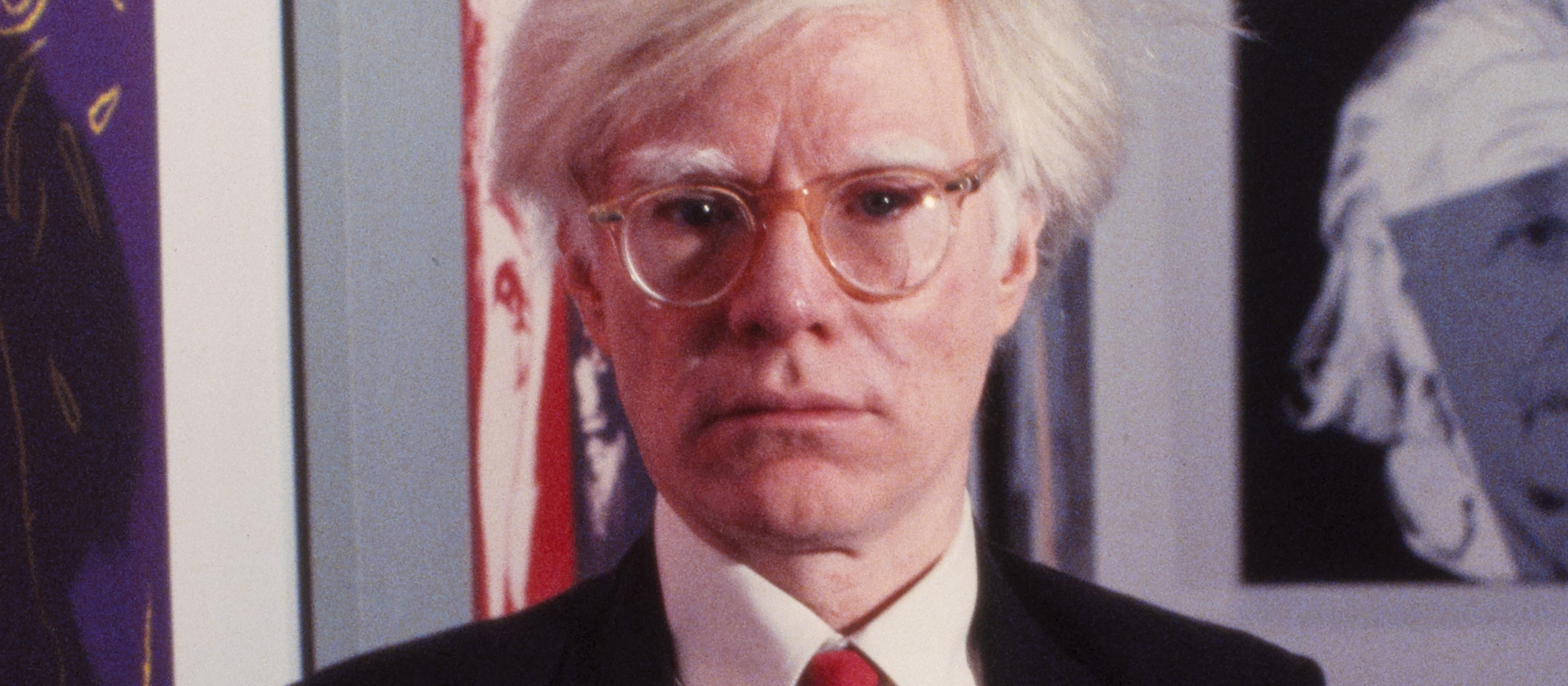
“If I had to describe Andy Warhol’s work in just one or two sentences, I would describe it as the world seen not as it is, but the world seen as it might be transformed by grace.”
—James Romaine, President of the Association of Scholars of Christianity in the History of Art
Andy Warhol is famous for his iconic pop art paintings of Campbell’s soup cans, Marilyn Monroe, and Elvis Presley, yet beneath the celebrity veneer was a man of quiet devotion who regularly attended Catholic Mass, volunteered in New York City soup kitchens, and was the son of Byzantine Catholic immigrants. I would like to take you behind Warhol’s silver wigs and Studio 54 glamour to offer some insights into his idiosyncratic relationship with Catholicism.
Andrew Warhola Jr. was born on August 6, 1928, in Pittsburgh, Pennsylvania. He was the fourth child of working-class immigrants from Austria-Hungary. Warhol’s parents were devout Ruthenian Catholics and regularly attended St. John Chrysostom Byzantine Church, where the infant Andrew was baptized. When he was eight, Warhol contracted strep throat, then scarlet fever and ultimately Sydenham’s chorea, an autoimmune disease, which isolated him from school. At home he spent his time reading magazines, cutting out photographs, making collages, and drawing.
He graduated from Schenley High School in 1945 and won a scholarship to the Carnegie Institute of Technology, where he continued his passion for drawing and art. He completed a Bachelor of Fine Arts, and his work was first published in Glamour magazine in 1953. Art news writer Barbara Guest noted that Warhol had developed an “original style of line drawing.” He developed a reputation in the fashion advertising industry for his shoe advertisements, with one admirer noting, “Nobody drew shoes the way Andy did. He gave each shoe . . . a Toulouse-Lautrec kind of sophistication.”
In 1957, Warhol began to produce and distribute self-published books of his illustrations and design record covers for Blue Note and Prestige records including The Congregation (1956), The Story of Moondog (1957), and Blue Lights, Volume 1 (1958). In 1961, his first “pop art” works were displayed in a window of a Fifth Avenue department store. Warhol became attracted to silkscreen techniques and began creating his now-famous Campbell’s Soup Cans, featured in Time magazine alongside pop artist Roy Lichtenstein. Campbell’s Soup Cans became Warhol’s breakthrough, the foundation for his work, and the iconic image of the burgeoning pop art movement.
Warhol kept his Catholicism fiercely private, with only family members and close confidantes. Yet his art often revealed his deepest convictions.
Pop art developed throughout the 1950s and ’60s in the UK and US. It challenged fine art conventions by incorporating advertising, comic books, celebrity culture, and everyday consumer goods. Lichtenstein leaned heavily into comic book art, James Rosenquist was influenced by billboard advertising, and Warhol was drawn by supermarket products and celebrity icons like Marilyn Monroe. The works were defined by bold primary colors, broad canvases, and striking designs. Pop artists sought to make fine art—usually associated with high culture and elitism—accessible to the masses, creating works that elevated everyday objects and the experiences of American life. Warhol was central to the movement and pushed the pop art movement beyond the gallery into a cultural phenomenon, combining painting, music, and film into an all-encompassing cult of personality.
After the success of Campbell’s Soup Cans,Warhol exhibited his famed Marilyn Monroe (1962) and Elvis (1963) series. He relocated his studio to 231 East 47th Street, colloquially named “The Factory.” The Factory projected an image of openness and inclusivity for the marginalized members of American society. It became a mecca for many renowned painters, writers, and musicians, including Bob Dylan, Mick Jagger, Truman Capote, Salvador Dalí, and Lou Reed, who, with Warhol, produced the influential album The Velvet Underground & Nico (1967).
The Factory soon became infamous for its hedonism and excesses. Warhol openly expressed a gay identity and later became an icon for the queer community. He experimented in cocaine use and ironically installed a sign in The Factory reading “Absolutely No Drugs Allowed,” encouraging users to “shoot up on the stairwell” rather than in the studio itself. The photographer Nat Finkelstein recalled:
Andy Warhol’s Factory was just one big room on West 47th Street covered in aluminium foil. . . . I was there with all of these mainly gay men and women, all dressed in black leather jackets, black t-shirt and jeans, as well as all these incredible crazy transvestites and I took photographs. . . . I always felt the hedonism at The Factory was a bit put on. It was like they were all living in their own movie in their head.
This level of accessibility ultimately backfired when radical feminist Valerie Solanas attempted to assassinate Warhol on June 3, 1968. Warhol was seriously wounded by the attack and remained in critical condition for several months. He was psychologically and physically scarred by the incident, and he had to wear a surgical corset for the remainder of his life to prevent his stomach from distending. The assassination attempt radically altered Warhol’s life, becoming the catalyst for a profound realignment with the Catholic faith of his childhood.
The assassination attempt radically altered Warhol’s life, becoming the catalyst for a profound realignment with the Catholic faith of his childhood.
Warhol’s first exposure to art was looking up from a pew at the multicolored windows of St. John Chrysostom Church. These astonishingly beautiful icons left an indelible impression on the young Andy. The Warhol Museum chief curator José Diaz elaborated:
This is something Andy Warhol would have seen as a young boy going to Church with his family. Icons are a way to speak to holy figures in terms of adoration and prayer. . . . To take images of Jackie Kennedy or images of Marilyn Monroe and understand that they would speak to the masses, I think that was a tool he would have learned just by observing life in Church.
Warhol continued to be a regular Mass attendee at St. Vincent Ferrer in New York City. He went to Mass several times per week with his mother, Julia, with whom he lived and prayed daily. His mother said of her son, “He is a good religious boy.” Warhol kept his Catholicism fiercely private, with only family members and close confidantes. Yet his art often revealed his deepest convictions.
In 1967, he directed a film called Imitation of Christ, featuring Nico reading aloud Thomas à Kempis’s De Imitatione Christi. In the same year, Warhol was commissioned by renowned Catholic art collector John de Menil to create an artwork to be featured in the Vatican-sponsored ecumenical pavilion in the 1968 San Antonio World’s Fair. The work became Sunset and was included in Warhol’s 24-hour film Four Stars (1967).
Warhol’s camera gazes out over the California coast, capturing the sun setting over the ocean as dusk spills into a purple sky. Nico once again narrates the film, intoning mysterious reflections with her incantational voice: “You are the light . . . his hand holds life . . . the night is white . . . they do not see me, they do not see you.” The film is at once simple and deeply profound. The camera invites the audience to meditate on the setting sun—an everyday experience we don’t often dwell on. Warhol’s camera is a still witness to this extraordinarily unrepeatable event. We are called to gratitude and communion with the day, with the sun and the light tapping into our primordial relationship to nature and God.
The early Church associated Christ with the sun and called him the Sol verus (true Sun) or Sol iustitiae (see Malachi 4:2), bringing to mind Christ’s descent into darkness and his resurrectional ascent to life and light. Warhol appears to invite us to meditate on the beauty and sacrifice of Christ’s death and resurrection—as the sun rises and sets everyday in our life. Not coincidentally, Warhol chose to film the sun over the ocean, referencing the waters of Genesis, where God separated the dark from the light. Though Sunset was never officially exhibited during the 1968 World’s Fair, the short film is a profound insight into Warhol’s sacramental imagination and unique capacity to infuse popular mediums like film with Catholic liturgy, transcendence, and beauty.
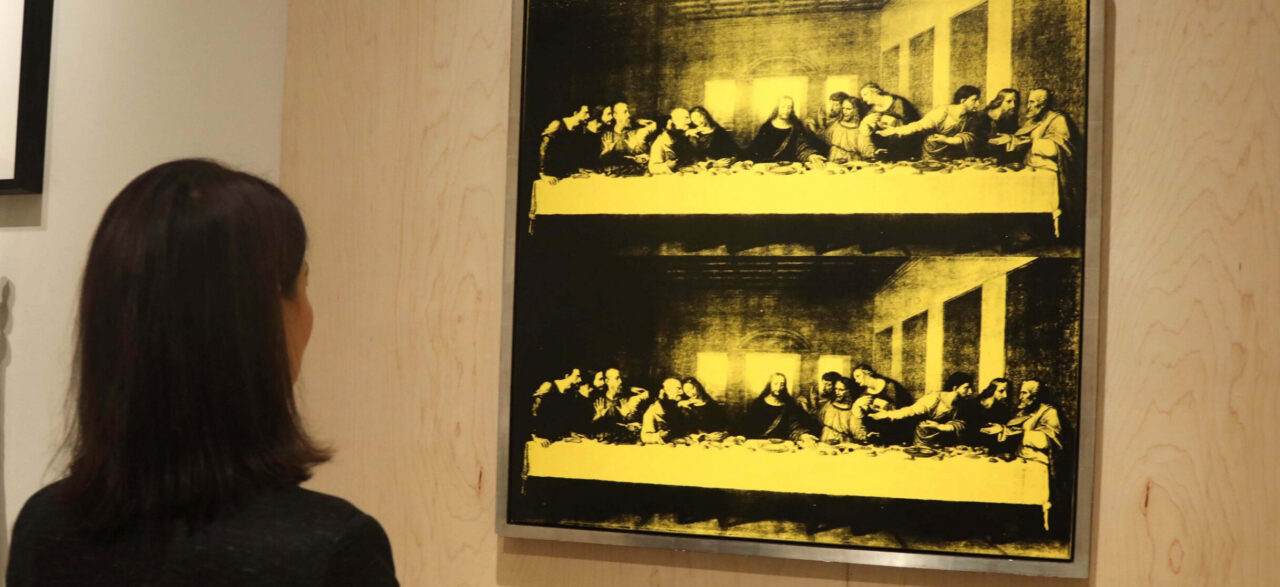
Perhaps the most well-known of Warhol’s Catholic-inspired artworks is his depiction of The Last Supper (1984–1986). The series included over one hundred variations on the theme and was the last work Warhol exhibited before his death. The Last Supper is the culmination of Warhol’s oeuvre, incorporating repetition, bold colors, and commercial logos. The works are directly inspired by Leonardo Da Vinci’s rendition. Warhol employed his famous silkscreen techniques and produced replicas of the original artwork. In this context, Warhol’s signature repetition reflects both the mechanical rhythms of consumer capitalism and the recurring patterns of the Rosary, liturgy, and ritual more broadly. The Last Supper series illuminates Warhol’s attempt to reconcile his inner life of faith with his outward experience of consumer capitalism. As mentioned earlier, icons had a profound effect on Warhol’s imagination as a child, as explained by Kassandra Ibrahim of the Orthodox Christian Studies Center:
[Warhol] is inspired by both the Byzantine aspects of iconography, and the iconic image of an individual in a one-point perspective, but then we see his Last Supper paintings and you can see the influence of the Renaissance. . . . It’s kind of a mix because Byzantine Catholicism is also a mix. It is a fusion between an Orthodox visual reality and then Catholic doctrine. So, it’s in communion with the Catholic church, but visually it looks very Orthodox.
At the opening of The Last Supper exhibition, Warhol asked French art critic Pierre Restany, “Do you think the Italians will see the respect I have for Leonardo?” Restany later reflected, “Consciously or not, Warhol seemed to me to have acted there as a curator of a masterpiece of Christian culture, of maintaining a tradition he was a part of.” The Last Supper series was Warhol’s final attempt to cement his legacy within the Christian art tradition that he adored.
By the 1980s, Warhol was committed to distancing himself from the secular hedonism of his youth and to surrounding himself primarily with Catholic friends and family. After Andy (2017) author Natasha Fraser-Cavassoni observed:
Almost everyone who remained relevant in Andy’s life was Catholic. . . . Being brought up Catholic gives a sense of hierarchical order, discipline and faith. Faith, when embraced, anchors the creative. . . . I think it would also be fair to say that the romantically rich and multi-layered religion that forgives all . . . allows for unconventional traditionalists.
Andy Warhol died in 1987, and his funeral was held at St. Patrick’s Cathedral in New York City. The service was attended by over 2,000 people, including Debbie Harry, Calvin Klein, and close friend John Richardson, who shared a eulogy offering considerable insight into Warhol’s Catholic convictions:
To my certain knowledge, he was responsible for at least one conversion. He took considerable pride in financing a nephew’s studies for the priesthood. And as you have doubtless read on your Mass cards, he regularly helped out at a shelter serving meals to the homeless and the hungry. Trust Andy to have kept these activities very, very dark.
Andy Warhol and his legacy are as complex and paradoxical as the man himself. Yet it is undeniable that his Catholic convictions formed a theological framework not only for much of his personal life but for his influential artistic vision. Beneath the seemingly superficial surface of celebrity, consumerism, and commerce was an artist molded by Catholic ritual, icons, transcendence, and grace. Far from existing apart from his faith, Warhol emerged from it, positioning him as one of the most distinctive Catholic artists of the twentieth century.