
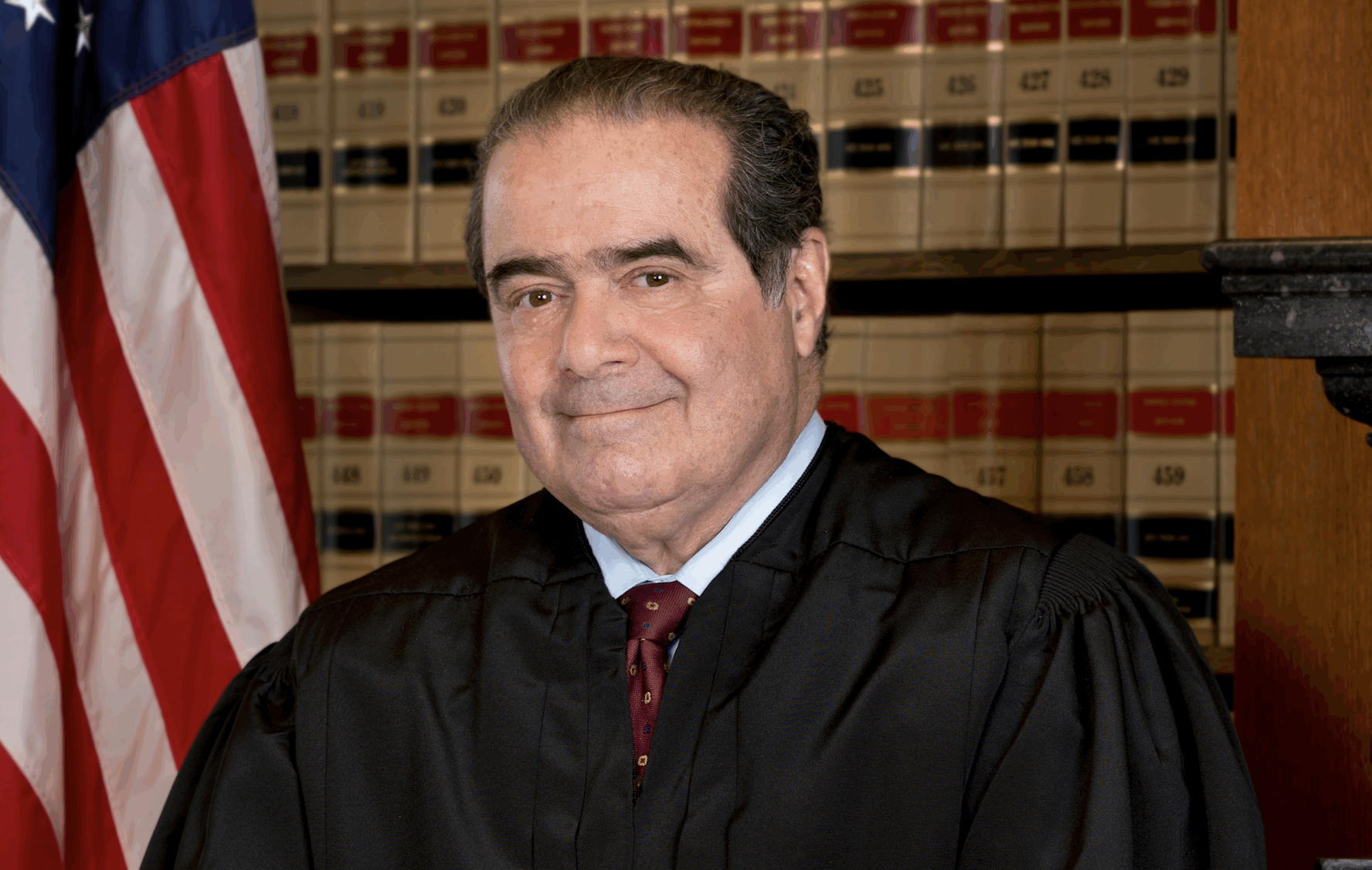
On September 26, 1986, with his wife, Maureen, and all nine of their children, devout Catholic Antonin “Nino” Scalia was sworn in as the court’s one hundred third associate justice of the United States Supreme Court. The story of his years on the Court is told by author James Rosen in the second, and most important, book of the trilogy on Scalia’s life: Scalia: Supreme Court Years, 1986–2001. Rosen’s book is 528 pages long and worth every page.
In recent decades, Republican nominees to the Court have been forced to endure a hyperpartisan and shameless inquisition by the Democrats of the Senate Judiciary Committee. Fellow conservative William Rehnquist endured such abuse that his experience was dubbed “The Rehnquisition.” But when Scalia followed Rehnquist fourteen years later, he caught the Democrats sleeping, as he was confirmed 98–0. Two senators abstained. Whenever Scalia brought home an A- from school, his father would demand, “Why not an “A”? Accordingly, the new justice was irritated for years that he had not been confirmed 100–0.
The irony is that Scalia became a far more influential member of the Court than Rehnquist, though the latter ultimately became Chief Justice. Scalia joined a Court largely dominated by liberal justices, led by William Brennan, that included Harry Blackmun, the author of Roe v. Wade. Rehnquist welcomed Scalia’s arrival. Until Scalia’s confirmation, Rosen explains, “Rehnquist was the Court’s lonely conservative, penning so many solo dissents—fifty-four—his clerks gave him a Lone Ranger doll.”
For the next several decades, Scalia, though modest in stature at 5 foot 7 inches, became a towering intellect who fundamentally changed the Court. His tenure was long; he served for twenty-nine years as an associate justice.
A “Roly-Poly” Kid
Nino, a “roly-poly, jovial, Italian American kid,” shot rabbits with a .22 rifle in the woods of Long Island. On the playgrounds and streets of Queens, he played every sport available and “tortured the French horn.” Though the horn did not last, the roly-poly profile never quite disappeared.
Scalia was habitually jovial and gregarious, liked by nearly everyone. He reveled in a long friendship with Justice Ruth Bader Ginsberg, with whom he rarely agreed on the Court. They shared a love for opera, and their families typically celebrated New Year’s dinner together, with Ginsburg’s husband, Marty, preparing gourmet meals.
But Scalia also had a temper. At a restaurant in DC, Scalia and Maureen met friends to celebrate his confirmation to the bench. Things got off to a rough start when the maître d’ told Scalia that he could not smoke his pipe in the restaurant, even though cigarette smoking was allowed.
Nino threw the menu down on the table, got up, and walked out of the restaurant, leaving his wife. . . . We all looked at [Maureen] immediately and started laughing because he was just throwing a fit. (15)
Scalia was waiting for the group at the next planned stop, cheerful and glad to see his friends again.
Scalia was incensed at the way in which Clarence Thomas was treated by the Democrat-led Senate Judiciary Committee, which gave a platform to salacious accusations against the SCOTUS nominee, accusations that even Committee Chairman Joe Biden admitted lacked credibility.
It may come as a surprise that in 1996, Chairman of the House Republican Conference John Boehner asked Scalia if he might quit his job at the Court and enlist as the running mate of Senator Robert Dole, whose presidential campaign was floundering and needed heavyweight help. Scalia’s personal record was also important, given that the various fine-tooth-comb investigations of his life never discovered even a mere hint of a scandal, no matter how thorough the scrutiny. Scalia gave it some thought out of a love for country and a sense of obligation, but he ultimately declined. Dole and running mate Jack Kemp lost to Bill Clinton by an embarrassingly wide margin: 159 electoral votes to 379 for Clinton, so Boehner was right to worry.
He is best known for his majority opinion in a handful of important cases that, over time, moved the orientation of the Court in fundamental ways.
“We Are All Originalists Now”
“We are all originalists now” was famously uttered by Justice Elena Kagan in 2010, suggesting that originalism—the doctrine that the Constitution should be interpreted based on its original meaning at the time of its adoption—has become the dominant mode of constitutional interpretation, whether a justice is conservative or progressive. Originalism is closely linked with textualism, which simply means that any interpretation of the Constitution should begin with an earnest attempt to understand its language and the rhetoric its authors employed. Kagan was, in essence, recognizing the way in which Scalia had fundamentally shifted the way in which the Court decided cases.
Scalia wrote 282 majority opinions in his tenure on the court, but he is best known for his majority opinion in a handful of important cases that, over time, moved the orientation of the Court in fundamental ways. District of Columbia v. Heller (2008), dealing with the Second Amendment right to “bear arms,” is a case study in following the text of the Constitution and ascertaining the intent of those who wrote it. It settles forever the question of whether gun ownership is an individual right or solely a group right exercised by a “militia,” which today is represented by the National Guard in each of the states. Heller is so careful and comprehensive it seems impossible that it will ever be overturned. Instead, if more limitations on gun ownership and use is wanted, it will require the courage and hard work necessary to pass a constitutional amendment.
Printz v. United States (1997) was also about guns—background checks, specifically—but this time it was a question of federalism, or the proper relationship between the states and the national government, not the Second Amendment. I happened to be in a wine store in Valladolid, Spain, when the announcement of the decision came over Spanish radio, exclaiming that the US Constitution now allows any type of gun, for any reason and for any purpose. “No,” I said to a few people present, “The decision only means that the national government can’t order the states to undertake thorough background checks without providing the resources the states need to comply.” Many CLEOs (chief law enforcement officers) complained that they did not have the in-state budget nor the personnel to fulfill the new requirements. Lujan v. Defenders of Wildlife (1992) is a tongue-in-cheek opinion telling American animal lovers that they have no “standing” to sue the government just because they don’t like the treatment of crocodiles on the Nile or Asian elephants and lions in Sri Lanka. Scalia called the plaintiff’s argument that we are all part of the great circle of life “beyond all reason.”
The Colorful Dissents
Whereas Scalia is responsible for important, seminal majority opinions, his dissents are notable and nothing short of entertaining. They are at times scathing, written with either excessive sarcasm or brilliant wit, depending on one’s point of view. They are certainly useful and instructive for showing students that constitutional law is not boring.

In Lemon v. Kurtzman (1971), the Supreme Court established what is known as the three-part “Lemon Test,” a rubric intended to guide decisions having to do with the “no establishment” clause of the First Amendment. The Court’s religious case rulings have become more and more confusing over time, and the Lemon Test was intended to bring clarity and confidence to future cases. It has not worked. All three parts of the test are hopelessly vague:
- Does the activity have a primary purpose that is secular?
- Does the activity promote or inhibit religion?
- Does the activity foster excessive entanglement between church and state?
Scalia had nothing but contempt for Lemon, and he never missed an opportunity to deride it. Lee v. Weisman (1992) attempted to ascertain whether a prayer could be offered at a high school graduation ceremony. In a split 5–4 decision, the Court said no, using the Lemon Test to reach its verdict. The majority opinion, written by Anthony Kennedy, feared that any non-Christian person who was in attendance would feel “coerced” by a general prayer, notwithstanding the country’s tradition of the occasional civic invocation.
Scalia wrote that the Court, building on the Lemon precedent, invented a “psycho-coercion” rule. He called his fellow jurists “amateur psychologists,” relying on specious “research” that is no more than “psycho-babble” having “no roots in our people’s historic practice.” Scalia complained that the majority opinion read as if religion was a personal activity that should only be practiced “entirely in secret, like pornography, in the privacy of one’s room.”
As the years passed, Scalia became increasingly concerned about the direction of the country.
Lamb’s Chapel v. Center Moriches Union Free School District had to do with the use of after-hours public school space by an evangelical church to show pro-family films. The church was denied use even though other social and civic groups were allowed access. The Supreme Court ruled unanimously in favor of the church—that was good news. But Justice Byron White crossed a Scalia line when he invoked the Lemon Test in the majority opinion reasoning. Scalia wrote in his concurring opinion,
Like some ghoul in a late-night horror movie that repeatedly sits up in its grave and shuffles abroad, after being repeatedly killed and buried, Lemon stalks our Establishment Clause jurisprudence once again, frightening the little children and school attorneys of Center Moriches Union Free School District. . . . Its most recent burial, only last term, was, to be sure, not fully six feet under.
Planned Parenthood of Southeastern Pennsylvania, et al, v. Casey, Governor of Pennsylvania, et al. was the last big case before Dobbs overturned Roe v. Wade. It was an attempt to put a “right to abortion” on more solid constitutional footing, but it failed in the effort. In an unusual move, Justice Kennedy, Justice Sandra Day O’Connor, and Justice David Souter issued a joint majority opinion, but the style of the opinion bears all the marks of Kennedy’s rhetorical flourishes. Once again it seemed that it was Kennedy writing the majority opinion and Scalia tearing it apart. Scalia and Kennedy had earlier been fast friends, but no friendship could survive Kennedy’s jurisprudential mediocrity and Scalia’s acid wit.
At this point, we should note that Justice Anthony Kennedy appears to have aspired to be a philosopher, though his opinions confirm the wisdom of his choice to pursue law. His opening sentences in Lawrence v. Texas (2003) are cringeworthy:
Freedom extends beyond spatial bounds. Liberty presumes an autonomy of self that includes freedom of thought, belief, expression, and certain intimate conduct. [This] case involves liberty of the person both in the spatial and more transcendent dimensions.
And what exactly did Kennedy have in mind in his metaphysical musing about the “spatial and more transcendent dimensions” of the human experience? Oh, right: Sodomy between members of the same sex.
The majority opinion in Casey begins awkwardly as well: “Liberty finds no refuge in a jurisprudence of doubt.” This is little more than a Rorschach blot, meaning different things to different people. To others it means nothing at all. The total opinion clocks in at a rambling, discursive one hundred and fifty pages. The “mystical flavor of the opinion,” according to Rosen, “was more than Scalia could stomach.”
Quoting the majority opinion, Scalia’s sarcasm is thick enough to cut with a knife:
The issue is whether [abortion] is a liberty protected by the Constitution of the United States. I am sure it is not. I reach that conclusion not because of anything so exalted as my views concerning the “concept of existence, of meaning, of the universe, and of the mystery of human life.”
The Court After Scalia
As the years passed, Scalia became increasingly concerned about the direction of the country. While he was disturbed at the policy positions that were birthed by SCOTUS rulings, he was most concerned that the Court was undermining the democratic process by taking the country in directions that should have been decided by the people at large through the legislative process. Thus, the Court was also guilty of violating separation of powers as well as democratic practice.
On February 12, 2016, Nino Scalia was found serenely lying in his bed at a Texas hunting lodge, where his heart had stopped during the night. History has already judged him one of the most influential jurists on the Supreme Court. What the Supreme Court will look like in years to come is impossible to predict. More justices like Scalia would bode well for the future.