
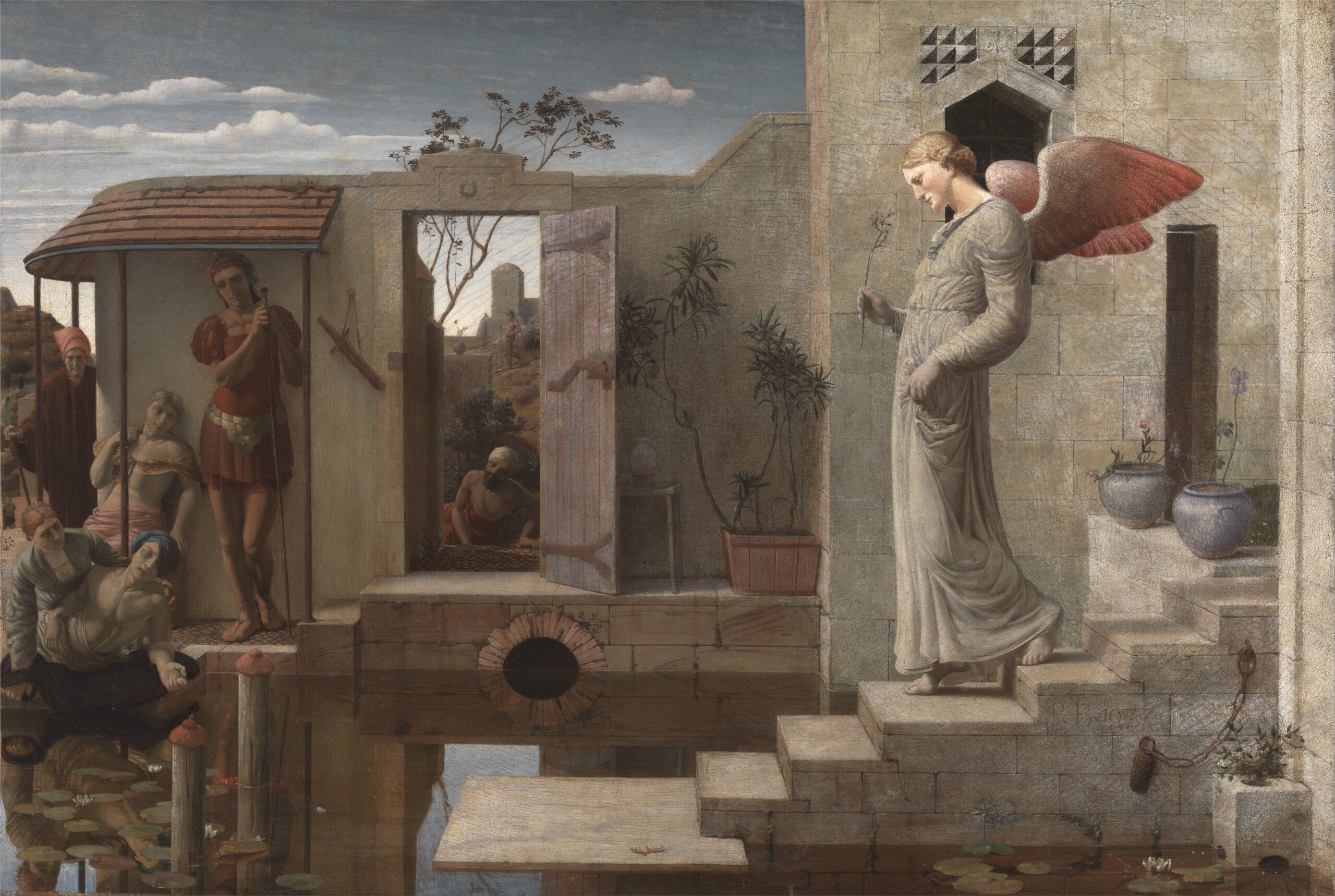
In a recent essay, I reflected on how a few simple words from the sixth century’s Rule of St. Benedict express the core of Catholic social teaching’s principle of the common good. Three Gospel scenes provide a follow-up by illustrating what happens when people pursue—or neglect—the good of one another.
Following Benedict’s principle, a rightly ordered community provides for both the strong and the weak so that the strong have something to challenge them and the weak are engaged, given purpose, and don’t become isolated from community life.
The parable of the rich man and Lazarus and two stories of Jesus’s healings show us the consequences of success or failure in pursuing the common good.
1. The Parable of the Rich Man and Lazarus (Luke 16:19–31)
The first story I want to consider is the parable of the rich man and Lazarus. It’s a familiar story—so familiar that it’s easy to read (or hear) and not be moved by the warning it contains. Jesus’s parables are didactic and challenge us to reflect on how well we’re applying the message of his teaching to our lives. I often try to not identify too closely with the rich man in the parable, but when I’m honest, I can see how similar we really are. The rich man’s fate is painful to contemplate when we see ourselves at his table.
Jesus shows us Lazarus resting on the bosom of Abraham while the rich man—traditionally called Dives—is in torment. But even then, Dives reveals his hubris. He asks Abraham to send Lazarus to his brothers to warn them of their eventual fate, but Abraham refuses. He tells him that they have Moses and the prophets. There will be no blessed messenger back from the dead to enlighten them further.
Any one of us who walks through the streets of a city knows how easy it is to stop seeing the dignity of the poor, unhoused, and addicted.
All of Israel knew that they would be judged by the law. As St. Paul wrote, “All who have sinned under the law will be judged by the law” (Rom 2:12), but Dives ignored the precepts of the law, and we see him suffering his judgment. Even his conscience—what Newman called “the aboriginal vicar of Christ in the soul”—had been silenced by his self-indulgence.
Dives’s crime is that his pride blinded him to Lazarus’s presence; he looked past Lazarus’s needs and allowed him to remain hungry at his feet. Any one of us who walks through the streets of a city knows how easy it is to stop seeing the dignity of the poor, unhoused, and addicted. In some cities, the suffering is overwhelming, and compassion no longer stirs our consciences into action. Dives’s concern was only for the comfort of his table while Lazarus remained hungry at the gate.
The parable of the rich man and Lazarus is a sobering warning of the consequences of failing to respond to the demands of the common good. Catholic social teaching later gave formal expression to what Scripture presumes: Human life should be ordered to the good we all desire, the common good.
2. The Pool of Beth-zatha (John 5:1–15)
Now, let’s move from Jesus’s teaching through parables to his deeds. St. John provides a vivid image of what Jesus found when he passed through the Sheep Gate and entered Jerusalem near the pool of Beth-zatha, or what we more commonly call Bethesda. There were five porticoes, or entrances, to the pool, and the area was most likely covered by a roof as shelter from the sun. When Jesus entered there, he found many who were “blind, lame, and paralyzed” lying about because, as St. John tells us, the pool was known to be a place of healing. We are told that when the water in the pool was stirred up, the first person in the water was healed of their infirmity.
Jesus encountered a man there who had been waiting for thirty-eight years hoping to be healed, but because he couldn’t walk, he wasn’t able to drag himself to the water before someone else found their way into the pool before him. Imagine that man’s persistence. Day after day he fought against his disability to drag himself toward the water, and for almost four decades, he watched others get there first and be healed. When Jesus asked the man if he wanted to be made well, he didn’t say yes. His response expressed his dependence and the absence of assistance: “I have no one to put me into the pool.” It was every man for himself at Bethesda.

There is an interesting detail often overlooked. The pool was near an entrance to Jerusalem called the Sheep Gate because it was the entrance nearest the temple and was used to bring sheep into the city on their way to be sacrificed. The priests herding the sheep would stop at the pool to ritually purify them before bringing them into the temple to be sacrificed. The symbolism of Jesus, the good shepherd, entering Jerusalem through the gate and his healing of the paralytic there is striking.
In a place where healing was dependent on one’s strength or association, Jesus looked into the man’s eyes with compassion and told him to stand up and walk, then disappeared into the crowd. The next time we find the two together is in the temple. The man had been healed by Jesus, restored to right worship in the temple and to his community of faith.
Isn’t it interesting that in thirty-eight years no one extended themselves to help this poor determined man into the water? Was there no one grateful for their own healing who returned to help others? No volunteers who came forward at the pool to help? Was there no relative who could have helped? What about the priests who came to wash their sheep in the pool? Everyone at Bethesda was self-interested and competing to be first—but where was the compassion?
The “blind, lame, and paralyzed” had no advocate, no friend to assist them until Jesus arrived and gave strength to the man’s weak legs. Imagine how different that man’s life might have been if someone had helped him into the pool thirty years earlier.
The common good is absent in a society where everyone puts themselves and their needs first—where it’s everyone for themselves. Solidarity, another core principle of Catholic social teaching, asks that we all support one another’s flourishing in the midst of a loving Christian community. We must bring healing to other’s needs so that the common good becomes a joyful lived reality, not an unfulfilled aspiration.
Bethesda was a place of loneliness and want. The temple was a place of community and worship. Jesus was the bridge between the two.
3. The Healing of the Paralytic (Mark 2:1–12)
Mark’s account of the paralytic at Capernaum offers the clearest image of friendship serving the common good, but Matthew and Luke also tell this story. It’s a beautiful story of faith and friendship and a heartwarming example of the common good lived in solidarity and with respect for the dignity of the paralytic, whose friends long for Jesus’s healing power to cure him.
Where love is given freely, it is never diminished but rather can be multiplied to an infinity of good.
We read that Jesus had just returned home to Capernaum after touring around Galilee “proclaiming the message in their synagogues and casting out demons” (Mark 1:39). When people heard he was there, so many had gathered around him to hear him preach that it was impossible for a latecomer to get close. Four men arrived carrying a friend of theirs who was paralyzed. Unable to reach Jesus through the crowd, they climbed up on the roof, opened it, and lowered their friend into the midst of the crowd before Jesus.
Mark tells us that when Jesus saw their faith, that of the man’s friends, he said to the paralytic, “Son, your sins are forgiven.” It is a striking image of friendship as intercession. The contrast to the scene at Bethesda is evident.
Unfortunately, many families who experience disability also encounter Bethesda at their parishes. Some even Dives! Many people with intellectual disability report having no friends, and an even greater number say that they often experience loneliness. Research has also shown that being present in church doesn’t necessarily mean that a person with a developmental disability will be welcomed and feel like they belong. Loneliness is a significant factor in the higher incidence of mental health concerns among those with intellectual and developmental disabilities.
The International Theological Commission recently wrote in Quo Vadis, Humanitas? (Where are you going, humanity?): “The mystery of the human person includes his or her call to social communion,” and echoed Gaudium et Spes, stating that human beings “cannot fully find themselves except through a sincere gift of themselves.”
We saw in our third story that grace came into the moment where friendship was lived as a gift. The common good always seeks the good of the other first and is found when the strong and the weak work together. Where love is given freely, it is never diminished but rather can be multiplied to an infinity of good.