

Having “the talk” is typically not something parents look forward to doing with their kids. We know it’s going to be awkward, but we know it has to happen. Choosing the right moment takes a good deal of discernment. You don’t want to speak up too soon and scandalize your child, nor do you want to wait too long, should someone else start giving him misinformation first.
These days, there’s a lot more to discuss beyond the birds and the bees, and it comes at our kids earlier than it used to. We parents need to step in even sooner if we want to claim the space of authority on these topics in our children’s lives. It’s not an easy place to be.
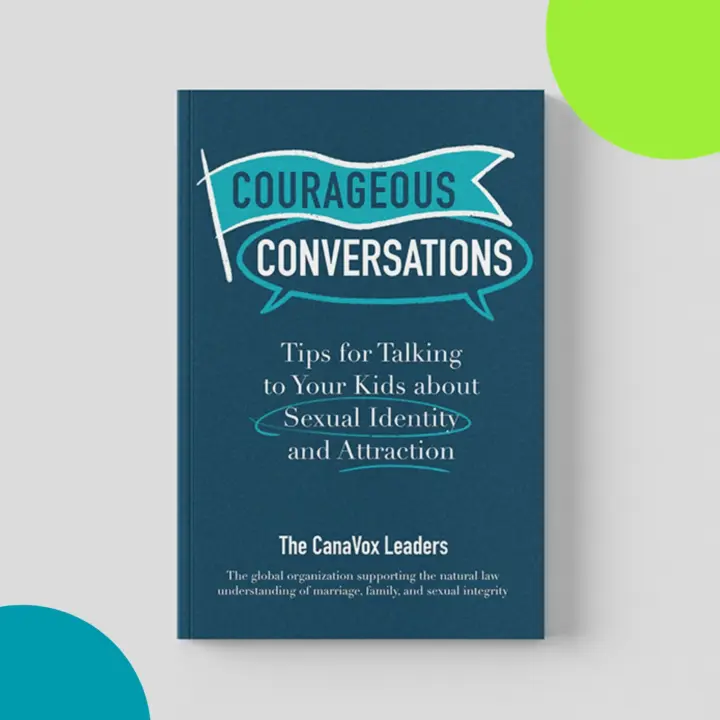
Like much of what’s skewed in our culture, topics of sexuality have roots that run deeper than they seem. The tough conversations we need to have with our kids are not just about sex, identity, orientation, and pronouns. They’re really about what it means to be human, a question for which the culture doesn’t have a sound, common answer. As the leaders at CanaVox state in their new book, Courageous Conversations: Tips for Talking to Kids About Sexual Identity and Attraction, “We are raising kids through one of the greatest identity crises in human history.”
Introducing Natural Law to the Next Generation
Per its website, CanaVox, an offshoot of the Witherspoon Institute, is a “cheerful marriage movement that offers reading groups to friends who support the historic understanding of marriage. . . . Rooted in natural law, social science and plain good sense, our reading groups provide . . . support and instruction on the meaning and magnificence of marriage.” Five years ago, CanaVox released Tips for Talking to Your Kids About Sex. The present book is a continuation and a deepening of the former.
In the authors’ language, “Natural Law is a philosophical approach to understanding what it means to be human and how to thrive as one. It rests on the belief that morality is not something we create but something universal that we discover.” When we stand on this foundation, rather than in a defensive stance against hot-button issues, conversations with our children about sex don’t have to be terrifying. Rather, the authors posit that they can be an opportunity.
Teens who might otherwise have yawned at discussions about identity are now facing serious questions about their own personhood, and they are open to robust answers. This is our chance to present the timeless truths of the Natural Law tradition, enriched by the insights of modern research across various fields. In the long run, these efforts toward a sound sense of identity will offer us all lasting peace and stability.
We have to start now, and early, if that peace and stability are the end goal. As is often said in CanaVox circles, “Better a year early than five minutes too late.” Our conversations ought to start earlier than adolescence; for most like-minded parents, the authors note, they probably already do. We naturally note the differences between male and female animals, we explain that boys grow into men and girls into women, we tell our little ones that a man and a woman come together to make a baby. These topics come up in ordinary conversation and provide a foundation to a more mature appreciation of sexuality and attraction in the years to come.

This is a good start, but things will get more complicated. Kids love to ask why. That’s when we parents can start to feel out of our depth.
A Piece of (Identity) Cake
As an aid, the authors propose the “identity cake,” an image of a six-layer cake whose purpose is to represent the elements of a person’s identity. The authors explain the “overarching message conveyed by the Identity Cake is that personal identity is grounded in our human nature but is also forged by our personal choices.” Rather than understanding identity to be defined by one element (such as sexual orientation), they argue identity is “shaped by many interrelated elements that should be integrated into a personal whole.”
The bottom three tiers—human identity, sexual identity, and familial identity—are all of the same size. These are elements an individual cannot choose. We do not choose whether or not we are human. While the authors later elaborate on terms like “gender identity,” it is an objective fact that each of us (with 0.02% of the population as an exception) is biologically male or female. Familial identity refers to the reality that “we enter the world deeply rooted in a web of family connections” that contribute meaningfully to who we are.
The upper tiers—religious identity, relational identity, and professional identity—are smaller; these are the elements that we “forge” by the choices we make. These are up to us and can change over time.
Dignity Comes First
It comes as no surprise that our human identity is the most fundamental element of the whole. The authors repeatedly return to this truth in transcribed and hypothetical dialogues between parents and children. No matter what choices the people in our lives make, they are all human beings—that is, rational animals, body-soul unities with inherent dignity. Catholics understand this truth to be integral to our relationship to God as his creations, but these statements can also be made and justified without invoking God or having recourse to a faith tradition.
It will do our society a huge service to make natural law part of the next generation’s understanding of themselves and the world in which they live.
The same holds for the more detailed analysis of sexual identity the authors provide. Genotype—our genetic material—and phenotype—observable characteristics that result from our genotype—are scientific, nonreligious terms. Understanding this language alongside data from the social sciences on behavioral tendencies provides vocabulary and rationalizations to work through challenging questions on self-knowledge, expressions, and interactions for children at different developmental stages. Again, faith traditions may well align with this approach, but it is not necessary to profess a religion in order to agree with it.
Ready for Whatever Comes Next
Currently, I have children in each of the three age groups discussed in the book. To my mind, the talking points and tone are spot-on. I appreciate that the book was composed not by one author with one motive and one point of view but by a team with a wealth of experience and depth of knowledge that goes well beyond my own. The explanations are both well founded and respectfully offered, which can be hard to come by these days.
I’m already beginning to look for moments to have relevant conversations with my kids. As I do, it strikes me that the lessons and methodology infused in this approach will likely extend beyond decisions on sexual identity and attraction. I might introduce my children to natural law as a means of answering their questions today, but there is good reason to expect it will continue to serve them in whatever else they have to confront as they come of age. Ethics regarding technology comes to mind. The rest might yet be too far out to see.
The leaders at CanaVox see their role in matters of marriage and sexuality “as one of defense, not aggression. . . . Respecting the dignity of those who hold differing viewpoints, while refusing to surrender our own convictions—this will be our winning strategy.” In reflecting on this read, I can better articulate my desire to raise kids not threatened by the culture but ready to love, challenge, and improve it. It will do our society a huge service to make natural law part of the next generation’s understanding of themselves and the world in which they live.