
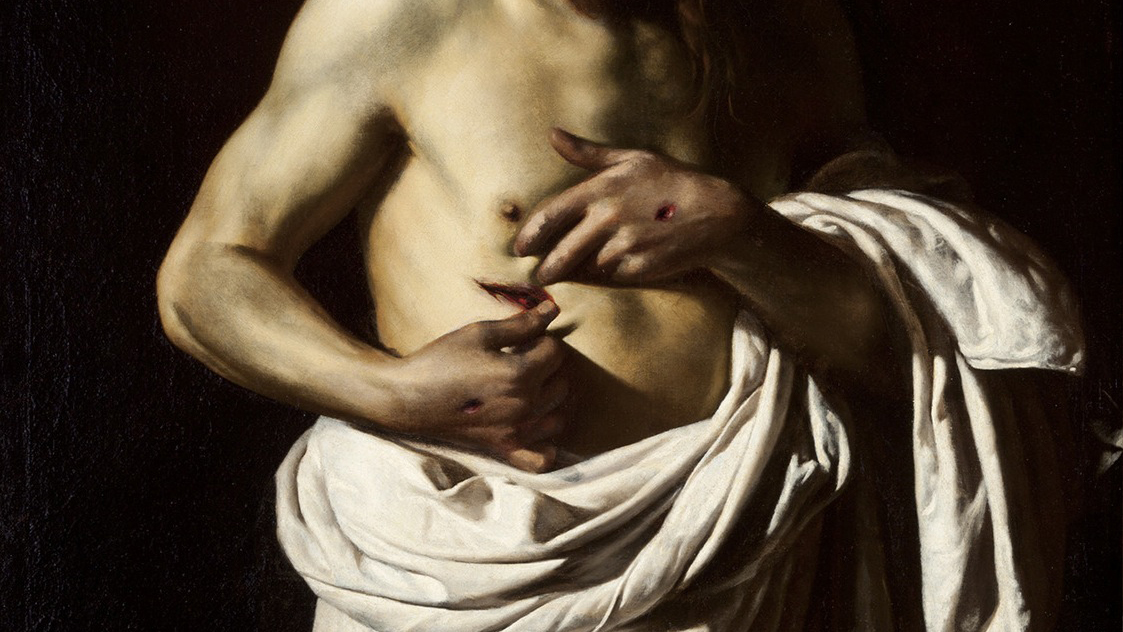
It is difficult to look directly at the crucifixion. We know the story—the whip, the barbs, the insults, the crown, the hoisting, the weight, the falls, the nails, the agony of taking a single breath. We have traveled the Stations around the walls of our parishes in a punctuated pirouette, kneeling and rising, echoing a refrain and intoning a somber melody. We have seen The Passion of the Christ and forced our eyes open during the lash of the whip, the thrust of the nails. We know this suffering is a necessary element in Christ’s glory. Still we avert our eyes, we bow our heads, we turn away.
In our own ways, we look for outs, alternatives that mitigate the gruesomeness of the scene. We struggle to accept a gift so freely given. Either we relativize and excuse our sins, or we attempt to take the burden on our own shoulders, as if we could spare the Lord. Even if we manage to ease our nerves, our most heartfelt and diligent efforts cannot replace Christ’s sacrifice. We forget that he never asked us to take his place. He came to take ours.
Who Could Be Worthy?
Amadeo Padilla, the centerpoint of a trio of protagonists in Kirstin Valdez Quade’s 2021 novel The Five Wounds, knows there is something powerful in what takes place on Good Friday. He imagines his portrayal of Jesus in a local procession reenacting the crucifixion might mean the vibrant delusions of what he could be someday will finally materialize. Amadeo is unemployed, drinks too much, depends on the resources of his mother, Yolanda, and was, until just now, separated from his teenage daughter, Angel, who is eight months pregnant when she returns to him.
Amadeo’s first mistake is in fathoming he is capable of supplying the strength to endure the pain of the display:
He needs to know if he has it in him to ask for the nails, if he can get up there in front of the whole village and do a performance so convincing he’ll transubstantiate right there on the cross into something real. He needs to know he can face that pain, straight on and with courage. . . . Total redemption in one gesture, if only he can do it right.
He calls for the nails and receives them in his palms, but results are mixed. His fellow hermanos congratulate him as they help him down from the cross and clumsily wrap his palms in towels. His uncle Tíve, for whose acceptance as a father figure Amadeo yearns, is less impressed. Tíve coolly instructs him to claim his wounds are the work of a nail gun when he gets to the emergency room. There will be no ambulance; one of the other men will drop him off. Angel is likewise disappointed. “How’re you going to hold the baby? Or didn’t you even think of that?” she asks.
Where is the redemption that is supposed to follow suffering?
Confused about the nobility of what he’s just undertaken, Amadeo engages cloudy reasoning as he begins to consider the people for whom he ought to be responsible. He attempts to sober up. He is confident about a windshield repair business that he will launch from a kit purchased from a late-night infomercial. When Amadeo does the math, sixty thousand dollars rolls in easily.
We Can’t Help But Stumble
If Amadeo’s story runs any sort of parallel to the road to Calvary, then his falls are DWI arrests. The second comes on the night of Easter, creating yet another obstacle for his up-and-coming business venture. His poignant encounter with his mother comes some time later and is heartbreaking because it is her life, not his, that is near its end. For a remarkable period of time, Yolanda has hidden her rapidly growing brain tumor from her family. She knew she was lying when she told herself the choice for secrecy was made in charity for her children and grandchildren. Really, she has looked out for them for so long, she fears none of them knows how to see her as anyone other than the leader, the safety net, the savior. As things stand, she’s not wrong.
When the truth comes out, Amadeo has just botched the gig his mother landed him with her own boss. His last moments of oblivion are spent in a downward spiral, “his crime [ballooning] to fit his shame, and as it does, so does his pity for himself. He ruined a car, his prospects, his entire life.” It seems to him that no matter how he tries, he is a failure, an idiot, a waste. “He jabs at the scars on the front and back of both his hands, willing them to hurt, but they don’t,” which exacerbates his sense that not only has he been cheated by life, by Christ, but the cheating was inevitable. Sure, being crucified was hard, Amadeo seethes, but “Jesus never had to watch people return to their own concerns and forget what he did for them.” The irony is completely lost on him.
Seeing Yolanda in the hospital bed post-surgery shakes Amadeo. His whole life, his mother has filled the gaps for him in order to keep him on a path to some kind of self-sufficient existence. Not so anymore. “Hot horror” overcomes him when he realizes the stress he routinely caused likely made her situation worsen more hurriedly. The responsibility of taking her home to die forces him to see things differently.
Time for Redemption
The name “Amadeo” can mean “love of God” or “one who loves God.” The Christian reader will recognize that the protagonist is worthy of the former at every moment, regardless of how much kicking and screaming this thirty-three-year-old man is capable of. The latter requires reflection and surrender, which, in time, appears to be Amadeo’s next chapter. While early on, he attributes his being spared the heroin addiction that claimed his father and great-uncle to his fear of needles rather than to the grace and mercy of God, daily encounters with his growing grandson, his surprisingly competent daughter, and his dying mother recalibrate Amadeo’s sense of his place in his community and so his relationship with God.
In months prior, he might have turned to liquor when he found himself sincerely reckoning with his mother’s imminent passing (and in fact, he will reach for a bottle in another pivotal moment; proof that we desperately need God’s mercies to be new every morning). Now he finds himself grappling with imminent loss at the morada where he once prayed to prepare for the procession. His attempt at prayer quickly disintegrates into ranting, which he is self-aware enough to recognize. Thank goodness for once he doesn’t congratulate himself for this shrewd observation.
Irreverent reflections on Jesus and Mary lead to the first moments of genuine contemplation. “He always assumed there was time, time to grow up, time to quit drinking, time to become the astonishing individual he’s surely been on his way to becoming. Now, what’s the point? Who is his audience?” The ritual of the procession is now, in his eyes, the work of “feeble, limited people.” He is ashamed of his “humiliating belief that the performance meant something.” Again he pokes his scars, frustrated when the pain doesn’t follow. Where is the redemption that is supposed to follow suffering?
He is close to leaving when another man and his son enter. The son, Isaiah, is an addict who has just lost his girlfriend to an overdose. Al, his father, invites Amadeo to pray with them. The experience is vastly different from his solo effort. Now, “with the press of the concrete rooting him to the dirt and the whole spinning planet, Amadeo thinks not of himself, but prays, truly prays, for this lost young woman and this addicted man and for this father who loves him.” Delayed though its effects may be, the mock crucifixion has made its mark on Amadeo—not just on his hands but more emphatically on his heart.
First You Have to See It
Amadeo’s conversion, tenuous as it is, fixes him more firmly in the present. He applies for a job at Lowe’s and attempts to mend a relationship he was ready to walk away from. This is progress, but no one is drawing up the papers for his cause for canonization. He continues to misread personal situations and abuse alcohol. One horrifying night, he makes a mistake he’s sworn he will not repeat and nearly destroys the one thing holding his family together. Again, God’s grace intervenes and goes unacknowledged.
Delayed though its effects may be, the mock crucifixion has made its mark on Amadeo—not just on his hands but more emphatically on his heart.
The following Lent, Amadeo is in recovery and his vision has cleared enough for him to see what he’s been missing: What Christ felt was not only pain and suffering but love, which Amadeo understands to be “both gift and challenge.” As he prays with the hermanos, “He pities his old self, the self that once believed there was a single, big thing he could do to make up for all his failings. He missed the point. The procession isn’t about punishment or shame. It is about needing to take on the pain of loved ones. To take on that pain, first you have to see it. And see how you inflict it.”
Amadeo attends this year’s procession—today, Isaiah walks as Christ—though he recognizes that “for someone with his particular weaknesses, performance is a distraction.” He is drawn, rather, to “the quiet of the building, with his eyes shut among these murmuring men, his voice folded in with theirs. He is aware of their heat and thrumming thoughts, and as the prayer flows around him, he falls into the current.” This brotherhood and its communion nourish him, satisfying the need for male presence that has gone unmet since he was five years old. It is something of an oasis, the form of a monastery cropped up in the midst of the world.
Redemption isn’t inaccessible anymore, because Amadeo no longer has illusions of being the savior. The crucifixion is no longer a test of strength but a measure of love, poured out even for him. Good things can and will be taken away. What remains—hope, new life, relationship—is evidence that none of us travels this life alone. Amadeo has traded in his delusions for reality. It is not as glamorous, not as easy. Its being true is more than enough.