
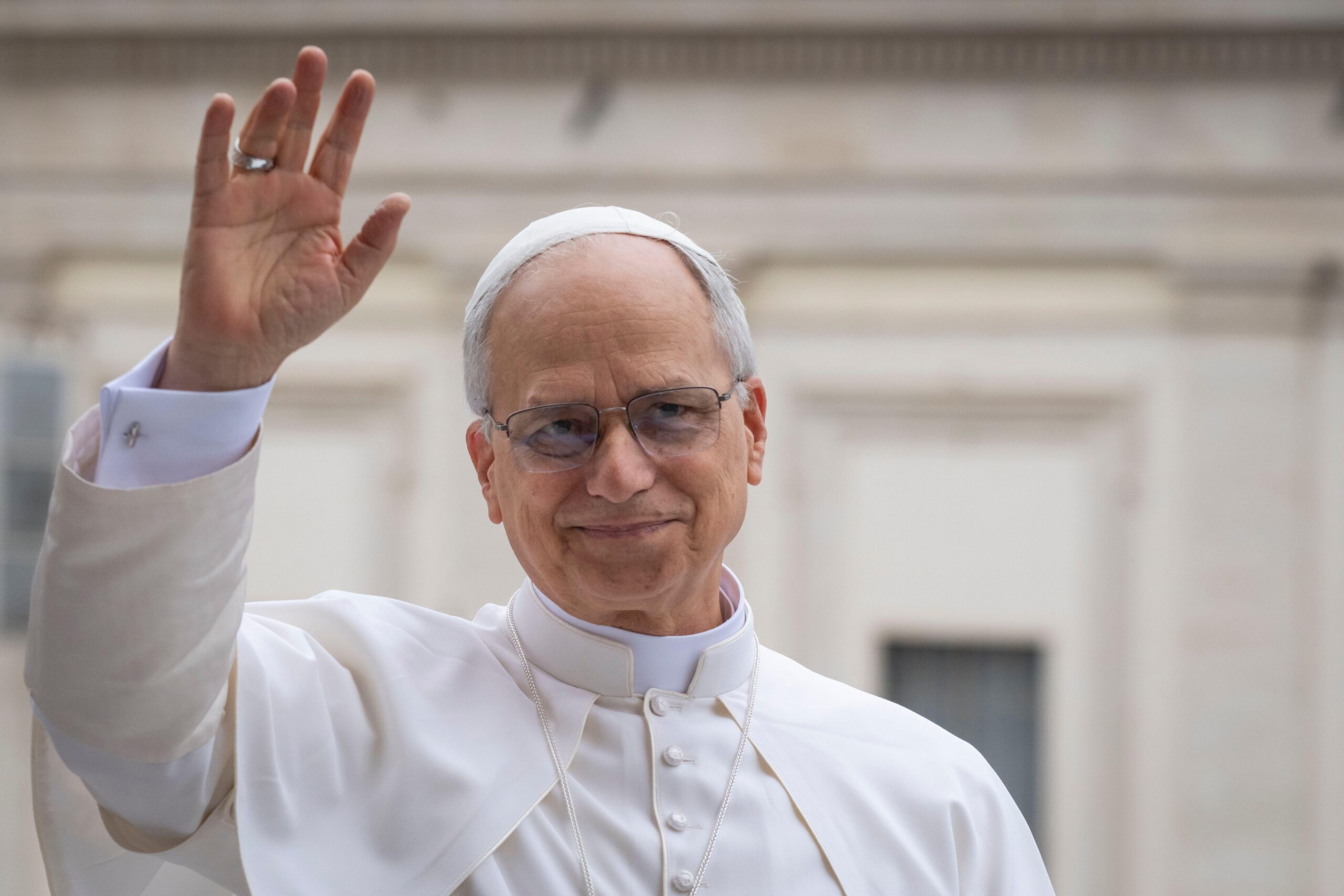
As expected, Pope Leo XIV’s first encyclical adds to the long list of papal documents on Catholic social doctrine in the lineage of his pontifical namesake’s Rerum Novarum. That encyclical by Leo XIII addressed new social and economic conditions brought on by the industrial revolution. Magnifica Humanitas (On Safeguarding the Human Person in the Time of Artificial Intelligence) considers the recent growth of technology—especially the development of artificial intelligence—as a digital revolution with its own promises and dangers that likewise need to be addressed for the good of all humanity. Magnifica Humanitas was signed on May 15, 2026, in honor of the 135th anniversary of Rerum Novarum, which was promulgated on May 15, 1861.
The new document, which was not released to the public until May 25, consists of an introduction, five chapters, and a conclusion. Following standard practice, there are also section (or paragraph) numbers for easy reference, which we will use for parenthetic citation herein. This article will provide a summary of the main points of the nearly 38,000-word, roughly 80-page document.
To address the new technologies that are changing our world, the Holy Father seeks a collaborative effort between the Church, governments, and all people of good will. While the Church does not displace the distinct sphere of politics, she nevertheless “actively participates in the process by which society grows and is organized, and she offers her own contribution to the creation of a more just and fraternal society” (19).
Leo XIV uses two contrasting biblical images to illustrate the crossroads that humanity now faces with the advent of technologies such as artificial intelligence. The first and negative image is the Tower of Babel. The second, positive image is the rebuilding of the walls of Jerusalem following the Babylonian Exile. The former was a project undertaken out of pride and an inflated sense of self-sufficiency that, in the end, led to a breakdown of communication and societal division (7). By contrast, the latter was done in a collegial fashion that led to societal unity. Nehemiah “convened the families, assigned each of them a section of the wall to rebuild, listened to their concerns, coordinated their efforts and addressed any opposition” (8). Each member of society had their role to play and the opportunity to voice concerns. Furthermore, God was at the center of the endeavor. The second image is the example that ought to be followed.
Securing humanity from attacks against its dignity involves our own spiritual development.
Early on, Pope Leo acknowledges that AI is not intrinsically bad. On the contrary, it has potential benefits. Yet, as will all technologies, it must be oriented toward the good lest it cause severe harm (4). Wisely, then, Pope Leo does not just jump right into discussing AI and its implications for humanity. Rather, he first takes time to set forth fundamental principles that must be grasped in order to address the promises and dangers of this new technology.
To this end, in Chapter One (17–45), he gives an historical and theological overview of Catholic Social Doctrine from Rerum Novarum to the present day. Therein, one finds expressed foundations and principles for the Church’s social doctrine, which he explicates further in Chapter Two (46–89). The foundations of social doctrine are: 1) humankind as the image of the Triune God; 2) God is Love, which finds “its most concrete expression in the face of Jesus Christ” (49); 3) the equal ontological dignity of all human beings (51–53); and 4) the supreme value of human rights that must be respected and protected (54-58).
The principles of Catholic social teaching are: 1) the common good (59–64), 2) the universal destination of goods (65–67), 3) subsidiarity (68–72), 4) solidarity (73–76), and 5) social justice (77–81). Later on in the document, Pope Leo applies these principles to the specific case of technology, especially AI. But he also states that the goal of such application is integral human development (82–85), which means “‘the development of each man and the whole of man’” (82, citing Populorum Progressio). Because of the possibility of environmental impact, he also adds integral ecology as a factor for consideration. The question that must be asked is: “Do [technologies] truly help individuals and populations to become more humane and fraternal, while respecting our common home and future generations?” (85).
“Chapter Three: Technology and Dominance. The Grandeur of Humanity in the Light of the Promises of AI” can be considered the core of the encyclical. While urging us “not to be afraid of the present challenges” (91), Pope Leo XIV nevertheless honestly presents concerns over the misuse and negative effects of artificial intelligence.
Pope Leo shares Pope Francis’s concerns about the technocratic paradigm, which is “the tendency to let the logic of efficiency, control and profit alone shape personal, social and economic decisions . . . reducing creation to an object of exploitation and human beings to mere cogs in a system driven toward ever greater efficiency” (92). As Pope St. Paul VI already said decades before: “‘the most extraordinary scientific progress, the most astounding technical feats and the most amazing economic growth, unless accompanied by authentic moral and social progress, will in the long run go against man’” (94).
“With the same faith as Mary, let us become ‘weavers of hope’ in our world, so that the presence of Jesus may grow among us and his Kingdom take shape.”
This is nothing new. What is new, however, is that States are often no longer the main ones in control; tech companies and the like typically have more directive power than governments (95). This situation will require a great deal of oversight to mitigate the dangers this new type of power can inflict (96).
Key to properly engaging with AI is the recognition of what AI is and is not. AI systems do not have experiences; they lack bodies; and, while they imitate certain functions of human intelligence—with incredible speed and computational capacity—their kind of “intelligence” cannot be equated with human intelligence. AI is a form of data processing, but it lacks moral conscience and cannot judge between good and evil or grasp true meaning. As a result, it cannot bear responsibility. It also lacks “the affective, rational and spiritual perspective through which human beings grow in wisdom (99).
What is more, there are three aspects of AI that can mislead people in their personal use thereof: “the ease with which results are obtained, the impression of objectivity and the simulation of human communication” (100). The speed of getting answers to prompts can “encourage excessive reliance and the search for readymade answers.” The objectivity is not real but only apparent, yet the undiscerning user can “overlook the fact that they reflect the cultural assumptions of those who designed them and trained them, with all their strengths and limitations.” Since AI mimics human modes of communication, it can create “the illusion of relationship with a real personal subject” (100). On a separate note, the amount of natural resources (water, energy, etc.) required to run AI poses a real threat to the environment, which needs to be carefully mitigated (101).
Furthermore, while AI appears to be objective, it is not. AI systems can become vehicles for manipulation of data and misinformation. It can also be used in ways that violate privacy (102). For this and other reasons, Pope Leo insists that “responsibility must be clearly defined at every stage: from those who design and develop these systems to those who use them and rely on them for concrete decisions” (105). Individuals and groups charged with making decisions must avoid the temptation to just let AI decide.
In §109, the pope succinctly connects the principles of social doctrine outlined earlier in the text to AI specifically. He writes:
speaking of the common good means exposing this new form of epistemic, economic and political asymmetry and naming the new monopolies of AI. To speak of the universal destination of goods means finding ways of ensuring universal access to both technologies and the education needed to use them. To speak of subsidiarity calls for protecting the ability of communities to make choices and corrections, rather than confining their role to mere oversight after the standards have been set elsewhere. To speak of solidarity obliges us to recognize the hidden, often exploited workers, who sustain algorithmic systems. To speak of justice requires questioning the global distribution of power that decides who in fact can train these models and who is merely subjected to them. Likewise, it means acknowledging that social justice is not only a goal to be safeguarded after technologies are deployed, but a condition that must shape their very design from the outset.
Additionally, Pope Leo XIV calls for “disarming AI,” by which he means “freeing it from the mentality of ‘armed’ competition,” which “entails a race for ever more powerful algorithms and large datasets, driven by the desire to secure geopolitical or commercial dominance. To disarm means discrediting the assumption that technical power automatically confers the right to govern” (110).
After considering some of these potential dangers, the Holy Father notes aspects of humanity that must not be lost (112–114). Humans are not products “to be optimized”; they are persons who are called to communion. And while intelligence is a key aspect of humanity, it is not the only one; “affection, the will, commitment and relationships” are also integral parts of what it means to be human (112). On this front, Pope Leo warns against transhumanism and posthumanism. These regularly involve “enthusiasm for new technologies through a futuristic vision of an ‘enhanced human being’ or ‘human-machine hybrid” (115).

In Chapter Four, the Holy Father raises some further concerns and offers suggestions to help safeguard humanity in this digital age. He considers impacts on society, education, and work.
Regarding society at large, AI must not be allowed to be a vehicle of disinformation. The danger of people no longer being able to distinguish between fact and fiction, what is true and what is false, is real and must be curtailed (134, with reference to Hannah Arendt). “On the level of public policy, this entails establishing norms so that the decision-making behind content selection and its development becomes more transparent and protects personal data” (137). Likewise, there is need for “intermediary organizations, serious journalism and forums for debate, where reasoned argumentation and verification carry greater weight than immediate reaction” (137).
In the realm of education, Leo expresses concern that students will become too enamored with gaining fast answers to questions and thus get easily bored with authentic education that requires patient research, thoughtful reflection, and discernment (139, 146). Students need to be educated in what not to use AI for as much as how to use it (140). Because of the dangers extant in the digital world—which are already being exacerbated by AI—adult supervision is particularly needed for young people. Pope Leo warns against unsupervised access to personal mobile devices at “too early an age” (141), as this can have profoundly negative psychological effects, in addition to the moral dangers. Alongside the call for parental responsibility, Leo also thinks service providers ought to be held accountable and be expected to have “specific protections against all forms of online sexual exploitation and violence” (142).
Work and its dignity must also be safeguarded in light of this new technology. AI should be employed in ways that aid workers, not the other way around (150). The potential for unemployment must also be addressed, lest huge portions of the population be left without meaningful and economically viable work (151).
In Chapter Five, Pope Leo XIV addresses the issue of war. The threat of cyberattacks and propaganda are real and accelerated by AI (183). Technology is increasingly being used to wage war and to otherwise dominate others. With the loss of historical memory (i.e., first hand witnesses of past events and eras), there is the danger of “rewriting the past” in distorted ways that can obscure the horrors of war (191). Presently, weapons systems are now also being augmented by artificial intelligence. “For this reason, the development and use of AI in warfare must be subject to the most rigorous ethical constraints” (197). For example, Pope Leo insists that “it is not permissible to entrust lethal or otherwise irreversible decisions to artificial systems” (198). We must break out of the mentality that thinks war is an inevitable human reality and instead work to build a civilization of love (210–211).
While the pope advocates for dialogue, governmental and international regulations, and other forms of human cooperation to ensure that human dignity is secured from the misuse of AI, in his Conclusion, Leo avoids any Pelagianism, reminding us that the Incarnation is “at the heart of everything” (231). The fact that the Word became flesh provides the authentic alternative to trans- and post-humanism (232). He calls us to contemplate “God’s plan, living ecclesial unity by partaking of the Eucharist, building a world centered on the common good and praying in union with the Blessed Virgin Mary” (229). He thus advocates for “a Eucharistic spirituality, that is, a spirituality of ecclesial unity in love” (234).
Pope Leo calls us to “remain faithful to the truth!” (237). Securing humanity from attacks against its dignity involves our own spiritual development. In the face of societal ailments, we can still trust in God, as Mary did in the politically tumultuous times in which she lived (243). God’s providence is still operative. And so, he exhorts us, “with the same faith as Mary, let us become ‘weavers of hope’ in our world, so that the presence of Jesus may grow among us and his Kingdom take shape” (245).