
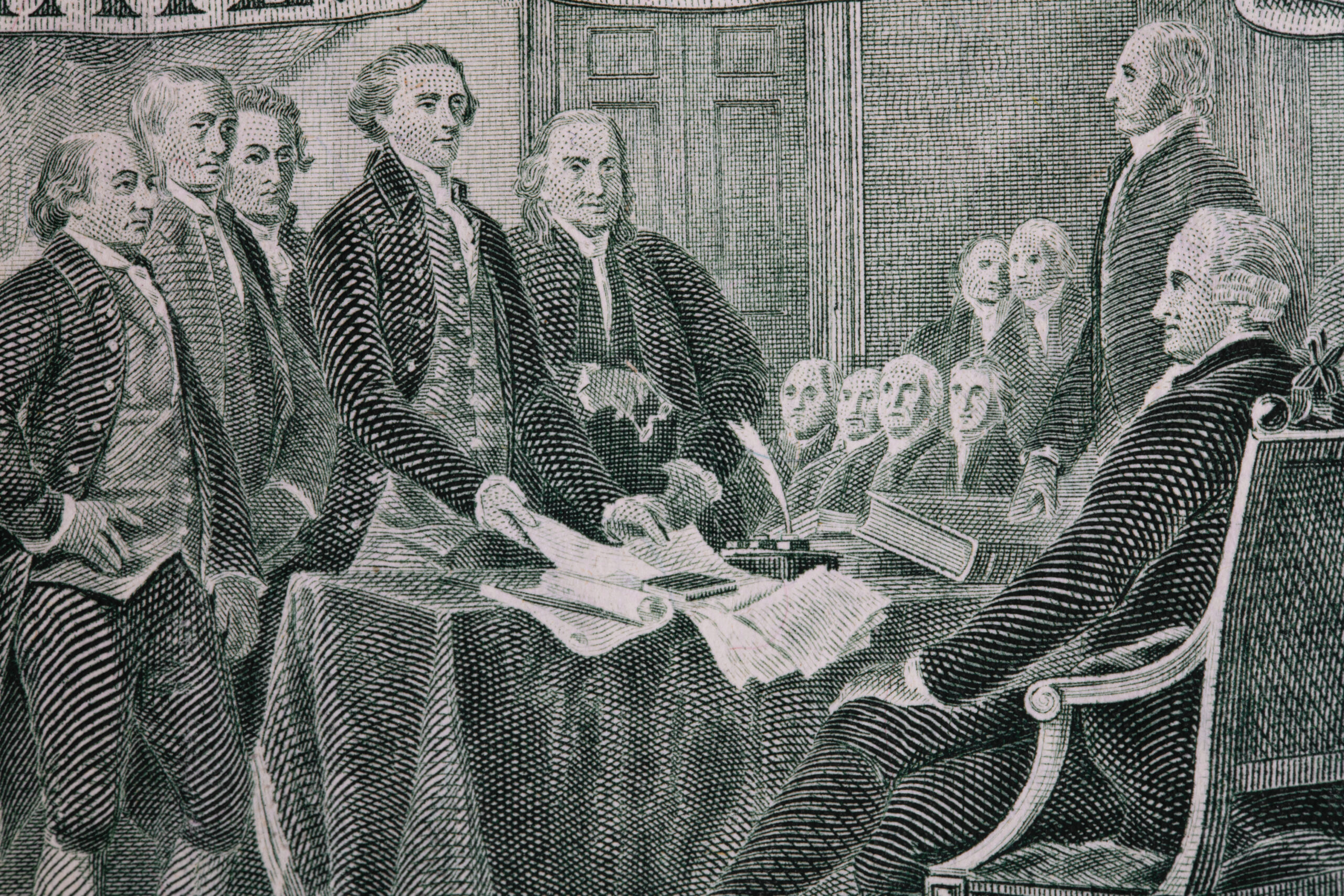
According to the Declaration of Independence, human beings are “endowed by their Creator with certain unalienable rights.” This claim raises the question: Does God do any real work in the Declaration? Is the Creator language decorative or load-bearing? Arguably, the Declaration’s appeal to God clarifies human status and limits human authority, which should not be concentrated in the hands of a single person.
The invocation of God shapes how human beings understand their own nature. We are “created equal.” This phrase serves as an implicit reminder of what a human person is not. Humans cannot create themselves. We cannot create the conditions necessary for human existence. We can refashion created things, but we do not create ex nihilo. So what kind of created nature do we have?
Historian and political philosopher Harry Jaffa writes, “In short, as men are neither beasts nor gods, they ought not to play God to other men, nor ought they to treat other men as beasts. Here is the elementary ground, not only of political but of moral obligation.” Since we are not divine, we need political restraint. Since we are not beasts, we have the responsibility to shape our futures together. We have powers of reflection that enable political deliberation, orchestral composition, and philosophical refutation. This recognition of our created nature leads to further insight into our basic moral status vis-à-vis one another. Someone who places himself in absolute power over other human beings usurps God’s place and implicitly denies his own humanity. Human beings may not justly consider themselves divine in relation to other human beings.
For this reason, the consent of the governed is relevant for just government. Harry Jaffa holds that consent is needed because “men are not unequal, as are man and God, or man and beast, nature by itself does not decide the question of who is to rule.” Consent comes to light in the Declaration as an alternative to rule by nature, as a source of the just powers of government. God rules by nature, but no human being is God over another.
The Declaration invokes God not as a mere decorative sentiment but as an underlying supposition of the American experiment.
The three branches of American government—legislative, judicial, and executive—not only ensure that federal power is not all in one person’s hands but also reflects the three ways God is invoked in the Declaration. First, the Declaration invokes God as legislator in speaking of “the Laws of Nature and of Nature’s God.” Second, the signers invoke God as judge in “appealing to the Supreme Judge of the world.” Third, the Declaration invokes God as executive in speaking of “a firm reliance on the protection of Divine Providence.” The framers invoke the legislative, judicial, and executive power of the divinity.
In God is found perfect justice, wisdom, and goodness. Since we do not share the divine nature, we lack this perfection. Jaffa draws out the political implications of this insight: “It is an absolutely necessary condition of the rule of law that the three powers of government never be united in the same human hands. For them to be so united, whether in a singular or a collective body, is the very definition of tyranny, as the Founding Fathers never ceased to repeat. For the equality of mankind is an equality of defect, as well as an equality of rights.” A perfect tyranny would be absolute power without absolute wisdom, justice, and love. Since no human being has absolute wisdom, justice, and love, no human being rightfully exercises absolute power over any other.
Thus, the inclusion of the divine in the Declaration underscores human equality as neither divine nor beastly, as well as underscores the proper limits on human authority based on the reality of our being created equal. If we remove the Creator from the Declaration, it is not simply that our basic human rights become merely governmental gifts. What Caesar gives, Caesar can take away. If the Creator is the ultimate legislator, judge, and executive, then no single human being should hold ultimate legislative, judicial, and executive power over all others. This division of powers supports human liberty. The Declaration invokes God not as a mere decorative sentiment but as an underlying supposition of the American experiment.
This article is part of a series in which Dr. Kaczor provides insights leading up to the celebration of the 250th anniversary of the Declaration of Independence.