

The pro-life movement is often critiqued for focusing too much on babies in the womb and neglecting the other stages of life through natural death. What about the mother, the infirm, the elderly, and so on? Present policies and practices affirm convictions in some areas and fail in others. Some of this will shift for the better with debates and data, but the most significant advance will come when there is an acceptance of the inherent dignity of every life in the mind and a shift toward the eternal good in human hearts. That intersection of mind and heart is where literature offers something to the conversation.
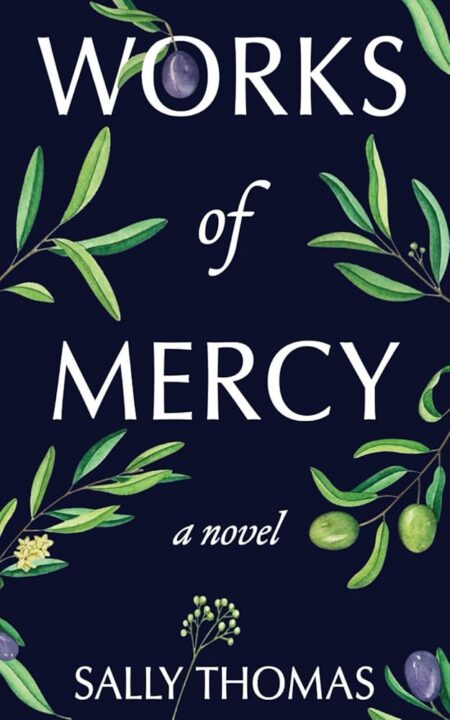
Sally Thomas’s 2022 novel Works of Mercy, published by Wiseblood Books, is not explicitly a pro-life novel. You won’t see any slogans in the back cover copy or a plea for protest in the author’s note. At its core, however, this novel is deeply concerned with the dignity of the human being—even when she considers herself to be past her prime, content in her narrow sphere, not yearning for anything more in this life.
Protagonist Kirsty Sain is an older woman who doesn’t think she has much to offer beyond her devout Mass attendance and her weekly cleaning of the parish rectory. Kirsty considers her cleaning a kind of apostolate. She doesn’t sing and doesn’t prefer the company of children or other women, and so a morning’s worth of cleaning is the most suitable way for her to serve her parish. Widowed, she enjoys keeping house and cooking in her own kitchen: “Food preparation, like cleaning, signaled my own existence,” she explains. Never mind that she cannot stand to eat the carefully planned and executed meals once they are prepared. She inevitably stows them in her freezer and eats a sandwich standing up instead. Kirsty misses her husband, Ranse, yet admits she would “rather long for human companionship than have it. Had I been born in the right century,” she reflects, “I might have made an adequate anchoress.”
She was born, however, in the twentieth century, when anchoresses were less plentiful. In this later stage of her life, she is content to keep to herself, keep order, and keep quiet. Yet even in a limited sense, she is a part of a community—her parish—and soon it will ask something of her.
Something with claws
Well kept as Kirsty’s home is, the sound of claws in her closet evidences a mouse problem. A neighbor has a solution in mind and brings her a cat. Kind of. The “cat” he brings is likened to a gargoyle. Nearly starved, but certifiably free of mites and fungus, this small creature has no eyes. Kirsty is sure she cannot love him. When she asks the neighbor why the cat was not put down when it was examined by the vet, he confesses, “Poor little thing’s lived this long. Maybe with some loving it’ll live longer.”
Reluctantly, Kirsty takes the cat in. When a week later the cat is still alive, she calls on the vet, curious about the creature’s hairlessness. The doctor indicates this trait makes it more valuable, not less: “The more improbable an animal is, the more valuable it becomes.” Though she never manages to bestow a name on the cat—“Think as I might, I could come up with nothing that seemed to suit him”—she does come to love him, and he does come to finally serve his intended purpose, leaving a caught and killed mouse on her hearth on Christmas morning.
Loving people is not the same as loving cats
Kirsty’s relationship with the cat finds resonance in other gradually developing relationships. First, there is the profoundly introverted Fr. Schuyler. This parish is the first assignment for one who’d imagined himself a Carmelite. To say he struggles to connect with his flock is a gross understatement. He locks himself in the sacristy before and after Mass to avoid interacting with parishioners. Though he possesses an “obvious discomfort with the human race,” he hears confessions with “a great and surprising gentleness,” offering “kindly yet rigorous counsel” and giving absolution with startling tenderness. Otherwise, he is barely there. He seems to be getting thinner as weeks pass. Kirsty continues to clean the rectory, even as the kitchen and bathroom show no signs of anyone living there.
Each soul is called to go where she is needed.
Yet it is Fr. Schuyler who notices a gap in Kirsty’s presence, who comes to her house when she is severely ill, who gets her to the hospital. It is Kirsty who pushes Fr. Schuyler to be present to his parishioners, even when it makes him more than uncomfortable. Little by little, their mutual encouragement—even to do things they themselves wouldn’t want to—reaches families in need, souls in crisis. Kirsty writes of her beloved Robert Southwell, Jesuit and poet, “It had been my Jesuit’s way to fly into danger, hawking terms precariously in hand. He’d gone, always, not where he was safe, but where he was needed.”
Because her formative years were marked by an illicit relationship, a child lost in the womb, and a depressed and inaccessible mother, Kirsty built an adult life without being clear-sighted on where she was needed. Her acceptance of marriage and of life on the other side of an ocean was more reactive than proactive. Experience had already shown Kirsty that overwhelming romantic love was not in the cards for her. She “didn’t mind the idea of marrying” Ranse and figured the next best thing of extending kindness and honoring him would be sufficient for them both. Dutifully she served, and their marriage seems to have been enough for him. Now, though, she is not sure that she really loved him. There is a tinge of regret in her realization that to love him would have asked something of her that she might not have been able to give.
Even at home, miles outside her comfort zone
Kirsty will not have another chance at romantic love, as far as readers can see, but her hardened heart need not stay that way. Fellow parishioner Janet Malkin is “a conversation in search of something to be about” who regales Kirsty, unbidden, with her life’s story at the conclusion of noon weekday Masses. “By the time I got home,” Kirsty says, “I would be starved for my lunch, but strangely over-sated with something else.” One could not rightly define their relationship as a friendship but rather as a deep-seated acquaintance. They have their faith in common, and that’s about it.
Kirsty and Ranse’s childlessness registers in stark contrast to the Malkin family, who have so many children Kirsty fails to determine the count. They ran “a whole human gamut . . . their number seemed continuously to expand and contract and scintillate.” She may not know their number, but Kirsty does know something about tick-obsessed Henry, of whom she will later reflect, “It was a vocation, I thought, to be sent into the world to marvel at its strangeness. One could make a whole life of such work: Henry had done it.”
An accident in a swimming pool causes Henry’s death, which understandably shakes everyone involved. Fr. Schuyler is stunned at the first death of a child he’s witnessed. Howard Malkin, Henry’s father, leaves home in his despair. The entrance of Howard’s otherwise estranged mother is no comfort to Janet, who is nearly full-term with another child, or to the other children in the home.
Kirsty does not want to get involved; she does not feel entitled to sit with this family she knows tangentially in their grief. And yet, they grasp at what she has to offer, little as it is. Of all the losses she’s suffered, it’s the loss of this child that evokes her outpouring of grief. Kirsty spends a long night weeping, crying out to the Lord, feeling the intensity of her loneliness. She wrestles to understand why her life goes on while this child is dead. “My body was rigid with the effort of grief. My jaw ached; my cheeks hurt; my bones felt sucked dry.” She has persevered through her own pain and loss, but only now, in the presence of this deformed cat, this struggling priest, this boisterous family, only in these relationships is she able to experience suffering so completely. It is a full body-soul experience, and it is grueling.
Many years ago, her first confession after years away from the Church was simple, matter-of-fact, without fanfare. Sincere as that was, the relationships she has formed have pushed her beyond her supposed limits. She is not capable of bearing this pain alone. Abandoned as she feels, “in its own good time, the morning came,” as it always will.
Life goes on, but differently
The cat is helpless; Kirsty can serve as a caregiver. Fr. Schuyler is young and inexperienced; Kirsty has a maturity born of decades’ more life experience. The Malkins are overwhelmed, to the point that their marriage crumbles; Kirsty has margin in her days to respond to their needs and be a source of stability and strength. But make no mistake: None of these relationships is one-sided. Kirsty never explicitly doubts the value of her life, yet initially there is a sense that her better years are past. What’s left is a kind of quiet waiting, a perseverance until the natural end comes.
In so illustrating the value that remains in Kirsty’s life, in the ways she still has the capacity to grow and to love more deeply, Works of Mercy makes a strong case for the value of life at every stage. A life that is not so obviously active is not one that society needs any less. Each soul is called to go where she is needed. We are all called to marvel at this world’s beautiful, glorious strangeness.