
“Yet, as the sun acknowledges
With a warm look the world’s hunks and colors,
The soul descends once more in bitter love
To accept the waking body.”
—Richard Wilbur, “Love Calls Us to the Things of This World”
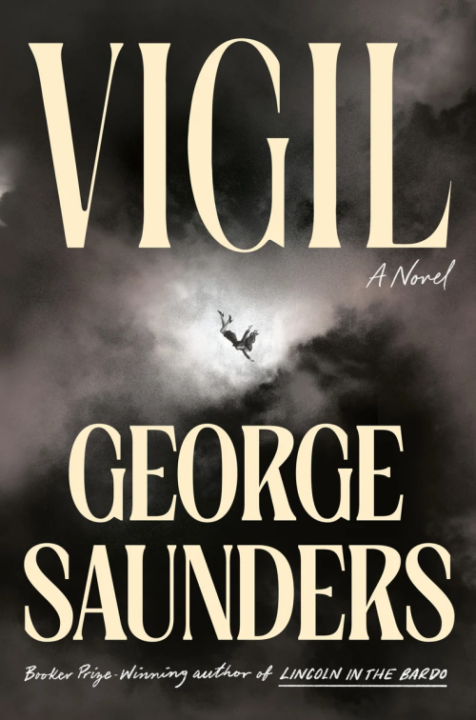
George Saunders’s newest novel, Vigil, is a journey into the underworld. Instead of a classical hero, the protagonist is the soul of Jill “Doll” Blaine, a midwestern woman who died in the 1970s; and instead of the realm of the dead, Jill descends into the realm of human beings, with all of their weakness and yearning. Her occupation in Saunders’s imagined afterlife is to comfort people on their deathbed (Jill never had a deathbed, having died in a tragic accident in her early twenties), reckoning finally with their entire life in their last moments. Jill is “elevated,” having comforted more than 340 souls, but her newest “charge,” K. J. Boone, an elderly oil magnate responsible for catastrophic damage to the environment, proves a stubborn mule, causing her to confront her own earthly life and death more intimately than she ever has before.
Saunders opens up the journey through the underworld largely through a descent into memory: Jill’s memories, the memories of her charge, and the memories of other souls they encounter. Unlike spiritual beings who live outside time, human persons rely on memory in order to make sense of their existence and all of reality. A master of narrative pattern, Saunders makes memory the guide of the novel’s pace and the catalyst of action, deftly structuring memories to move Jill’s voyage forward.
Jill’s charge is, obviously, an evil man. Much of the novel’s drama centers on whether he will surrender to the weight of his memories of sin and admit guilt on his deathbed. But the greatest virtue of Vigil, set in 2023, is its deeply humanist bent. Through childhood memories and the love that other family members give in Boone’s presence, Saunders presents an impenitent man responsible for irreparable damage to the earth with considerable dignity. Boone’s daughter, speaking to him while he lies unconscious, invokes Christ’s death on the cross and encourages him to “forgive his many enemies,” and at times, the reader is almost (almost!) dared to forgive him too. The novel includes other characters at opposite ends of society who, in real life, could never escape stereotypes awarded them by socially conditioned polarization, and Saunders, through Jill, withholds condemnation.
Vigil also displays the goodness of earthly life, rendering it strange and otherworldly to souls long immersed in the afterlife (a close example of this in narrative art is the film Wings of Desire, in which the angel Damiel is enchanted with the beauties of finite existence). As the novel goes on, Jill slips into episodes where she remembers vast amounts of small details from her life, little moments growing larger in immortal hindsight:
“Me, Mom, Dad” at “St. Monica’s,” my little body warming up but just on one side in the many-colored light beaming down from “stained-glass window” showing six gaunt gray “Apostles” pulling a net of fish up into their already fish-tilted boat.
Could make left wrist (but not right) crack by giving it “good hard pop.”
In terms of times tables: nines and elevens, easy; twelves not “my cup of tea.”
In “big hallway mirror,” I looked “so long and pretty,” like (Big Deb, mom of my best friend, Little Deb, would say) “a dang gazelle.”
In terms of favorites: Color: green; Season: winter; Candy: “Smarties.”
Dad, watching me looking up all reverent at those Apostles in that tilted boat, gives me a double-pat on the shoulder, as in: You’re good, kid, sure am fond of you, Jillie.
Early in the novel, Jill regards these episodes as handicaps, since they encumber her state as an “elevated” soul: “More such recollections would soon be forthcoming. Though they were harmful. Ugh.” Still, Jill continues to welcome these “happy faults,” as her underworld descent more and more becomes an attachment to incarnation itself.
In his book The Art of Fiction, John Gardner writes that one of fiction’s most essential principles is that human beings have free will. “Stripped of free will—robbed of all capacity to fight for those things they aspire to and avoid those things they fear—human beings cease to be of anything more than scientific and sentimental interest. For the writer who views his characters as helpless biological organisms, mere units in a mindless social structure, or cogs in a mechanistic universe, whatever values those characters may hold must necessarily be illusions, since none of the characters can do anything about them.”
Saunders takes the contended notion to task directly in his character study. A key element of what he calls “elevation” (or at the very least, Jill’s understanding of it) is the achieved perception, detached from incarnation, that human beings are inevitable occurrences. “My charge,” Jill thinks, “had been born him. But had never chosen to be born him. That had just happened to him. Then life had happened to that him, exerting upon it certain deleterious effects, including but not limited to: the powerful nature of his early desires, which had led him to strive, which, in turn, led him to accomplish and, in accomplishing, he had brought about harm, even as the mind he’s been given, from the start, bloomed forth, just as it must, causing him, in the face of that harm (and the accusations made against him due to that harm), to suppress and deny the reality of the harm and become, over time, averse to even acknowledging it.” Jill regards the man who accidentally murdered her in the same way, “an inevitable occurrence, upon which, therefore, it would be impossible, even ludicrous, to pass judgment. Who else could he have been but who he was? At what moment could he have become other than he became?”
In this framework, we’re all freaks, forever conflicted between the desires of flesh and spirit.
This materialist-determinist worldview (inevitably characteristic of our current zeitgeist and a position at least in part shared by Saunders himself), which prompts Jill to reembrace her own duty to “comfort” the dying, is the guiding principle of Jill’s moral arc, from which she descends into incarnation and proceeds, in the end, back to elevation. Of course, she necessarily makes deliberate choices of her own free will that move her along that arc. Accordingly, Jill never regards herself, or her life on earth, as an inevitable occurrence. Her repeated insistence on that reality as she perceives it in others, combined with her own intervention in the fate of Boone’s soul, prompts the reader to an acceptable, even necessary doubt. The story does not proceed to what Gardner calls “logical exhaustion,” a narrative resolution that “reveals that the character’s supposed exercise of free will was illusory.” This bears out in the afterlife of fellow dead souls, many of which live within and act upon the world from beyond the grave and are (seemingly) forever colored by the events and actions that marked their life’s ultimate concern.
Saunders’s ultimate concern, it seems, is to strive for balanced, if incomplete, human perception. Incarnation and disinterested elevation (which Saunders seems to liken with “being one with God”) are separate sources of perception that can’t reconcile within the human heart; at best, their attempted synthesis produces a state where we feel, like Jill, “weird, dual, not quite right”: “It seemed I’d somehow damaged myself on that stupid trip to Indiana. Had become, it felt like, a bit of a freak. A freak of sorts. A hybrid. Part elevated, part Jill ‘Doll’ Blaine. . . . I couldn’t seem to shake Jill ‘Doll’ Blaine (all she’d seen, been, and done) and didn’t want to. But neither could Jill ‘Doll’ Blaine shake me, the elevated part, and didn’t want to.” In this framework, we’re all freaks, forever conflicted between the desires of flesh and spirit. If we take on too much of the spiritual, everything becomes inevitable and nothing is free. If we take on too much flesh, everything is an abuse of freedom and nothing is sacred. And neither, in their extreme, can comprehend the other. The only other alternative Vigil offers is to submit to a diminished hybrid perception. Saunders shows this perception in his portrayal of disparate characters who carry the risk of popular stereotype. He combats stereotype with a sed contra every time one human dimension of a character asserts dominance. Implicitly, that approach implies that the incomprehensible whole is greater than any of its comprehensible parts by resisting the ideological impulse to caricature. The human dignity we so desperately seek to affirm in the year of our Lord 2026 doesn’t manifest except within a fragmentary infrastructure.
Vigil, like the habit of examen, teaches that human nature reveals itself in the face of memory and death. How we read the novel, with its abundance and deficiency of answers, will reveal whether our nature can endure what Walker Percy called “eschatological prickling”: What are we really after? Can we relate meaningfully with the afterlife while we still live? Could we actually affect the living while we are dead, “spending heaven,” like St. Thérèse, “doing good on earth,” and would that exude a contrapasso of our earthly life? Would that shackle or unshackle us in the hour of death?
And what if the examen doesn’t end with death?