

Acedia. Heavy sadness. Emphasized by the Desert Fathers a millennium ago, despondence of soul has never exhausted its currency. “Acedia,” writes the theologian Reinhard Hütter, “creates a void that we try to fill with transient rushes of pleasure—primarily venereal pleasure—to ward off the ennui of life bereft of its very center. But the simulacra that promise the rushes of pleasure we seek betray us. . . . They only increase the craving to fill the void we cannot fill, breeding compulsion and intensifying spiritual apathy, thereby encouraging acedia’s most dangerous shoot to spring forth: despair.” For Andrew Martin and his new novel, Down Time, acedia provides the dramatic action.
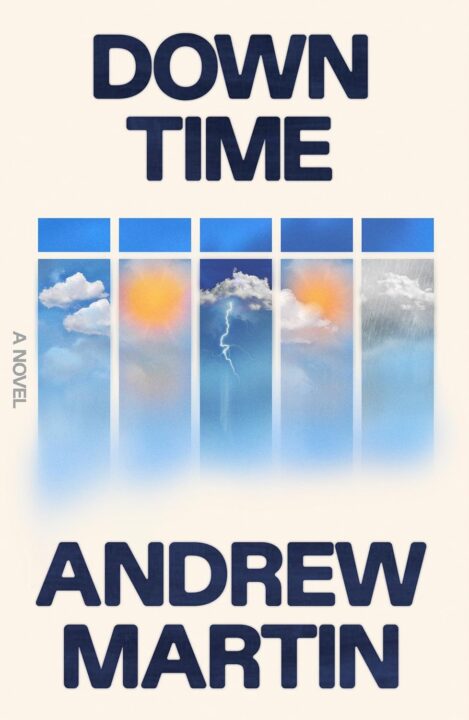
A so-called slacker novel, Down Time follows young professionals in a period of profound paralysis. All of them grew up in upper middle class families. All of them have been educated at high levels, whether in Ivy League schools or small liberal arts colleges. All of them are proven literati, able to converse about and seriously engage operas, foreign films, and deep cuts from Bob Dylan’s catalog. All of them are, to their own chagrin, registered Democrats who lament that Bernie Sanders lost the primary; they tolerate association with “quote unquote” liberals, “but they’re still, you know, capitalists.” “It was fun to have come from money,” a character muses, “as long as you knew you didn’t deserve it.” All of them subscribe to the dominant opinions on desire and self-invention, and all of them have seen recent professional success, either through academic appointments or published books. Martin himself belongs to this particular social echelon, and like his other work, Down Time interrogates the people who comprise it: their assumptions, habits, and proclivities. In this case, these characters are woefully mired, together or alone, in heavy sadness following a time of prosperity. And it is arguably a natural predicament; to quote Hütter again, “The old vice of acedia, of spiritual apathy, is the root cause of the typically bourgeois ennui, boredom.”
The book’s title connotes multiple things. “Down time,” of course, refers to time without any obligations, time that, implicitly, suggests a need to be filled, time threatened by idleness. It also can represent a period of sadness, depression, grief, “feeling down.” More classically, the title signifies the Wheel of Fortune, through which people routinely encounter periods of prosperity and failure. “We turn our wheel on its flying course,” Lady Wisdom says, impersonating Fortune, in The Consolation of Philosophy. “We delight in changing the low to the high and the high to the low. Rise up, if you wish, but on this condition: don’t consider yourself injured when you descend, as the rules of my game demand.” Down Time narrates the particular turn from high to low, which coincides with the COVID pandemic, and the particular inability of rising generations to endure that turn.
Martin writes from the perspective of four characters; three of them, Cassandra, Aaron, and Antonia, are written in the third person, but one, Malcolm, is written from the first. Martin admits in interviews that he wanted to experiment with multiple points of view; this does not seem to succeed other than to secure the novel’s fragmentary tone. Martin also writes with what is often regarded as “MFA style,” a method often learned in MFA programs that emphasizes interiority, subjugates plot, and leans on a plain, almost pedestrian tone.
Reading Down Time quickly produces an unwelcome reminder that COVID, thankfully in the past, was not that long ago. The daily routine Malcolm charts for himself in the early pandemic days reads eerily familiar, at times too on the nose: “My life—and I was certainly not alone in this—had gotten very small. Violet went to the hospital, and I minded the home front, i.e. drank, read, watched movies, worried. Sometimes I taught my writing class through the computer. I reread Beckett for relevant material, which was present on nearly every page. . . . I read helpful posts about how far sneezes could travel, refreshed the neighborhood case counts.” In its paradigm of social distance, remote communication, and home stranding, COVID gathered together different movements that had begun to course through culture. Even before the pandemic, social patterns and digital saturation were already forming habits of isolation—people spending more time alone, their interactions and professional lives thoroughly marked by screens. Martin writes of Aaron, “It was safe to live vicariously, both epidemiologically and in the name of protecting his increasingly fragile sense of self.”
A spiritual sadness cannot be conquered except through spiritual recovery.
Certain elements of Malcolm’s character seem autobiographical, offering another potential motivation for writing his chapters in first person. Martin, for example, grew up an Armenian Catholic, and throughout the novel, Malcolm talks at length about growing up in the Church—the Catholic schools he attended that animate his fiction, the alcoholic priest-uncle that he unwittingly feels deep affection for, the sense of guilt that preoccupies most Catholics who leave the Church. Catholicism itself serves as a kind of cultural residue in the novel; set in the northeast, the boundaries of Down Time are populated with parishes and schools and even the occasional seeker.
Malcolm and the other characters, of course, are ordinary Americans in their thorough indifference to Catholicism, beyond the detritus that its buildings and teachings leave behind on city streets and human hearts. Recounting his upbringing, Malcolm says,
Whatever I was now, the Catholic stuff had been a big part of it. Whatever I was now: certainly not a model of service to the Lord. No traditional values, or at least none that I wasn’t actively working to undermine. I had never worried seriously about hell—actual hell, I mean—outside of looking at Renaissance paintings and marveling at their inventiveness in conjuring demons and punishments. But I had spent most of my life feeling guilty for nothing. Or rather, guilty for things I’d done, some of which I was objectively correct to feel about, others of which seemed wholly the product of a sin-centered upbringing.
Malcolm jokes about the Church’s teaching on sex, which figures especially into his memories of guilt: “I’m not just talking about sex. But another thing about being raised Catholic is that one learns earlier than most everything is, in fact, about sex.” In such moments, Martin reveals a sharp ability to convey common experiences in cradle Catholic life.
A key irony of Down Time, it turns out, is that every character is obsessed with sex to one degree or another. Minor characters are especially debauched, reinforcing beau monde convictions of personal freedom. In their effort to reckon with Fortune’s downward turn, all four protagonists capitulate to desires both natural and forced, in a manner unexceptional for the zeitgeist. Happiness is sincerely not the goal of such pursuits; reflecting on an ended affair with another woman, Antonia states baldly, “The abasement was the entirety of the relationship.” Every new paramour presents possibilities, and every new paramour brings a deeper sense of distance from resolution (and hence another resonance of the book’s title). Aaron acknowledges the futility of a rendezvous with another man: “Aaron went to sleep not happy exactly . . . but briefly relieved of some essential tension.” This rampant, self-acknowledged lust, the intimacy of which Martin depicts too explicitly and too often, in the frequent manner of contemporary fiction (consider this a firm content warning), indicates how pornographied the commonplace mind tends to become. Hütter draws attention to a thread between acedia and the onset of pornographic habits: “Fueled by ennui and ressentiment and elicited by the roaming unrest of the spirit, vain curiosity takes the first allegedly innocent step that all too soon leads to the regular, then habituated, and eventually compulsive practice of pornographic voyeurism.” Such voyeurism isn’t always physical; it can even be a disease of the soul. “That summer,” Martin writes, “Aaron discovered that you could, in fact, live almost entirely in your imagination . . . by lubricious texts and emails from the fantasized other.” As the spike in pornography consumption during COVID demonstrated, real isolation breeds unreal fantasy breeds ever more real isolation, a smaller and tighter cog in the larger wheel that Fortune pilots.
Once again, however, COVID is not the catalyst but the culmination. The pandemic descends only halfway through the novel, by which time the acedia-rooted habits of thought and action are already cemented. The often-compromised relationships between characters reveal how starkly these habits come through: Malcolm, reflecting on his love of Violet, admits, “Even after all these years, I still often found myself at a loss for what to say to cheer her up, or to even know if she wanted cheering up. I worried that the effect of ‘all this’ [namely, COVID] would be to bury her feelings even deeper, perhaps permanently, making it less likely that I would ever understand her.” Even when the wheel seems to turn back upward, when characters are called out of their inertia toward a higher life, they can’t reckon finally with it, stuck at the gulf between their self-understanding and the interpersonal life outside their mind. Malcolm and Violet eventually marry and find themselves expecting a child, but Malcolm regards it all as unfathomable. “Sometimes I thought it was all a dream, our getting married during the lockdown, the pregnancy, the impending kid. I didn’t want it to be. I was ready, I thought, for reality. This was the first important thing in my life that hadn’t sent me into an existential panic. Maybe that meant something?”
Down Time ends, predictably, not with a bang but with a whimper, as Cassandra and Antonia, meeting in a cafe and implicitly acting on behalf of all the characters, both share an existential wish for “something good to happen.” A spiritual sadness cannot be conquered except through spiritual recovery. To quote Hütter, “The single most important practice that . . . protects us from acedia is an active and persistent discipline of prayer. . . . The root of the problem is a spiritual one,” he continues, “overcome only when the negative spiritual root, acedia, is eradicated,” which “the practice of prayer addresses.” Malcolm, the character plausibly most renewed by the end (though it’s hardly noticeable), turns to prayer in the middle of the narrative. Constantly exhausted by, yet tender to, the Catholic faith, he smuggles out a few sincere petitions as he passes a cathedral on the street.
I headed down Vanderbilt toward Atlantic, the nearly automatic route to my friend Kenny’s house, even though he’d been at his parents’ place in Virginia for the past month. I went past the gaudily imperious cathedral on Pacific. The doors were closed, as they had been for a month. I made sure no one was looking before making the sign of the cross and muttering a Hail Mary under my breath. Then I switched into my childhood prayer style, asking someone—God, Mary, whoever—to watch out for my parents, my sisters, for Father Jim, for Violet, even. Finally, almost as an afterthought, I prayed for myself.
Malcolm’s orbit of petitions, first to others and then to himself, mirrors the structure of St. Paul’s account of Christ appearing to the disciples after the resurrection: “He appeared to Cephas, then to the twelve. Then he appeared to more than five hundred brothers and sisters at one time, most of whom are still alive, though some have died. Then he appeared to James, then to all the apostles. Last of all, as to one untimely born, he appeared also to me.” The reader could regard the episode, like so many in the novel, as a simple psychological regression into immature behaviors, had Malcolm not reassured us of his autonomy, a disclosure that no other character makes: “I felt an urge to move. I was different now. I could act if I needed to.” It is a rare moment of true freedom in a manifestly illiberal novel.
Down Time succeeds when it holds up a mirror to the experience of COVID and studies the attitudes of an ever-shrinking cultural elite. Martin has likely limited his potential audience and his aesthetic power by treating the novel as a self-interrogation and relying on the status quo of literary prose, in which insouciant presentations of the real betray their own lack of substance. Much like grace, certain extraordinary moments appear, almost in spite of the writer’s intentions. But as for everything, Fortune’s wheel comes for literary form, and the form of Down Time, alas, does not promise to have a long shelf life.