
Some time ago a theory struck me: What if the world is a dream? Not like in a novel when the protagonist wakes up to discover that the entire story was an illusion. What if God is actually sleeping, and all of creation is his dream, constantly unfolding as history in God’s mind as he sleeps? To borrow from one of Anselm’s favorite principles, that whatever exists in reality is greater than what exists in the mind, what if everything we have ever known or experienced, the road to heaven, the road to damnation, has been only partly real, a shallow experience, and will only be fulfilled at the end of time, when God wakes up and his dream comes true at the final judgment?
The idea is more poetic than instructive, but it does suggest to me that God’s will has the qualities of myth: The landscape is otherworldly. Not everything is as it appears. There is a narrative foundation to the world. All kinds of strange creatures and events insert themselves at different points in the timeline. Archetypes and mysterious forces seem to have a hand in everything, from the growth and corruption of nations to the growth and corruption of grass. And perhaps most importantly for us, we have our own essential part to play. In a famous passage of After Virtue, Alasdair MacIntyre claims that
man is in his actions and practice, as well as in his fictions, essentially a story-telling animal. He is not essentially, but becomes through his history, a teller of stories that aspire to truth. But the key question for men is not about their own authorship; I can only answer the question “What am I to do?” if I can answer the prior question “Of what story or stories do I find myself a part?” We enter human society, that is, with one or more imputed characters—roles into which we have been drafted—and we have to learn what they are in order to be able to understand how others respond to us and how our responses to them are apt to be construed.
It’s common for children to pretend they are characters in fictional stories. Adults do this too, even more so in certain respects. But, like the grown-up protagonists in Eric Rohmer films, we often find in the course of our pretending that we actually belong to a story that is not of our own making, and though the outcome is not what we pictured, the choices we made during the story do affect it. And yes, our actions will contribute to whether we end up happy or damned.
The rhythm of myth is the rhythm of life, and particularly for the Christian, perhaps especially for the Christian.
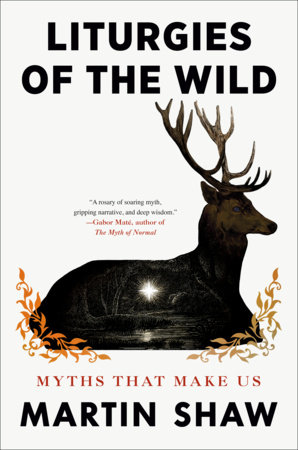
Martin Shaw insists that life as such has this kind of scope by default. His new book, Liturgies of the Wild: Myths that Make Us, claims that not only do we have a role to play in a grander story; our very selves are and should be defined by an understanding of reality as myth. The book aims to “help people find their way into the rigour and delight of relationship to story and place. These stories can range from the roving grandeur of The Odyssey to an issue in their love or work life . . . stretching the connections between the grand old epics and the intimacy of our own life’s challenges. It coaxes consciousness to do this, raises delight, and to some it feels like coming home.”
Myth gives us existence, and our receptivity to the dynamics of myth determines whether we are living well. “Humans are made of stories, and so we should be seeking the ones that call forth the best in us.” Shaw believes, perhaps unsurprisingly, that hardly any of us live a good life these days. Without the proper mythical context, we can only live according to myths that we conjure up for ourselves, and these myths will, by default, lack the substance and power necessary to sustain us with life-giving meaning. “We’re going to take facsimiles,” he writes, “over nothing at all. We will create stories that simply support the narrative of endless, exponential growth rather than the cautions and limits that have always supported traditional mythologies. We will settle for myth-lite. Myths that challenge nothing, and engage only in a rather tedious celebration of ourselves and only ourselves.”
Myths are characteristically wild, which is to say that they’re not tame: They precede civilized realities, though they don’t preclude them. People often encounter myths first in childhood, but Shaw craves a renewal of myth as a first principle of human life. People don’t ever graduate from fairy tales, folk songs, and the like; in the right soil, they tend to grow larger and larger with the person as the person gets older. Nothing but the experience of the wild can make a person civilized. Nothing but the garden in Genesis can lead to the heavenly city in Revelation.
In ages past, myths worked in tandem with rites of passage, through which girls and boys could, with concrete certainty, become women and men, with all of the rights and privileges proper to them. Those structures of initiation don’t exist anymore, and myths in turn have been relegated to the domain of entertainment. Initiation structures come off as primitive or backward-looking compared to the high-tech world in which everyone can be admitted to college and toddlers can experience pharaoh-level dopamine hits. It clearly doesn’t surprise Shaw that generations of people have seen their ordinary growth stunted. “We are wandering initiatory times,” he writes, “but lacking an initiatory language.” Nemo dat quod non habet: One cannot give what one does not have, and when we lack the language of myth, as Alasdair MacIntyre notes in the same passage in After Virtue, we lack a roadmap into the real:
It is through hearing stories about wicked stepmothers, lost children, good but misguided kings, wolves that suckle twin boys, youngest sons who receive no inheritance but must make their own way in the world and eldest sons who waste their inheritance on riotous living and go into exile to live with the swine, that children learn or mislearn both what a child and what a parent is, what the cast of characters may be in the drama into which they have been born and what the ways of the world are. Deprive children of stories and you leave them unscripted, anxious stutterers in their actions as in their words. Hence there is no way to give us an understanding of any society, including our own, except through the stock of stories which constitute its initial dramatic resources.
Every human life contains those “initial dramatic resources.” Wrestling with myths forms the person to attend to those resources, recognize the signposts they produce, and follow them. “Dare to entertain the thought that in the debris of your life would be stories worth examining,” Shaw declares. Only by listening for a voice that doesn’t belong to the sorceress could Rapunzel discover that her life wasn’t defined by the tower that she was confined to. Only then could real life begin.
MacIntyre concludes his famous passage thus: “Mythology, in its original sense, is at the heart of things.” This seems to be the thesis of Shaw’s book, permeating his reflections on the various dimensions of human experience: passion, vice, dreams, limitations, worship. The rhythm of myth is the rhythm of life, and particularly for the Christian, perhaps especially for the Christian. The “liturgy of the wild” that gives the book its title is Christianity itself, because the Christian myth is, as C. S. Lewis famously termed it, a true myth. The story of Christ, and of the Christian religion, is the one myth that actually happened in history. To train in the mode of myth, then, is to train in the fundamental skills of Christian life. “Gather your thrown-away stories,” Shaw concludes. “Get made, stand firm on occasion, and attend to the grace. That’s what makes a real human. To be a praise maker is to behold His earth in this way.”
MacIntyre characterized human beings as “dependent rational animals,” made for deeper freedom but useless to achieve it without solid ground to spring from. Solid ground is a scarce resource here in the second quarter of the twenty-first century, and with Liturgies of the Wild, Martin Shaw has declared himself hell-bent (nay, heaven-bent) on restoring its abundance. For that, and for his admirable new book, he ought to be commended.