
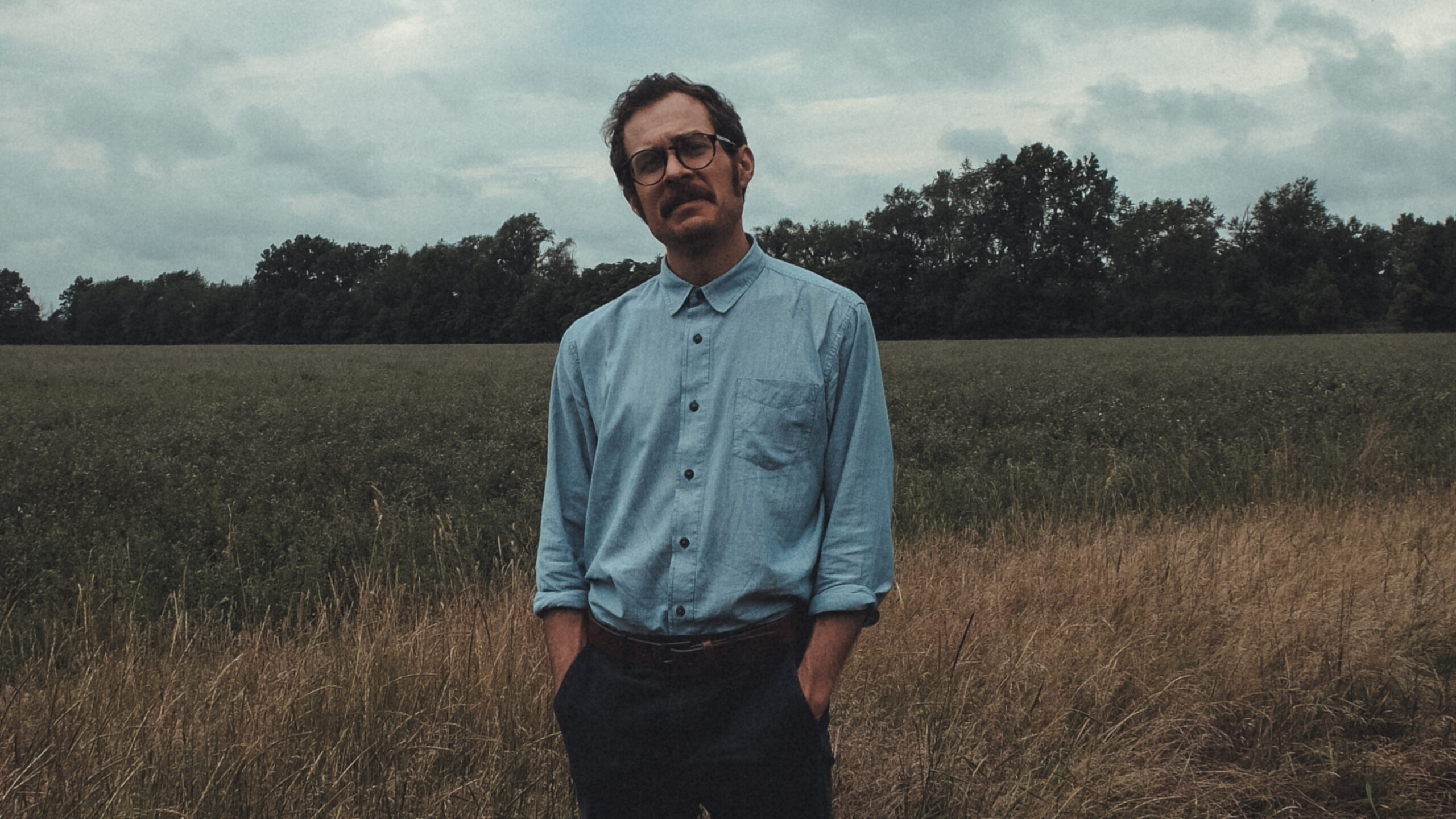
Former Ruins is the musical project of Levi Dylan Sikes, a Catholic convert from South Bend, IN. He has released multiple albums and EPs, and his most recent album, In Your Field, was released in September on his label, Slow Embrace Records. Andrew Tolkmith, assistant literary editor for Word on Fire Publishing, interviewed Levi about the new album, his conversion, and the enthralling yet daunting vocation of the twenty-first-century Catholic songwriter.
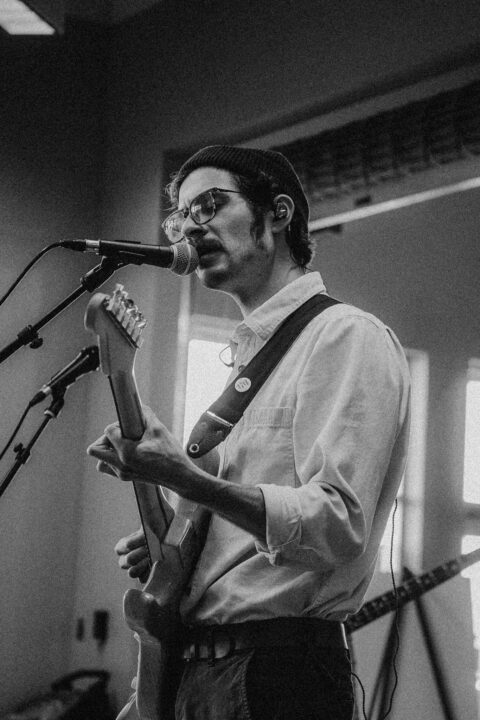
Andrew Tolkmith: The eucharistic imagery within In Your Field is palpable. A line in your song “Advancing” is a near-direct reference to a passage in Bishop Barron’s book Eucharist: “The sacrifice of the Mass does not constitute a challenge to God; rather, it breaks, as it were, against the rock of God’s self-sufficiency and returns to us as a life-enhancing power.” In “Back into a Body,” you illustrate the idea of anamnesis, in which memory makes what took place in the distant past, Christ’s gift of himself on the cross, present here and now, in the Eucharist that joins us to his Body. How has the doctrine of the Eucharist shaped the course of your songwriting?
Levi Dylan Sikes: The Eucharist and the sacrificial, mystical action of the liturgy (as we see it developing from the earliest writings of the Church onward) have profoundly shaped me. The First Apology of St. Justin Martyr to the emperor from the second century describes what a ‘church service’ looks like. It was shocking to discover that it resembled something far closer to the Mass or Divine Liturgy than anything I’d known previously. To speak of his Eucharist is to speak of Jesus, in whom all things hold together. The Eucharist has externalized and made concrete the private prayers and highest aspirations I held within myself when I would sit in silence at my Baptist church, grape juice and cracker in hand. I experienced fruits of spiritual communion (which we as Catholics also knew during the COVID lockdowns) for years, and these habituated me to a fullness I didn’t yet know existed—but it does. My wonder is consistently renewed at the way Jesus’s divinity and humanity extend through time and space and make contact with me. In my songwriting, I feel permitted to employ a cosmic wordbank that isn’t, in fact, New Age spirituality being shoehorned into Christianity. It’s a gift beyond all telling, but we try anyway.
My wonder is consistently renewed at the way Jesus’s divinity and humanity extend through time and space and make contact with me.
Family and parenthood come to the fore on the record. “One Hundredfold,” “The Field,” and “Unchosen” are tender yet weighty reflections on living the sacrament of matrimony. Despite their theological and spiritual richness, it seems rare for these topics to provide such rich material for Catholic songwriters, but they seem to be fundamental for your writing.
It feels too important not to sing about God’s plan for marriage and families. I am participating in what St. Paul described to the Ephesians as “a great mystery” (Eph 5:32), and that warrants some kind of response, if anything does. We have not heard too much of marriage, the Theology of the Body, or children but too little, or at least with too little wonder. Indie rock feels especially beholden to a childless-by-choice ethos and a purposeful subverting of the icon that marriage is. I want my songs to be remedial and acts of reparation, even.
I also want to be careful to not convey a kind of totalizing view of the vocation of marriage, however. There are other pathways to a full life in Jesus that we, as Catholics, should readily celebrate. I have an intention for LP 4 to write about friendships and modes of accompaniment that aren’t exclusive to marriage but nonetheless manifest God’s love for us.
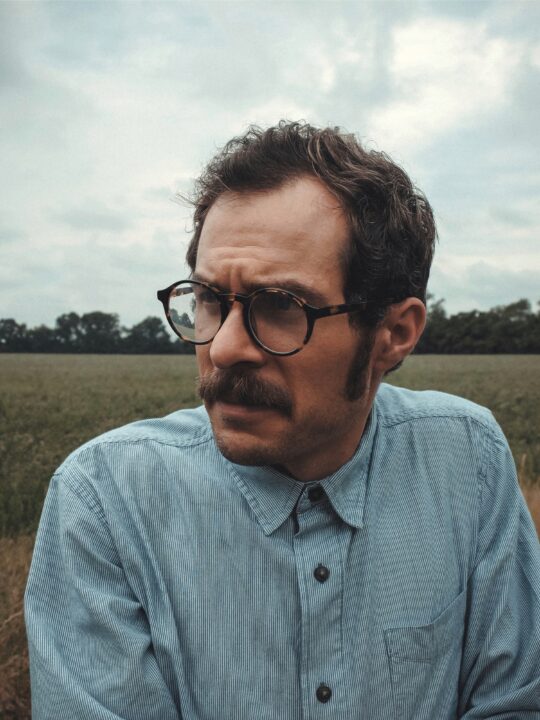
The concepts and images surrounding work and labor appear everywhere in these songs: “all we have to do is this day’s work”; “the work is done as all ages run”; “keep watering flowers before it rains.” Why does labor, both Christ’s and ours, hold so much weight for the record?
We can become so harassed by the devil and mistake a spirit of agitation for drive. Acquiring a peaceful heart, a surrendered heart, can be such a challenge in the face of all we could be doing to “advance in our field,” add a badge to our LinkedIn profile, or gain new followers. Well before I was Catholic, I was drawn to Scriptures like “We are his workmanship, created in Christ Jesus for good works, which God prepared beforehand, that we should walk in them” (Eph 2:10 ESV) and “This is the work of God, that you believe in him whom he has sent” (John 6:29 ESV). Working with all that God “mightily inspires” in him was St. Paul’s directive. All this conduces to the Catholic understanding of our role and God’s role in our salvation and the cooperative dynamic that still, without a doubt, rests on what God alone has accomplished. And yet, it’s his glory and initiative to involve us in his work, and there is no real competition there. The work of becoming most fully disposed to the working of God’s power through the sacraments is something I cannot stop wondering at. And so there continue to be songs about it.
Your lyrical approach appears to be very phenomenological, taking a memory or experience and singing contemplatively from within that experience, as in songs like “Hard to Tell.” What inspires such an approach?
I think we’re encouraged to do this kind of thing as Christians, even as we actively recognize life isn’t about me and my story primarily. I’ve heard Bishop Barron describe it as being swept up into the “theo-drama.” When we become rightly centered on God, we are not obliterated. We still sense that our stories—the particularities, the idiosyncrasies, the moments that feel written—matter. We reflect on these details, and they become charged with meaning as we, by faith, raise our contemplation to the fact that God has specifically loved and sought me, even as he seeks to draw all of us to himself. Especially when we read the Gospels, it’s the two-bit characters and their encounters with the Lord that draw us in. The woman caught in adultery seeing a rabbi scribble in the dirt, the centurion who entreats Jesus to “only say the word,” St. Dismas turning his head to ask the Crucified One to “remember me”—we are meant to see ourselves in them. It feels like a Christian innovation that these would-be nobodies become exemplars and subjects of our contemplation. Learning to see how the Holy Spirit is active in the fine texture of your life story shouldn’t lead to a kind of overly interior piety. An encounter with Jesus has to send you flying outward, like St. Photina—“Come, see a man who told me everything I’ve ever done” (John 4:29).
You open “New Attachment” with guns blazing: “Thanks, I wasn’t asking for this / Artificial intelligence.” In that song, you contextualize AI against the classic Catholic idea of material detachment, which generates spiritual growth. It’s common now to sound the alarm with AI, but how does singing against it heighten the attention given to its dangers? And what can Catholics do to foster authentically human experiences of music?
Whatever the shape of generative AI shows itself to be, I have many reservations about how it shapes us as sub-creators.
We shape our tools and our tools shape us, I’ve heard it said. I see how rapidly that generative AI has advanced and am disturbed, mostly for what it will do to keep accelerating violations on the dignity of the human person. I’m singing about it because singing itself, lyric writing, the generating of backing tracks with full band arrangements—all of these can now be done strictly through text-based prompting with an arguably better, more polished result than what I have made with my friends. This means of creation has dramatically flattened the curve of effort required and, as an ape of God, can manifest artworks without the material of the work itself—it needs ‘the word’ alone. Whatever the shape of this tool shows itself to be, I have many reservations about how it shapes us as sub-creators.
I really do trust listeners, though. There will be indelible, desirable qualities that come through in human performances, and Catholics in particular should train themselves to prefer these. We assign value to effort, such that even the mere knowledge that a song was shot through an AI tool will do much to color our perception of its quality. Host open mics in your backyard, work with your campus ministry to have an artist perform a coffeehouse-style gig, learn an acoustic instrument. Become aware of the provenance of the media you consume, and vote with your attention.
What are the greatest challenges that Catholic musicians face in our time, and what do you particularly struggle against as both your family and discography grow? How, in turn, can Catholics who want to support robust Catholic artistry do so?
Because the metrics of fellow artists’ successes are so public—followers, streams, listeners—comparison and discouragement are a particular struggle. Social media has also distracted musicians from the real work by siphoning away our time and attention—two precious currencies. I have mostly erred toward being on the platforms to make announcements over and against content, and I would encourage others to trust their listeners enough to do likewise. I would invite Catholic listeners to see the evangelistic value of original music that isn’t intended for liturgical settings. These songs can turn a cafe, a bar, a theater into a place of encounter with God, whose Spirit searches the depths of the human heart. From these missional outposts, a real bridge toward the liturgy and the heart of the Church can be built.
Many artists like myself rely on listeners to step forward as patrons to help us financially connect the dots. I release my music widely, but subscribers to my Bandcamp Patron Circle are given early and full access to everything I release along with deep cuts, such as my very first live performance as Levi Dylan & the Former Ruins in 2017. Jennifer and I are so grateful for our supporters who have now helped us fund and release two albums, with more to come. I’d welcome anyone who wants to invest in our work to take that step, or to become aware of fellow Catholic musicians closer to your circles and support them.
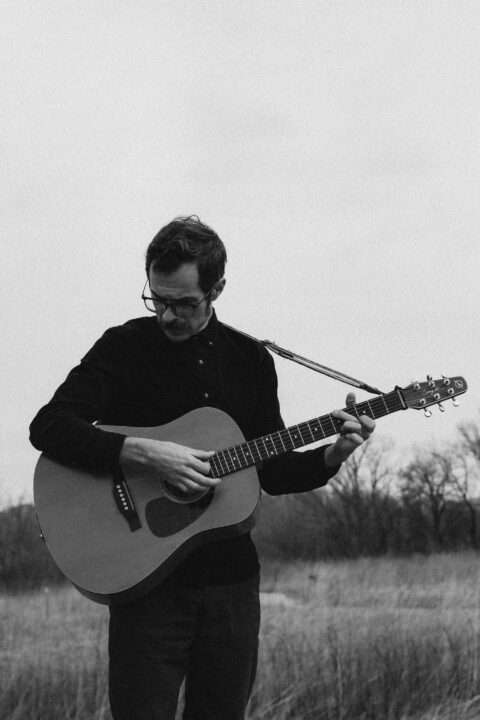
In Your Field, the new album from Former Ruins, is available now on physical and streaming platforms. To support Former Ruins and to learn more about Levi, visit formerruins.com. Photo credits: Cora Schiavone and Jennifer Sikes. Read the first installment of this interview here.