
At Christendom College, the small Catholic liberal arts school in the Shenandoah Valley of western Virginia where I teach, we’ve long had a tradition of hosting an event called Quodlibet. Coming from the practice of the medieval Scholastics, like St. Thomas Aquinas, quodlibetal sessions are times when, rather than hearing a set lecture or exposition of a text, students are able to ask their professors “what they will,” as the Latin name indicates. Custom encourages students not to ask trivial questions but to aim high, asking questions of theological and philosophical depth that also (often) pertain to how we live (or how we should live) our lives as Christians. At our last Quodlibet, on the Friday before Holy Week, one student asked what each of the panelists thought was the most serious challenge to living as Catholics today, and one of my fellow professors on the panel gave a penetrating answer: “Wealth.” As Americans, even those of us without large mansions or luxury cars are blessed with standards of material wealth and education that those alive at the time of our Lord’s earthly life would not even be able to imagine. While these things are blessings, there is a particular temptation that comes along with them that many have identified as rife within our culture: our proclamation—and attempted living out—of autonomy and self-sufficiency.
Thankfully, the Church throughout the centuries has produced a vast storehouse of meditations on all the variety of temptations that can lead us away from the life offered to us by our Lord Jesus in his resurrection, which we celebrate in this paschal season. It occurred to me recently that while many of us put substantial effort into Lenten resolutions, we shouldn’t cease being intentional in the spiritual life once Easter has arrived. While fasting is no longer appropriate since the bridegroom is with us (cf. Mark 2:19), prayer and almsgiving remain rules for our life in Christ, and reexamining some of the prayers of Holy Week and some of the Lenten literature Catholics have produced for our edification might prove particularly fruitful in the quest to understand how we should order our wealth, and to what—or whom.
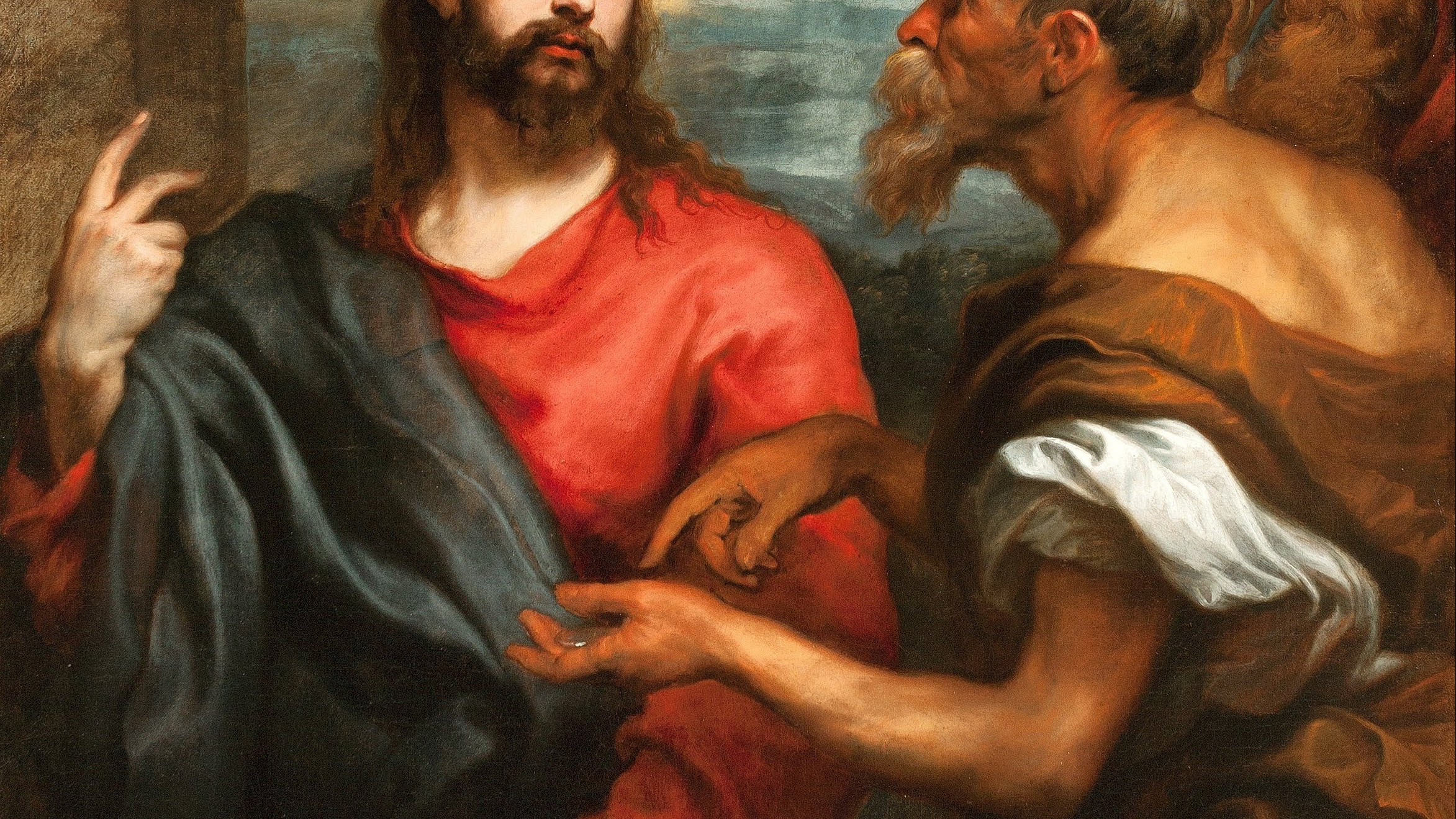
The proper prayers for the Matins of Holy Thursday in the Byzantine Catholic Church focus on the betrayal of our Lord by Judas, and particularly how Judas was motivated by his greed. The night before, on what came to be called “Spy Wednesday,” Byzantines hear the Gospel that tells the story of how a woman (often identified either with St. Mary Magdalene or St. Mary of Bethany) lovingly pours a jar of costly perfume upon the feet of our Lord, and Judas complains about the cost. Notably, St. John in his Gospel not only provides but also explains for us Judas’s complaint. After Judas says, “Why was this perfume not sold for three hundred denarii and the money given to the poor?”, St. John editorializes, saying, “He said this not because he cared about the poor, but because he was a thief; he kept the common purse and used to steal what was put into it (John 12:5–6).
If we remember to be grateful to God for his gifts to us, we can more easily yield them up as things that, ultimately, we have been blessed to receive.
One of the Matins hymns, the troparion, presents a series of antitheses, contrasting images, which by their pairing more vividly bring out the truth of the matter, as would the later chiaroscuro of Caravaggio’s Baroque paintings (such as The Taking of Christ). The hymnographer writes and the people sing, “While the illustrious disciples were enlightened as their feet were washed at the supper, the ungodly Judas darkened by a sick love of silver, betrayed you, the just Judge, to lawless judges.” The contrast is stark: The disciples are “illustrious” and “enlightened” by Jesus’s humble service in washing their feet as he proclaims, “The masters of the Gentiles lord it over them . . . but I am among you as one who serves” (cf. Luke 22:25–27). Judas, on the other hand, is “darkened by [his] sick love of silver”; the irony is that his desire for something shiny, resplendent with light, the reflection but not the source of its brightness, has turned him away from the true Light, our Lord’s love for each one of us, which includes Judas himself.
For while the troparion separates Judas from the disciples, prayers before and after that hymn remind us that he was one of the disciples, among our company, that we could (and do), like him, betray our Savior. One of the vesperal hymns of Holy Wednesday, which contrasts the woman’s gift with Judas’s treachery, concludes with a humble prayer, “Deliver our souls, O God, from the same!” This conclusion shows that, rather than identifying Judas as one utterly unlike us, rather than encouraging us in a false spiritual pride, the Church presents “the misery of Judas” to us as a warning, a pit that we could fall into were we to indulge in resentment against our Lord and long to console ourselves for our crosses with the comforts of mere material things.
A later prayer, in the midst of Ode 8, ascribes Judas’s fall to forgetfulness and contrasts Christ’s gift with his betrayal, Christ’s tenderness with his treachery: “Judas Iscariot forgot the laws of friendship; his feet, which You washed, now carry him to the betrayal.” How does he come to this, and how could we do likewise? The hymnographer writes, “He did not know how to cry out: Praise the Lord all you his works,” the very hymn sung by the three youths in the furnace, recounted in the book of Daniel and commemorated in Ode 8. By a lack of thanksgiving and praise, by a failure to attend to the goodness of God’s creation as God’s creation, Judas forgot the laws of friendship between God and man that consist in God’s generous giving to us of all that we are and all that exists. Our gratitude, our pietas, as the philosopher Josef Pieper notes, is never sufficient on its own to pay back our debt—even our prayer is God’s gift to us.
When thinking about pietas, we cannot forget the Roman poet Virgil, whose epic poem focused on the hero Aeneas, known for his piety. The sculptor Bernini famously depicted Aeneas saving his son and his father, who carries the Penates, the household gods, preserving the link between the generations and the divine. Virgil’s best-known poetic heir, Dante, also provides us with a timely meditation on the temptation brought about by wealth. In his Divine Comedy, Dante the poet writes of a pilgrim (whom we come to know is Dante himself) who undertakes a journey, beginning on Holy Thursday of the year 1300, through hell, purgatory, and heaven. His guide for the first two realms is none other than Virgil himself.
A question I encourage my students to puzzle through is why Dante the poet chose Virgil, and not his beloved Beatrice or his patron saint, as guide. One reason that Dante provides for this choice is given through the mouth of another Roman poet, Statius, who in Dante’s Purgatorio converted to Christianity but kept his faith secret in order not to risk martyrdom. When Statius realizes he’s in the presence of Virgil, he exclaims for joy, and Virgil asks him how he, Statius, a poet who displayed wisdom in his works, could be found among those being purged for the sin of avarice. Statius goes as far as to say not only that through Virgil he became a poet, but “through you, a Christian” he became as well—Virgil’s criticism of money-hungriness in the Aeneid led Statius away from his excessive spending.
Readers of the Roman epic might remember how often Virgil presents us with characters who suffer because of the greed of others: Take for instance Polydorus, a Trojan ambassador to Thrace, who was killed by the king of Thrace for the gold he kept for King Priam, or Dido’s first husband Sychaeus, killed by her brother Pygmalion for his wealth and power. Dante has Statius reference a verse from the Aeneid where Aeneas, after recounting the slaughter of Polydorus, curses the hunger for gold, saying, “Quid non mortalia pectora cogis, / auri sacra fames!” To what will you not lead mortal hearts, oh sacred hunger for gold! (Aeneid 3.56–57). Translators of the Aeneid usually render the word sacra here (from which we acquired the word sacred, derived from the Latin word sacer, priest) as “accursed” or “execrable” (also derived from sacrum), because Aeneas seems to use the word ironically; he is not actually calling the desire for gold holy but is mocking it instead.
Virgil and Dante both understand that we as humans are always tempted to make an idol out of our wealth. Sometimes we do this literally, as with the planned Hindu idol in North Carolina; more often, we do this figuratively, when we allow our desire for wealth—and the independence from God that it often comes to represent—to supplant our need to treat all of our material possessions as means to store up riches in heaven by following the law of the Gospel: loving the Lord our God with all our hearts, and with all our souls, and with all our minds, and with all our strength, and loving our neighbor as ourselves (cf. Mark 12:30–31). If we remember to be grateful to God for his gifts to us, we can more easily yield them up as things that, ultimately, we have been blessed to receive. How can we practice this remembrance? Precisely by being faithful to prayer and almsgiving—and giving alms not only within the realm of what is comfortable for us but in ways that stretch us to deny ourselves the material peace that the world gives, so that we might obtain the peace of Jesus Christ (cf. John 14:27). Thus we might continually remember with the righteous man Job that naked we came into this world, and naked we shall leave it, bereft of all possessions but the words that can shape our character as Christians: Blessed be the name of the Lord!