
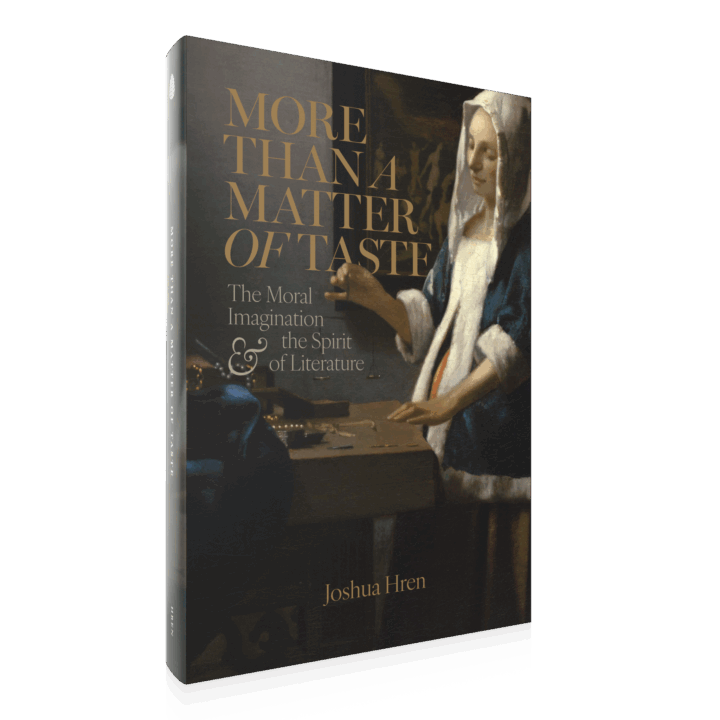
The following features an excerpt from Joshua Hren’s latest book, More Than a Matter of Taste: The Moral Imagination and the Spirit of Literature (Word on Fire Luminor).
In a passage that repays perpetual, lifelong revisitation, Simone Weil says that unless we are utterly vigilant, “the substance of our life is almost exclusively composed of fiction. We fictionalize our future, and, unless we are heroically devoted to truth, we fictionalize our past, refashioning it to our taste. We do not study other people; we invent what they are thinking, saying, and doing.” As Joyce puts it in Finnegans Wake, “O, you were excruciated, in honour bound to the cross of your own cruelfiction!”
Proust pierces through this same insight in his early novel Jean Santeuil, a work that is often marked by an artistic immaturity that amounts to romanticization of his hero: “Of such a nature is hatred,” he says, that it “compounds from the lives of our enemies a fiction which is wholly false. Instead of thinking of them as ordinary human beings knowing ordinary human happiness and occasionally exposed to the sorrows which afflict all mankind and ought to arouse in us a feeling of kindly sympathy, we attribute to them an attitude of arrogant self-satisfaction which pours oil on the flames of our anger.” Such traps of subjectivities, such projections of our own pettiness, at times emerge because, says René Girard, people are “incapable of ‘putting themselves in another’s place.’ The novelist is able to reveal their helplessness only because he has experienced it himself and overcome it.” Fiction dramatizes falsehoods, lures us into believing them—and then dismisses them as delusions, in order to cure us of our proclivities to lie and to be deceived.
What George Eliot puts so economically—“Falsehood is so easy, truth so difficult”—Georges Bernanos develops with care in his novel An Evil Dream. As Madame Alfieri acquires the all-too-human proclivity to falsify, she finds in her daily fictions “a marvelous evasion, a relaxation that always works, a rest, a forgetting.” Pursuing lying for its own sake, she “employs lies with profound cleverness and insight, those also who truly value lying only when true and false mingle in it so intimately that they become one thing and come to have a life of their own, creating another life within an ordinary life.”1 It is no accident that this phenomenon recurs again and again in the form of the novel. From Don Quixote onward, fiction fights fire with fire—telling beautiful fictions to purge readers of the falsifying fictions they too often cleave to.
In Bernanos’ A Crime, Madame Alfieri’s literary sister Evangeline announces this same phenomenon as good news with a bad underbelly. “Yes, I have loved lies,” she proclaims:
I don’t mean useful lies, that abject form of lying that is only a means of self-defense like any other, employed with regret and shame. . . . I have loved lying as such, and it has rewarded me handsomely. It has given me the only freedom I could enjoy without constraints, because, if the truth sets us free, still it places on our deliverance conditions that are too hard for my pride to accept, and lying imposes no conditions at all. There is one thing: in the end it kills you. It is killing me now.2
For a lifelong liar, Evangeline is unflinchingly frank. Her musings on the terrible truth about the pleasant fictions of our own making reminds us how hard it is to face truth when we overwrite the face of reality with bad novelizations of our true circumstances. Good novels, great literature, stories that tell us hard things: In the house of fiction, the uncensored truth is inseparable from the beautiful, making it possible for our flinching palates to swallow and stomach so much reality. As Samuel Johnson says, “Imitations produce pain or pleasure, not because they are mistaken for realities, but because they bring realities to mind.”3 And we might add: The realities they bring to mind we may have repressed into muffled silence instead of facing them, now, and paying truth’s cost of pain or pleasure. Fiction is not the only mediator between the fullness of truth and our own reconciliation with reality, but it is a wildly generous one.
Fiction dramatizes falsehoods, lures us into believing them—and then dismisses them as delusions, in order to cure us of our proclivities to lie and to be deceived.
By paying the price of time, heart, and mind—a scandalously cheap rent for such spacious rooms—we can dwell for a time in the house of fiction. As Henry James put it in his famous preface to The Portrait of a Lady, “The house of fiction has in short not one window, but a million—a number of possible windows not to be reckoned, rather; every one of which has been pierced, or is still pierceable, in its vast front, by the need of the individual vision and by the pressure of the individual will. These apertures, of dissimilar shape and size, hang so, all together, over the human scene that we might have expected of them a greater sameness of report than we find.”
Although these “windows” of novelistic perception are, at best, “holes in a dead wall”—they are not doors that unhinge directly upon life, they invite us into a polyphony of astute noticings that, altogether, can put us into proximity of that wisdom that comes from a vision of the whole: “There is fortunately no saying on what, for the particular pair of eyes, the window may NOT open.”
Relishing this vastness of vision, we look through rose windows and the standard winterized glass of northern suburbs, through the aperture of an obscure mud hut or the triumphant arcs of the Sacré-Cœur. Exiting—to run an errand or at the end of our stay—we find that we can bear just a bit more reality. Perhaps, in time, we will learn to bear very much. The irony is rich enough to rehabilitate the whole house and make it livable for tomorrow and tomorrow and tomorrow. Though we entered a state of affliction, riddled with our petty fictions, the spirit of literature read us like a doctor in the age-old hôtel-Dieu, diagnosing our unreal parts and palpating them back to life, bringing, wrote Bernanos in The Impostor, our “inner core into the open like a muscle suddenly jumping out of its covering in a surgeon’s hands.” Like a surgeon, not—please note—a priest.
The question is never whether a given aperture in the house of fiction is moral or immoral—every perspective necessarily implies some pragmatically accepted conclusions about morality, whether these conclusions are consistent or not, acknowledged or not. Given that all artists lack God’s omniscience, all apertures, all windows are partial—in ways that can be both wonderful and awful—even those that achieve incredible feats. The question is twofold: Has the writer made her morality appear in a way that is artful? And is her morality a true account of the real all around us?
But the greatest of novels can do more than diagnose illnesses and palpate our unreal parts back to life. They can elevate our appetites to beautiful goods that we had forgotten to ask for—that we had maybe disbelieved could even exist. The greatest of novels are more than hospitals—they are more like cathedrals. The harmony of plot and character, pacing and painterly attention to detail, are as the awesome agreements between vaulted ceilings and winged buttresses, stained-glass windows and high altars. The only right and just response upon entering a great book is gratitude swelling into awe. As we enter into a given work of fiction’s imaginative rendering of human nature, we cannot help delving into what it implies or indirectly indicates about good and evil or God—but amidst these explorations of the moral imagination, and well before we make sense of everything, we should remember, with thanksgiving, the sheer joy of inhabiting a well-made work of art.
Good stories allure us into complex moral deliberations as we accompany a vast cast of characters caught up in life-altering conflicts.
Good novels, smaller houses of fiction, are like beautiful parish churches, more modest but nonetheless elevating our souls. Assuming that we cannot reduce aesthetic judgments to mere taste, what criterion can we use to determine whether a novel is good or great? All art makes present for us the forms of the things that it represents. A given scene or setting or character of a novel represents several things in relation in a manner that manifests choice parts of their essences. A given excellent sentence might isolate just one aspect of a tree’s leaf as it falls, brittle and beautiful, to the earth’s floor. Daniel McInerny describes how through mimetic picturing that transcends mere photographic copying, novels represent things in a manner that achieves “a deeper intelligibility,” and at its heights, mimetic picturing will make intelligible “what a thing essentially is.” Well-made art represents, through an ordered and formed “phantasm, the complex sensory image of a thing,” in a manner that invites the intellect into action, distinguishing “what is essential from what is merely accidental to that thing.” “To grasp what must belong to a thing,” McInerny explains, “is to grasp what is essential to all instances of that thing. It is to grasp it as a kind of universal.” I would like to suggest that great novels either achieve or come close to achieving universality in this sense. A novel that probes the nature of fatherhood will give us a vast array of masterfully selected isolated aspects of fatherhood, so that by the time we reach the end, we leave with imaginations and minds contemplating the very essence of what it means to be a father. McInerny voices a worry: “Doesn’t this abstractive activity of the intellect take me far away from the sensible particular . . . that I want to contemplate?” This does not happen when we are immersed in or formed by a work of art insofar as, in a novel, the soul ascends and descends the ladder from sensory particular to far-reaching insight: “The intellect is able to take the essential knowledge of a thing and apply it back to the sensory particular.” A moving scene of a father rocking his firstborn daughter at midnight will lift the mind to the self-emptying love that is at the heart of fatherhood, but even as we can muse on this self-emptying, seeing the way in which that emptying allows the heart to be filled with wiser blood, we see him stub his toe on the nail he failed to hammer down the previous day. The scene brings us back down to the phantasm, carefully selected to say something else about this particular father in this particular house on this particular night. And of course, the novel will not simply be “about fatherhood.” Our protagonist is also a pianist and the son of a murderer; at the moment he rocks the child and trips over the evidence of his preoccupation, his own father is on death row. The book will lean into other essences and elements of his character. A great book will leave us with a sense of essences that is at once exhaustive of phenomena and generative of contemplation. A good book will take us through several elements or aspects of fatherhood, well-arranged in relation to one another but not exhaustive of the thing being chased through the artist’s hot pursuit of the real.
Some good books, limited to a compelling record of natural man, have lower ceilings. Some bad ones have ceilings that are oppressive, creating a claustrophobic feeling. Like St. Peter’s Basilica for James’ heroine Isabel Archer, some books’ ceilings make our “conception of greatness [rise] and dizzily [rise]” until we reach the threshold of heaven.
Earlier I mentioned that literature is especially equipped to wed the universal with the particular. Good stories allure us into complex moral deliberations as we accompany a vast cast of characters caught up in life-altering conflicts. Because we are capable of analogous reasoning, we can make connections between our feelings and theirs, their dilemmas and ours.
In More than a Matter of Taste: The Moral Imagination and the Spirit of Literature, I strive to match principles with prudence. Story by story, page by page, I answer Newman’s summons to discriminate “‘the precious from the vile,’ beauty from sin, the truth from the sophistry of nature, what is innocent from what is poison.” If these essays chase after aesthetical incarnations of the ethical, they are especially attuned to those blessed vistas in which the moral opens out upon the transcendental—in which the merely human moral imagination must reckon with the incursion of the Holy Spirit.
Shaking awake after the pages close—after the dream of fiction is done—and taking a turn around the grounds, we find that under the house—under what Henry James called “the firm ground of fiction . . . there curled the blue river of truth” all the while. We feel—feet back on the pedestrian pavement—like a well-made character in a good novel, a novel good enough to make the moral imagination: not beyond good and evil, but ever so subtly and blessedly measured by “oughts” and “nots,” ever treasured by the Spirit who hovers and breathes love into the abyss. We look back, startled, at the humble entrance—the single opening sentence. We scratch our heads, hand over our hearts, standing there saved by stupefaction. We feel lifelike, as if painstakingly made and maybe even loved, madly, by a Creator.
. . .
1 Georges Bernanos, Un mauvais Rêve, 193, quoted in Hans Urs von Balthasar, Bernanos: An Ecclesial Existence, 147.
2 Georges Bernanos, Un Crime, 231, quoted in von Balthasar, Bernanos: An Ecclesial Existence, 147.
3 Samuel Johnson, preface to “The Plays of William Shakespeare,” 432, quoted in James Wood, How Fiction Works, 239.