
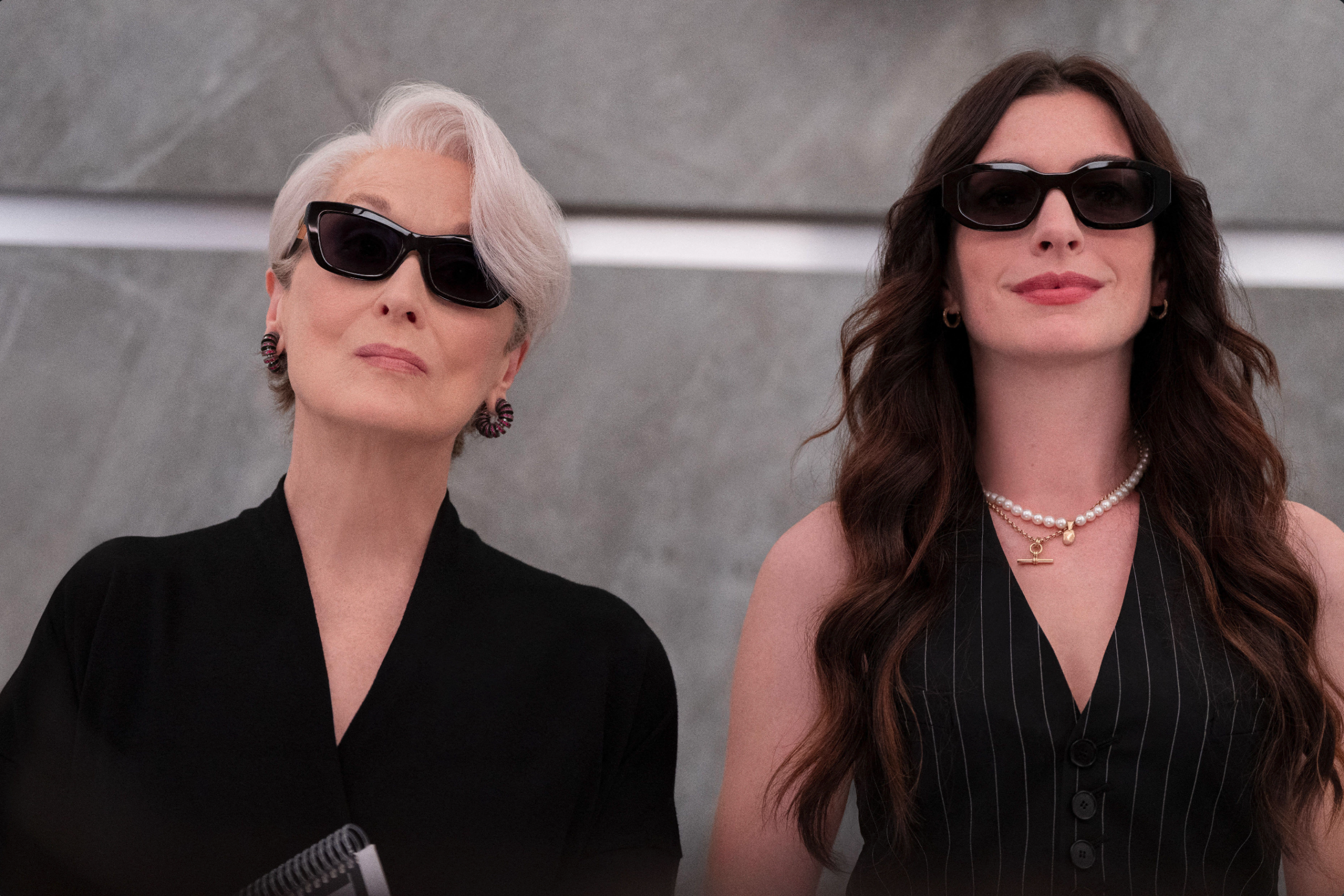
The Devil Wears Prada 2—a sequel to the Academy Award-nominated original from twenty years ago—is a fun Hollywood spectacle, reuniting heavy hitters from the original cast (Meryl Streep, Anne Hathaway, Stanley Tucci, and Emily Blunt) while adding tongue-in-cheek cameos from media figures like Kara Swisher and Jenna Bush Hager. Despite warnings from the otherwise legendary Armond White, who calls the movie a “rummage sale” of recycled decadence, mature, Catholic audiences primed for suspicion in the wake of Hollywood’s woke excesses and shallow propagandizing need not overthink it. Though the film occasionally stumbles into theological territory it plainly does not understand, the sequel to the 2006 blockbuster offers quippy, sharp dialogue; an escapist, larger-than-life engagement with its New York City setting; and a gripping corporate-takedown plot—complete with the death of a patriarchal titan, the fight over an elite media dynasty, and secret trips in black SUVs to billionaire compounds—reminiscent of HBO’s Succession.
Perhaps the movie’s most valuable insight, for those insisting on finding one, is its critique of managerial logic. Audiences concerned about the “McKinsey Effect”—about how journalism, fashion, literature, restaurants, and art have been stripped of human dignity and charm by the relentless drive to optimize, strategize, maximize clicks and profits, and subordinate everything to metrics and the bottom line—will appreciate it, especially at a moment when even Pope Leo XIV, in a forthcoming encyclical, is preparing to address the dehumanizing pressures of technocracy. Far from simply repurposing nostalgia, The Devil Wears Prada 2 provides an oddly funny, colorful, and timely validation of such anxieties.
In the plot, Streep’s Miranda Priestly—the iconic editor-in-chief who essentially defined the genre of twenty-first century corporate supervillains—and Hathaway’s Andrea Sachs—an equally archetype-defining, annoying but lovable pick-me girl—form an unlikely alliance defending Runway magazine against the McKinsey mindset of efficiency, algorithms, and brand monetization. Together with Lucy Liu—always a strong addition to a stylish female trio—they form a trifecta of cultivated competence: women defined less by corporate feminist slogans and empowerment rhetoric than by intelligence, taste, discipline, and hard-earned professional authority. Refreshingly, the film spares us the obligatory “girlboss” posturing that would almost certainly have dominated a version of the movie made in, say, 2013.
As the story unfolds, Andy is also navigating a flirtation with a building contractor. Peter, a burly Australian, has just finished renovating the polished, upscale one-bedroom Andy rents after receiving a raise. This allows for some interesting side commentary about urbanism and real-estate development. Is there a difference between the supposedly evil real-estate developers to which the film alludes (with Peter carefully distinguishing he is not one) and the Harvard MBA consultants who apply managerial logic to the historic beauty and editorial culture of a dying magazine? The film conflates the two—if only briefly and playfully—suggesting that luxury development, like corporate consulting culture, inevitably flattens neighborhoods, aesthetics, and local character into interchangeable monoculture.
The tragedy of much contemporary art and music is not that it longs for transcendence, but that it struggles to distinguish it from aesthetic intoxication.
Yet renovation and stewardship are not inherently the same as managerial optimization (and even that can have its place). YIMBY-ism can certainly go too far, especially when profit supersedes local culture and history, but buildings do not preserve themselves indefinitely. Done well, rehabilitation can itself be an act of conservation: a way of honoring beauty. And building—working with one’s hands to produce craftsmanship—remains a noble vocation. The film only half acknowledges this, with self-deprecating Peter—an almost comically “unproblematic” love interest—laughing along while Andy rants about gentrification and capitalism, even as she signs the paperwork for her new park-adjacent unit.
Anyways, this all makes for a cute diversion—an opportunity to reflect on the movie in the context of, say, Ed Glaeser—but one mustn’t get too invested. Much like Andy’s eggs, which she casually mentions are frozen at an IVF clinic on 85th, there’s no evidence this Bob-the-Builder romance will last. This is sad, not merely because IVF separates procreation from the sacramentality of the marital act, but also because Andy’s career-focused deference of marriage and childbearing is totally normalized and unquestioned. Again, the movie, thankfully, does not overly-sermonize or turn childlessness into a manifesto. But that it’s become such an ambient facet of millennial urban life is, undoubtedly, depressing.
Another time the movie brushes with heavier themes—once again moving quickly past them rather than lingering in self-serious commentary, thankfully—is in its use of Catholic iconography and aesthetics. At one point, in Milan, the characters dine in the Dominican convent Santa Maria delle Grazie, home to Leonardo da Vinci’s The Last Supper. Gazing upon the mural, Miranda confidently concludes that Christ’s missing halo in da Vinci’s rendering signifies his appreciation for our Savior’s supposed moral fallibility. This interpretation is on-brand with contemporary fashion’s use of Catholic imagery: it’s shallow and utilitarian, missing the broader point that Christ’s humanity in Christian thought is not evidence of moral confusion, but the very Incarnational means through which God enters human history in an act of a radical charity that most of us—let alone a harried, secular fashion editor—cannot even hope to fathom.

Yet, refreshingly, the film does not linger long enough to turn this into an extended lecture. Instead, it largely treats Catholicism the way the fashion industry itself does, with luxury designers—as at the 2018 Met Gala—borrowing freely from the aesthetics of saints, nuns, vestments, cathedrals, Vatican norms, and Renaissance art, less as a coherent theological system than as a source of beauty, ritual, hierarchy, and glamour to be appropriated for worldly purposes. Fair enough. Vain and frustrating, but relatively harmless for adult, catechized viewers.
“I found God in the shape of a woman,” Lady Gaga later sings from a high-fashion Milanese runway scene, crystalizing the movie’s deeper spiritual confusion via an original soundtrack contribution. Her idea is not, at its core, blasphemous. Catholics do not reject feminine beauty—in fact, they have historically been among its most devout and accomplished custodians. But the lyric is inaccurate in the way “Mother Monster” means it: in conflating feminine beauty itself with divinity. Beauty, properly understood, is not itself God, but a sign pointing beyond itself. The tragedy of much contemporary art and music is not that it longs for transcendence, but that it struggles to distinguish it from aesthetic intoxication. Add in the modern day’s preoccupation with identity politics—the need to filter creativity through feminist impulses, in this case—and it’s essentially a non-starter.
But alas, even if Lady Gaga misses the mark, all hope for transcendence in Milan is not lost. The city serves as the setting for one of the film’s most affecting moments, when Miranda’s longtime acolyte, the self-effacing Nigel Kipling (Stanley Tucci), finally rises to the occasion, delivering a high-stakes speech on Priestly’s behalf. It’s a beautiful scene, made possible by Andy’s recognition of Nigel’s oft-overlooked dignity and talent—a gesture of attentiveness later rewarded when Nigel reveals that he was the one who quietly landed Andy her own position. In a movie focused on ambition and status, the tenderness of Tucci’s arc is one of its sweetest elements.
But the kindness is not just reserved for Nigel. Perpetual snob Emily Charlton (Emily Blunt) is also on the receiving end of Andy’s patronal charity, something startling to witness within the film’s otherwise cut-throat environment. As in the original, Andy remains the eternal millennial pick-me girl—sincere, earnest, and desperate to be both morally serious and professionally exceptional. And yes, this can be extremely annoying. It was annoying in the first film, when Miranda delivered the now-iconic cerulean sweater beat-down after Andy smugly assumed herself above the frivolities of high fashion; and it is again here, when Andy predictably attempts to save the day, proving far too idealistic to deliver. Yet while pick-me girls often exude an exhausting moral superiority, Andy ultimately uses her earnestness for good. Her instinct is not merely to posture, but to care, however clumsily and sanctimoniously. That sincerity becomes redemptive, culminating most powerfully in her forgiveness of Emily, a cynical, permanently exasperated cat-like creature somehow still surviving on what appears to be her ninth life.
Miranda’s stubborn insistence on human particularity and aesthetic rigor begin to look less like cruelty and more like heroism.
Finally, without giving anything away, the movie ends with Andy once again revisiting the iconic cerulean sweater—the one that sparked the now-famous monologue. And Miranda, thankfully, stays on-brand, as well. This time around, she literally has an HR handler to keep her at bay. It half works, and the results are hilarious. I nearly fell out of my chair when she’s corrected for implying that models in a subpar photoshoot look like drug addicts from a neighboring state. “What? What am I not allowed to say?” she asks incredulously. “Methadone? New Jersey?”
Miranda knows she is approaching her career’s twilight—and she also knows Andy is in the lucrative position to potentially write an ugly tell-all. Surprisingly, she encourages Andy to tell the story and to be truthful: to reveal just how scathing and demanding Miranda can be.
“People should know there’s a cost,” she says, referring not merely to professional ambition, but to the cultivation and defense of beauty itself—to standards, excellence, hierarchy, and the refusal to flatten everything into algorithmic mediocrity. It is perhaps the movie’s most important line. As the walls of managerial logic and technocratic homogenization close in—the sort of dehumanizing tendency the Holy Father is himself expected to address—Miranda’s stubborn insistence on human particularity and aesthetic rigor begin to look less like cruelty and more like heroism.
Commenting on the rising surge of Catholic conversion, Julia Yost recently pointed out in the Washington Post that beauty has an increased currency in our pixelated age. It can be used for calculated, manipulative purposes—as in the hordes of influencers using endless supplies of Botox and hydrogen peroxide for “looksmaxxing”—but also for evangelization, as the most significant Catholic artists always understood. In an age increasingly dominated by AI slop and HR euphemisms, what remains distinctly human—taste, artistry, craftsmanship, intuition, glamour, tenderness, attentiveness, forgiveness—is worth defending. In that light, Miranda’s ruthless devotion to beauty takes on an almost religious quality of its own: not saintly, per se, but certainly sacrificial.