
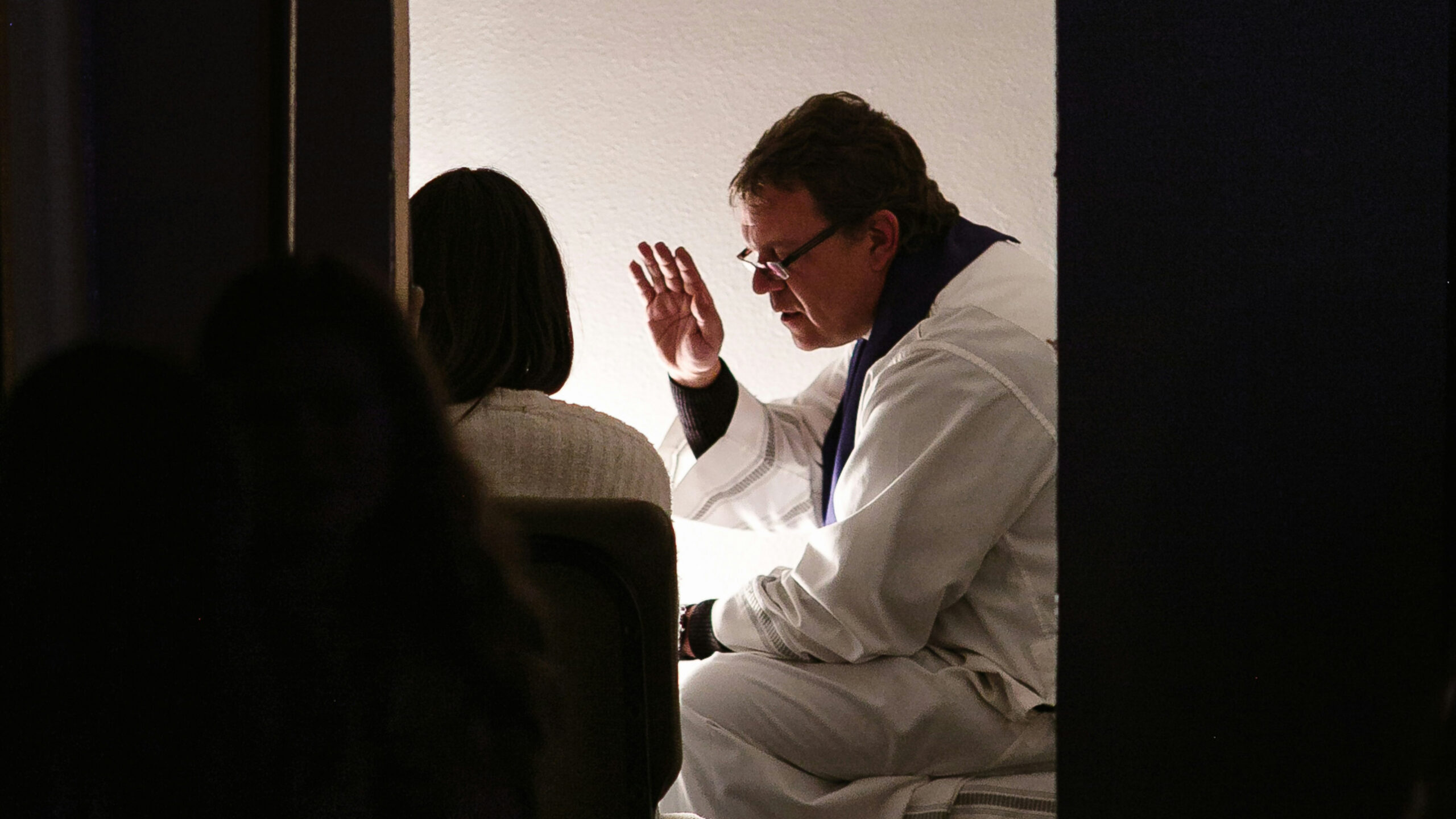
What I noticed first were the deep tones at Mass—a reservoir of notes poured out at a lower octave than I was accustomed to. I paused at the Responsorial Psalm, the Communion hymn, the moments when I would join my voice to the band of over one hundred men in formation during daily Mass in the chapel at the seminary where I work. I paused so that instead of adding my mid-range alto / low soprano voice to the mix, I could instead absorb the resonance of their masculine pitch. Day after day, I found myself dropping to the lower octave, allowing the cloak of their tone to surround me. It was as if I had discovered the opposite of so-called toxic masculinity—I was ensconced in healthy masculine vibrations. Our world needs this resonance: men who give themselves away in love. And as we approach ordination season across the country, we all witness man after man laying down his life to serve the bride, the mystical body of Christ: the Church.
To ponder what it means for men to give themselves away in love in the Catholic priesthood, we draw upon the riches of Jesus’s life in Sacred Scripture, the patristics, the teachings of the Church, and our beloved Pope St. John Paul II, a particular patron for Word on Fire Catholic Ministries. Jesus instructed his disciples in John 15:13: “Greater love has no man than this, that a man lay down his life for his friends.” St. Augustine preached in his sermon for Passion Saturday, “He is Christ’s servant even to that work of special love, which is to lay down his life for the brethren, for that were to lay it down also for Christ.” The Catholic Encyclopedia defines love as “a divinely infused habit, inclining the human will to cherish God for his own sake above all things, and man for the sake of God.” John Paul II frequently explored this teaching from the Second Vatican Council in Gaudium et Spes: “Man . . . cannot fully find himself except through a sincere gift of himself.”
It was as if I had discovered the opposite of so-called toxic masculinity—I was ensconced in healthy masculine vibrations.
I’m no theologian, but applying this brief assortment of evidence about the gift of self in love to our seminarians reinforces to me how truly holy and hard it is to love singularly the complex bride that is the Church. And in seminary spaces where men learn who they are as beloved sons of the Father and whose they are (spoiler alert: also the Father’s) to be given away, these conversations of growth and formation hold a deeper resonance literally and figuratively. The bride needs men of humble- and wholeheartedness. Seminaries are producing well-formed men by the hundreds—thousands—each year. And it’s an astonishingly countercultural output compared with what the world says about male-only casts.
To even evoke the idea of a male-only space brings up depressing shades of Fight Club or maybe the jarring, haunting electronic dance tones of VNV Nation—lots of crashing and thudding sounds sprinkled with eerie scratching (an early adulthood favorite amongst my late ’90s roommates). The depiction of the actions and sounds of a strictly male cast of characters is often a hefty dose of aggression with a touch of chaos. Yet the witness I’m bearing to priestly formation in the seminary is order, humor, and countless acts of brotherly care.
As a woman raised in the ’80s and ’90s, I can personally attest to the key importance of the presence of the feminine genius in the arts, sciences, classrooms, boardrooms, operating rooms, the list goes on. The designed need for one another suits our Catholic understanding of how God created man and woman as partners in sanctity, each bringing different but equally important gifts to the creative (and otherwise) table. And yet, where we encounter a resounding presence of men in brotherhood, we find flourishing when supported by women and men as admin, staff, faculty, family, and friends of the bridegroom.
This ordination season, what echo of prayer or support can we offer these men who begin the arduous climb of their own Calvarys to lay down their lives each day for their parishioners, along with the locks, leaks, lights, and litigation of their parishes? Pray. Pray at the Holy Sacrifice of the Mass, so that your sacrifice and his may be acceptable to God, the almighty Father. Bring a meal (and dessert) by the rectory as the new associate gets settled in. Forgive any off-toned notes the first few weeks and months as their voices adjust to the echo of your parish. And remember that we, too, are asked to give ourselves away in love, in the smallest of ways, the most hidden of ways. We can join our voices with the choir of angels in saying, “Blessed is he who comes in the name of the Lord” at the Sanctus of the Mass. We can appreciate the gift of our priest who comes in the name of the Lord to love us as his own.