
Stories are much more effective in conveying moral truths than reciting moral principles. We might tell someone to feed the hungry, or we could tell them a story of why we should feed the hungry and the consequences if we don’t.
Moral principles are guides to proper human conduct, and they are much more effectively taught when they are presented in a human context where they take on flesh and bones. A well-told story engages us empathetically. It draws us into the characters’ minds and bodies—their thoughts and feelings, where we can experience in our imaginations the consequences of their moral actions.
Jesus was a master storyteller, but the morals of his stories were sometimes lost on his listeners. Sometimes when we read them, we’re left bewildered too. Even his disciples had to ask him to explain their meaning, and once they asked him why he spoke in parables at all (see Matt 13:10). Parables can be confusing.
The story’s searing implication couldn’t have been missed by the Pharisees, and we can’t miss it either.
A good example of a story that may leave us confused is in Luke 16. There we read the parable of the unjust steward, where Jesus seems to approve of a servant defrauding his master. On the surface that feels oxymoronic, doesn’t it? The Pharisees were confused by Jesus’s message too, and they “scoffed at him” (Luke 16:14). However, there is no confusion in a parable Luke records later in the same chapter. It is the parable of the rich man and Lazarus (16:19–31). The story’s searing implication couldn’t have been missed by the Pharisees, and we can’t miss it either.
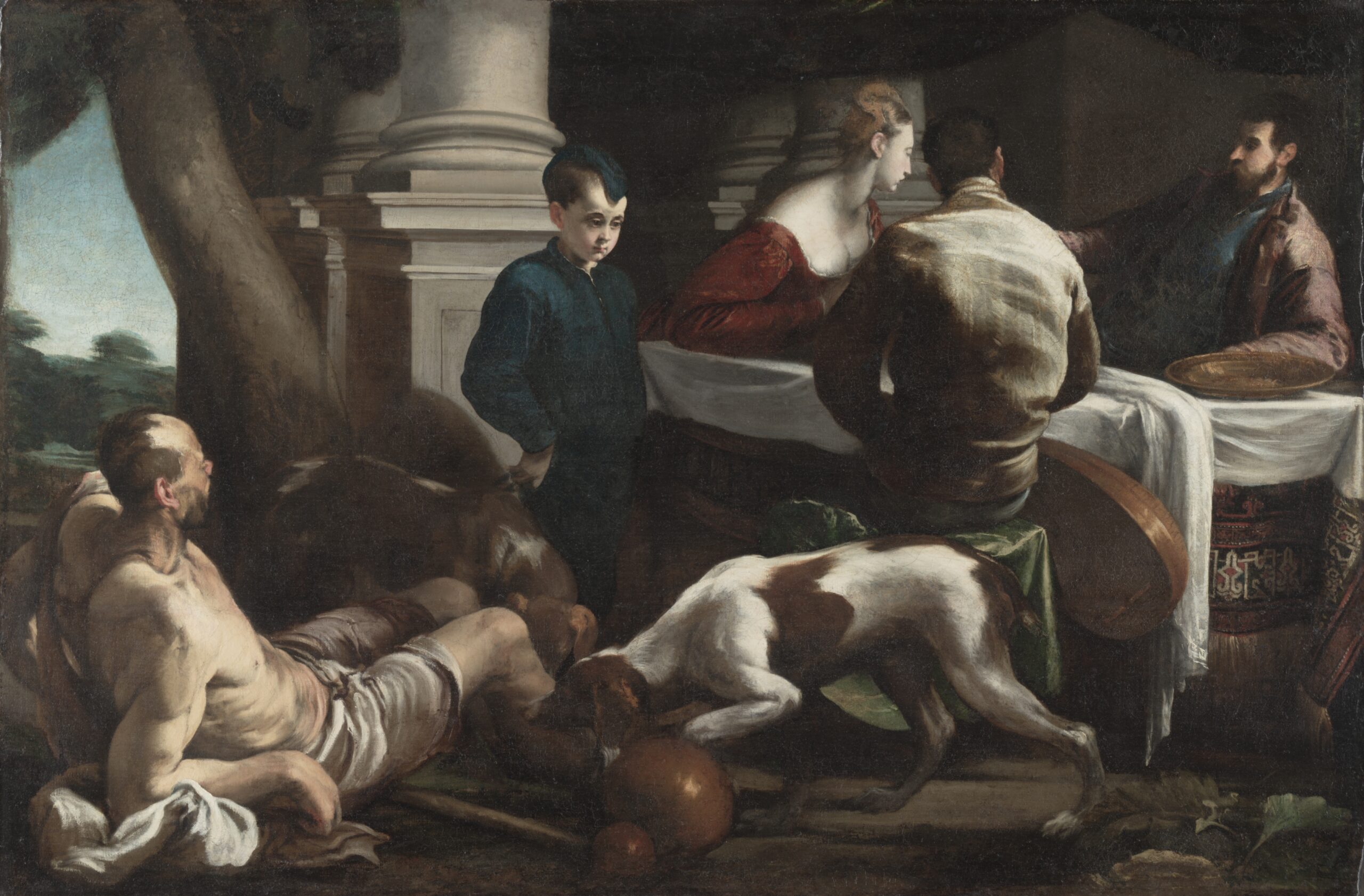
Tradition has given the rich man in this parable the name “Dives,” a Latin word meaning rich. Giving the rich man a name personalizes the story and adds shape to our mental image of this pathetic character.
Jesus surely intended for the Pharisees to recognize themselves in Dives. They too coveted their prestige and may have “feasted sumptuously every day” (Luke 16:19). Lazarus was poor. Indigent. He spent his days at the rich man’s gate longing to be fed. We can see in our imaginations Dives and his buddies as they step over Lazarus at the gate on their way to their feasts: Lazarus laying there, starving and invisible to them, begging with an outstretched hand as “dogs came and licked his sores” (16:21).

As I said, stories allow us to empathize and even identify with their characters, and Lazarus is an especially evocative character. Shamefully, I see myself in Dives every time I see Lazarus, and I’m sure I’m not alone.
We all know how the story ends. Both Dives and Lazarus die; Lazarus rests in the bosom of Abraham while Dives languishes in flames, thirsting in the torments of Hades. Dives begs Abraham for just a drop of water to cool his tongue, and when he is told that isn’t possible, he asks him to send Lazarus to his five brothers to warn them of what awaits them. Isn’t it strange that Dives expects the man he neglected while living to be sent as his messenger? Maybe Jesus is telling us that even the fires of Hades couldn’t purify him of his hubris.
The last few lines of the parable are tragically resigned. Abraham tells Dives that his brothers have Moses and the prophets and they should listen to them, but Dives knows his brothers. They are like him and won’t do that. Foreshadowing his own circumstances, Jesus alludes to his future death and resurrection—and rejection. Abraham tells Dives, “If they do not hear Moses and the prophets, neither will they be convinced if some one should rise from the dead” (Luke 16:31).
We live in hope and are committed to following his teachings.
Christians worship the one who rose from the dead. We live in hope and are committed to following his teachings. But are we convinced by the moral lessons contained in Jesus’s parables, the Beatitudes, and his commandment to love our neighbor as ourselves? At least six times in the New Testament he asks us by word or example to care for the poor; in fact, they are some of his most explicit teachings. Of course, we also have Moses, the prophets, and the example given to us in the early Church, but many of us are still Dives, and Lazarus fills our streets.
From the first major social encyclical, Rerum Novarum, written by Pope Leo XIII in 1891, Catholic social teaching has continued to amplify Jesus’s teachings and draw our attention to the universality of human dignity and the Gospel injunction for both society and individuals to provide for the needs of the poor. Of course, we understand “the poor” both literally and as a metaphor for all those among us who are vulnerable—the disabled and others the corporal works of mercy call us to serve.
In his 1967 social encyclical, Populorum Progressio, Pope St. Paul VI warned of a widening gap between the rich and the poor, linking it to the social unrest that he saw spreading throughout the world. He wrote, “Unless the existing machinery is modified, the disparity between rich and poor nations will increase rather than diminish; the rich nations are progressing with rapid strides while the poor nations move forward at a slow pace” (PP 8).
Recent wealth statistics show us that Paul VI’s concerns have gone unheeded; the “existing machinery” of governments is still not addressing the problem, and the disparity between rich and poor is far more vast. According to the Urban Institute, the wealth gap in the United States has increased dramatically since the 1960s. On average, the bottom 10 percent of Americans went from being $23 in debt in 1963 to having $450 in “wealth” in 2022. However, the top 1 percent’s wealth increased sevenfold during the same period, from $1.8 million to $13.6 million. Those in the middle, the fiftieth percentile, quadrupled their wealth. In the second quarter of 2025, the top 1 percent held about 31 percent of total wealth in the US while the bottom 10 percent essentially had zero, or negative net worth. Globally, the amount of wealth possessed by the top 1 percent increased to 40–45 percent.
Pope Leo XIV recently published his first apostolic exhortation, Dilexi Te, to draw our attention once again to the needs of the poor, and in it he echoes some of the same concerns expressed by Paul VI almost sixty years ago. He describes, once again, “a world where the poor are increasingly numerous” and where “we paradoxically see the growth of a wealthy elite, living in a bubble of comfort and luxury.”

What message could Dives have sent to his brothers that would have convicted them of their neglect of the poor? Could he have convinced them to share their wealth and be attentive to their needs? What message would be powerful enough to shake them from their selfishness and complacency if they would not even be convinced by seeing one rise from the dead? As Leo writes, Jesus was condemning the Pharisees and their “doctrinal rigor without mercy” (DT 48). That seems to be a hypocrisy impervious to change.
Pope Leo tells us that there is an urgency to address the problem. He says: “The dignity of every human person must be respected today, not tomorrow, and the extreme poverty of all those to whom this dignity is denied should constantly weigh upon our consciences” (DT 92). But like Dives, “we have become accustomed to looking the other way, passing by, and ignoring situations until they affect us directly” (DT 105).
There is another parable of Jesus that is a corollary to the parable of the rich man and Lazarus, equally clear in its meaning. Pope Leo calls it “a vivid illustration of the Beatitude of the merciful.” It is the parable of the last judgment, sometimes called the parable of the sheep and the goats (Matt 25:31–46).
This is the parable from which the Church derives what we call the corporal works of mercy: “I was hungry and you gave me food, I was thirsty and you gave me something to drink, I was a stranger and you welcomed me” (Matt 25:35). Almost like the words of Moses to the Israelites as they prepared to enter into the promised land—“I have set before you life and death, blessings and curses” (Deut 30:19)—Jesus presents a choice of salvation or condemnation inseparably linked to care for the poor. He associates himself personally with them by saying, “Truly I tell you, just as you did not do it to one of the least of these, you did not do it to me” (Matt 25:45).
We can look around us and see the deep need for renewal.
As Pope Leo teaches us, “One cannot love God without extending one’s love to the poor” (DT 26). The merciful—those who hear Jesus’s story, take to heart his will for us to care for the poor, and put it into action—will be welcomed by him into eternal life. Those who do not . . .
Pope Leo is “convinced that the preferential choice for the poor is a source of extraordinary renewal both for the Church and for society, if we can only set ourselves free of our self-centeredness and open our ears to their cry” (DT 8). We can look around us and see the deep need for renewal. Maybe this is the time, but it’s up to us.
Stories are powerful ways to convey moral truths, aren’t they?