
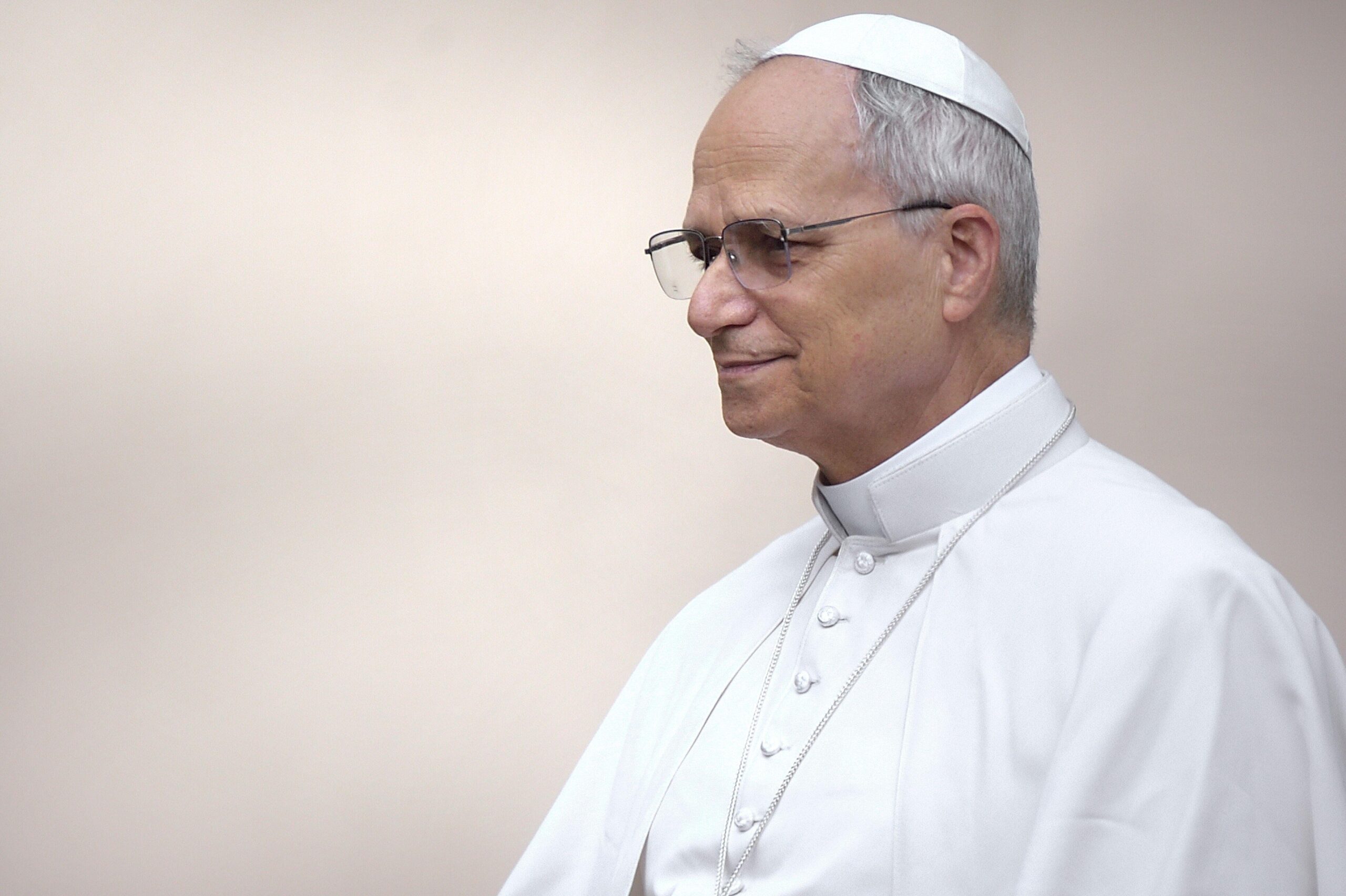
On August 28, 2025, Pope Leo XIV gave an address to a delegation of elected officials and civil personalities from Vale de Marne in the Diocese of Créteil in France. Showing his linguistic skills, the Holy Father gave the address in French. (All translations are my own, except where he quotes from a Church document, which I took from an existing English translation.)
Notably, Pope Leo’s address counters false understandings of the relationship between faith and public life. He notes that the salvation gained through our Lord’s death and resurrection “encompasses all dimensions of human life, such as culture, the economy and work, . . . education, and politics.” He cites the Compendium of the Social Doctrine of the Church, insisting that the theological virtue of charity, which is a gift from God, is “a force capable of inspiring new ways of approaching the problems of today’s world, of profoundly renewing structures, social organizations, [and] legal systems from within” (207).
To counter false secularism, the pope insists that these public figures should bear witness to Christ and their faith. “There is no separation in the personality of a public figure: there is not, on the one side, the political person, and, on the other, the Christian. But there is the political person, who—under the gaze of God and of his conscience—lives, in a Christian manner, his commitments and responsibilities!” He encourages politicians to enhance their comprehension of doctrine, especially social doctrine, and “put it into practice in the exercise of your responsibilities and in the drafting of laws.”
Pope Leo acknowledges that doing so will result in opposition and pressure, including within party politics. Nevertheless, he exhorts them to be courageous, which will require them to remain united to Christ.
“There is not, on the one side, the political person, and, on the other, the Christian. . . . ”
The Holy Father’s brief remarks reflect the teaching of Vatican II with respect to the role of the laity. Lumen Gentium teaches that “the laity, by their very vocation, seek the kingdom of God by engaging in temporal affairs and by ordering them according to the plan of God” (21, emphasis added). The lay faithful are called to “remedy the customs and conditions of the world . . . so that they all may be conformed to the norms of justice and may favor the practice of virtue rather than hinder it” (36).
While this dogmatic constitution on the Church acknowledges a distinction between one’s duties as a member of the Church and as a member of society, it nevertheless insists that “in every temporal affair [the faithful] must be guided by a Christian conscience, since even in secular business there is no human activity which can be withdrawn from God’s dominion” (36). Similarly, Apostolicam Actuositatem says that the laity “exercise the apostolate in fact by their activity directed to the evangelization and sanctification of men and to the penetrating and perfecting of the temporal order through the spirit of the Gospel” (2).
Pope Leo’s comment that the salvation of Christ encompasses all areas of human life, including politics, mirrors that document’s claim that “Christ’s redemptive work . . . includes also the renewal of the whole temporal order” (5). Later, it enumerates elements that comprise the temporal order and includes “the laws of the political community” (7).
Accordingly, like Leo, Lumen Gentium insists that the faith must enter into one’s political life. It clearly warns against “that ominous doctrine which attempts to build a society with no regard whatever for religion, and which attacks and destroys the religious liberty of its citizens, is rightly to be rejected” (36).
The idea that one ought to check one’s faith at the door when entering into the political arena is contrary to Catholic doctrine. So often, as Pope Leo admits, politicians are pressured by their parties to conform to the world or to their “ideological colonizations.” In other words, politicians are tempted to forgo their commitment to authentic virtue for the sake of political expediency. That is why the Holy Father expresses the need to have “the courage to sometimes say, ‘no, I can’t!’ when the truth is at stake.”
“ . . . There is the political person, who—under the gaze of God and of his conscience—lives, in a Christian manner, his commitments and responsibilities!”
Unfortunately, all of us, not just politicians, can fall into the trap of compromising our adherence to Catholic social doctrine when it is at odds with our political party’s attempts to gain power. For example, it would be unpopular within their ranks for a Democrat politician to proudly proclaim that they are fully pro-life. It might be politically disadvantageous for a Catholic government official to rebuke the president’s call for government funding of in vitro fertilization. It takes fortitude to stand up to one’s own party members. But how else can both parties be purified of their deficiencies and errors? (And they both have them!)
I think Pope Leo’s exhortation ought to be heeded. Only when Catholic politicians and citizens put Christ and the social doctrine of the Church ahead of their political allegiances can the laity truly order temporal affairs toward the authentic common good.
As Pope Leo XIV said in his address about the Church’s social doctrine: “Its foundations are fundamentally in accord with human nature, the natural law that all can recognize, even non-Christians, even non-believers. You must therefore not be afraid to propose and defend it with conviction: it is a doctrine of salvation that aims for the good of every human being, the building of peaceful, harmonious, prosperous, and reconciled societies.”
I hope all Catholic public figures—of whatever political affiliation—take Pope Leo’s words to heart and put them into practice.