
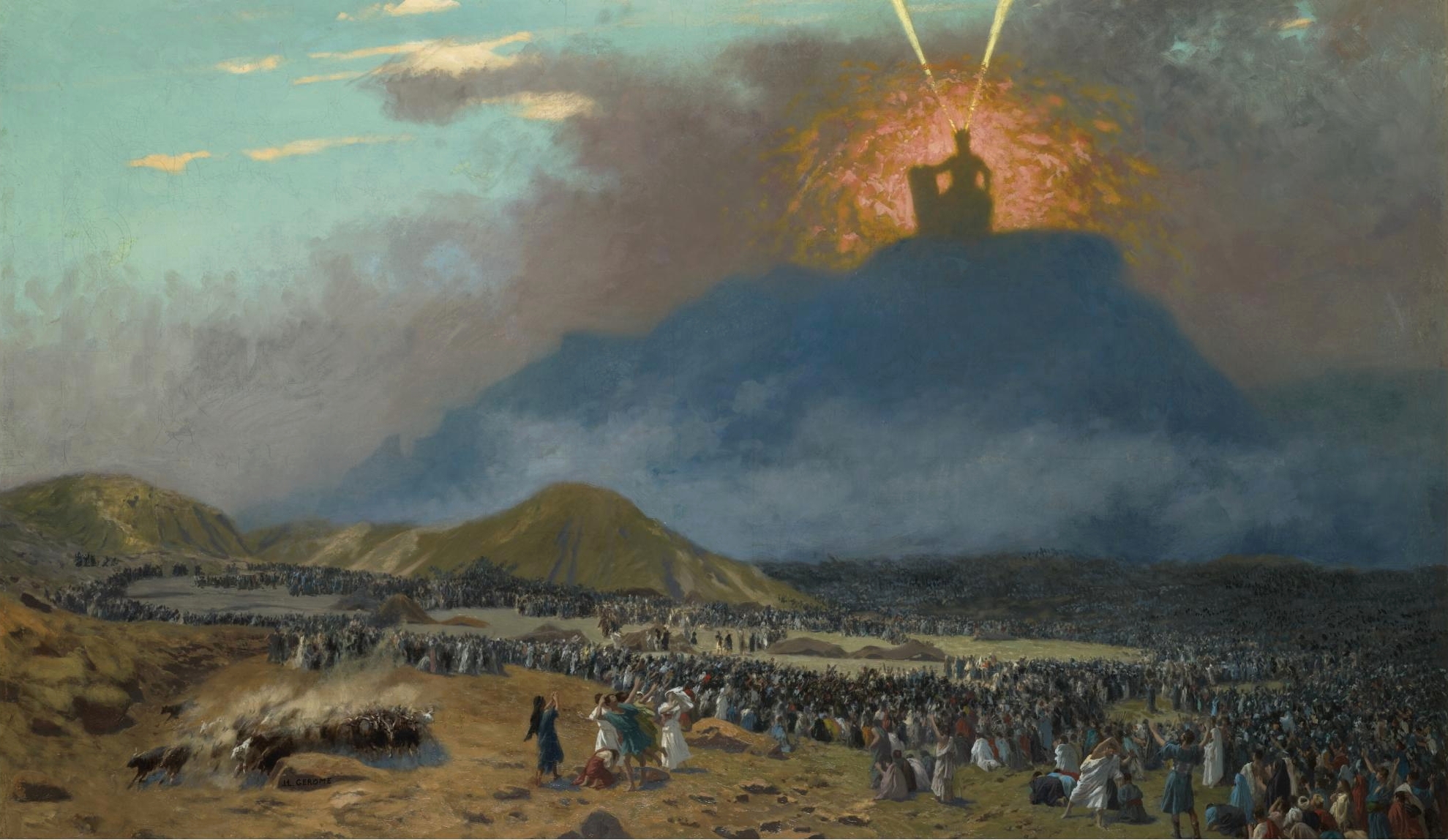
I always feel a bit corny showing the animated film The Prince of Egypt to my college students when we read the book of Exodus. But most of my students have had very little experience with the Bible, and they feel intimidated by it. They always love the film, which loosens them up and makes them interested in the text. They also appreciate the film’s retelling of the exodus story through the lens of freedom, which it presents in a generic enough sense to please an audience that cherishes individual autonomy.
But once they turn to the book of Exodus itself, they’re surprised to see how much license the film takes. The film plays on the Bible’s silence about what it would have been like for Moses to grow up in Pharaoh’s court, depicting him as seemingly unaware that he is adopted. It speculates that Moses would have been like a brother to Ramses, the boy who later becomes pharaoh when God calls Moses to lead Israel out of bondage.
While the Bible leaves the pharaoh an unnamed villain who arrogantly thinks of himself as a semidivine rival to the God of Israel, the movie portrays Ramses as a complicated man; he wants to honor the legacy of his demanding father, Seti, who worried that Ramses would be the family dynasty’s “weak link.” And so when Moses returns from his self-imposed exile, claiming to be sent by God to liberate the Israelites, Ramses fears his father’s criticism will come true if he yields.
Moses hates to hurt Ramses, but he wholeheartedly accepts his divine calling. “Look at your family,” Moses says to his new bride, Zipporah, having just encountered God in the burning bush. “They are free. They have a future. They have hopes and dreams and a promise of a life with dignity. That is what I want for my people. And that is why I must do the task God has given me.” This is Moses’s mission in The Prince of Egypt. The God of Israel detests slavery, and Moses will be his servant to lead Israel to freedom.
My students enjoy throwing red flags over all the ways in which the film bungles Exodus’s plot points and character arcs, but they see no deviation between film and text on the key theme that God hates bondage and aims above all at liberation. And at first glance this might appear to be a straightforward alignment between the core of the biblical story and the adaptation. In a recent homily, for instance, Pope Leo describes the biblical account of the exodus from Egypt as a “journey of liberation, thanks to which a group of divided and oppressed tribes was transformed into a united and free people.”
“The law given by God to his people is not in contrast with their freedom, but on the contrary is the condition for its flourishing.”
Leo’s point, however, is not that God wanted to free Israel for freedom’s sake or that God values freedom as an end in itself. The Prince of Egypt celebrates that vision of freedom. And even though the film’s final scene shows Moses descending Sinai with the Ten Commandments, it clearly means this as an afterthought that takes a backseat to what really matters: the story of liberation.
But Leo reverses that order of priority. God rescues Israel from slavery precisely because God desires to give his people the law. Israel’s journey of liberation reaches its climax not in the passage through the Red Sea but in God’s gracious gift of the Decalogue. And so we have to situate the real meaning of human freedom and flourishing within the drama of salvation history, where God graciously elects Israel and makes a covenant with them through Moses.
“The motivation for the Exodus,” the great Jewish biblical scholar Jon Levenson writes, “actually lies in the special relationship of Israel to God. . . . It is the special status of Israel, son of God, that explains why the Exodus is not,” at least not primarily, “a story of universal liberation.” It is, first of all, the story “of one nation’s release, the release of the first-born son to rejoin and serve his divine father.” The marvelous history of liberation depicted in the Bible therefore serves as a “prologue to a new kind of relationship, one in which [Israel] will show fidelity . . . by acknowledgment of [God’s] grace towards them in the past.”
The people of Israel come better to know and love God by observing his commands. The law, then, is not about legalistically earning God’s favor but about learning to live as God’s beloved children. God wants Israel’s freedom, of course, but as Leo says in his Angelus address corresponding to his homily earlier that day, it is a freedom God wants us to exercise for “a relationship of love with God and with our brothers and sisters.” God reveals himself in Exodus as a God who lives for his covenant partner in loving faithfulness. And through the gift of the law, God calls his people to live together in loving gratitude.
The law does not shackle us to rigorous and draconian obligations. It is “anything but a stern and impersonal taskmaster,” Levenson writes. Rather, it is the “vehicle and sign” of a people’s response to a friendship God initiated. “For this reason,” Leo explains, “Jesus says that he did not come to abolish the Law, but to bring it to fulfillment.” Jesus manifests most fully that the God of Israel is God-with-us, and in the Sermon on the Mount he teaches that the “full sense of God’s law” is to live radically as creatures made for God and for one another.
This calling also does not come to us as a foreign or external demand. It accords with our deepest identity as God’s creatures. Pope Benedict XVI observes in his lovely little book on Genesis, In the Beginning, that the repetition of “God said” ten times in Genesis 1 deliberately foreshadows and evokes the Ten Commandments, suggesting that creation finds its completion in the Decalogue. And more specifically, God rests on the seventh day to indicate that all creation bears a “Sabbath structure.” The Law does not, therefore, impose itself as an external standard but as the inner form of our fulfillment as creatures. Creation is ordered toward the Sabbath, toward rest in God.
The exodus narrative, therefore, does have human freedom at its heart, but it is a freedom that must pass through the law, not around it. As Benedict writes, the law calls us to go “forth into a world in which there will no longer be slaves and masters but only free children of God—into a world in which humans and animals and the earth itself will share together as kin in God’s peace and freedom.” And likewise, Leo explains that “the law given by God to his people is not in contrast with their freedom, but on the contrary is the condition for its flourishing.”
Modern life constantly presents us with the temptation to think that nothing matters more than our individual autonomy and that our dignity lies in our power to choose whatever seems best to us. We long for a “life without limits,” where we imagine that freedom means an absence of constraints rather than the capacity to love. This really is “the ancient dilemma,” Leo says in another homily. “Can I realize my life to the full by saying ‘yes’ to God? Or, in order to be free and happy, must I liberate myself from Him?” We find the answer by looking to Christ, who reveals to us the true meaning of humanity. Leo looks to Christ’s temptation by Satan in the wilderness and writes that there we see how “the new man, the free man, the epiphany of freedom . . . is realized by saying ‘yes’ to God.”
It’s for this reason that Leo often points us to Mary and to “her total ‘yes’ to the Lord.” This posture of obedience embarrasses the modern audience (and The Prince of Egypt). But as Leo attests, we find our true freedom by living with the grain of who God made us to be. And what this means is that real freedom comes not when we run away from God and assert our power of choice whichever way we want. It comes when we submit our will to God’s, expressing our gratitude by loving him with all our heart and loving our neighbors as ourselves.