
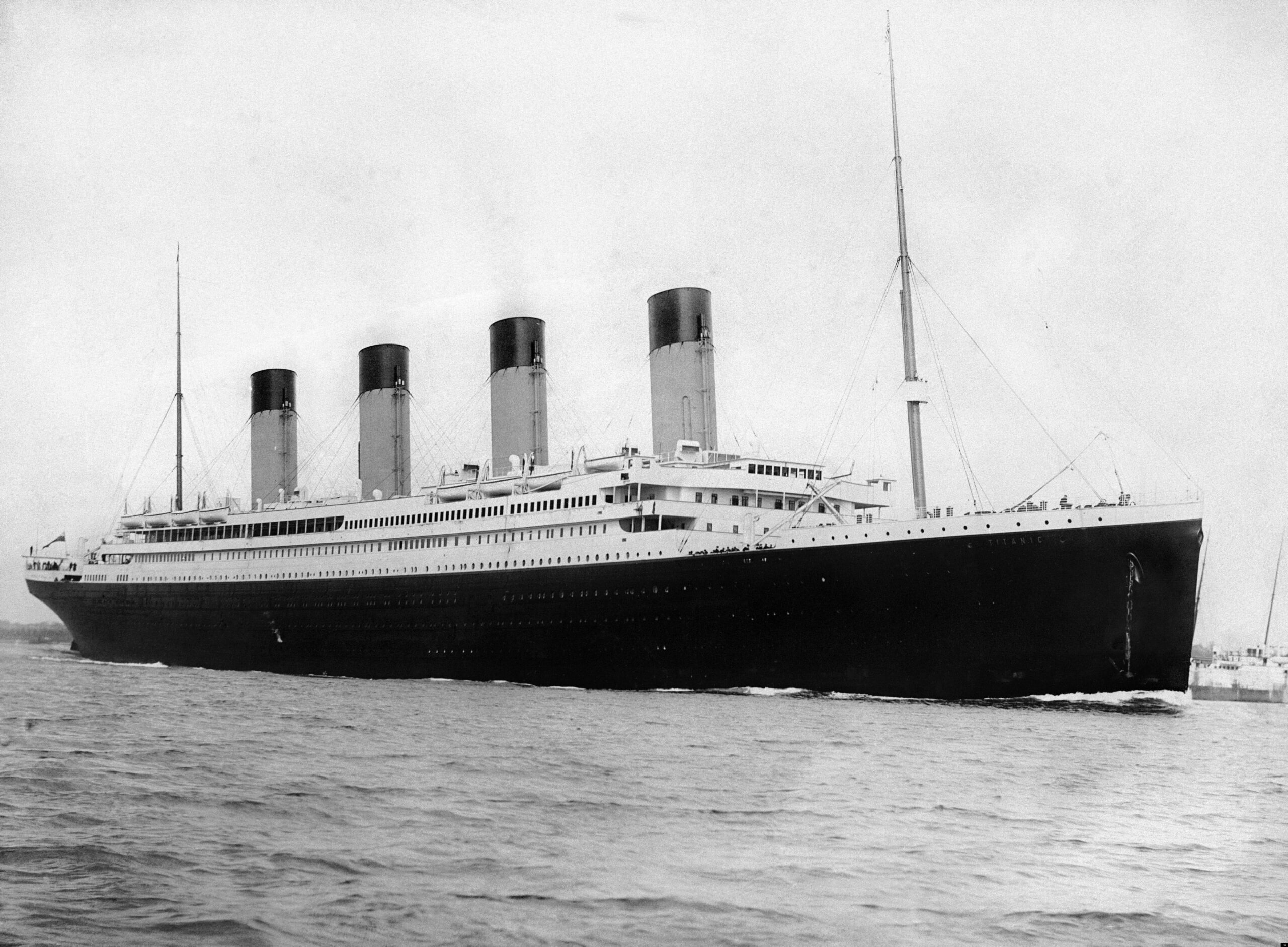
As the lights of the RMS Titanic flickered and the great ship tilted toward the freezing Atlantic, panic spread across its decks. Wealth and status suddenly meant nothing. Lifeboats were few. Time was running out. In the chaos, one figure moved calmly against the tide—not toward safety but toward the frightened, the poor, and the forgotten.
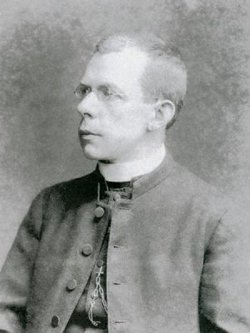
That man was Fr. Thomas Byles, a Catholic priest who chose to remain behind.
While others searched desperately for a way to live, Fr. Byles knelt to pray. He gave absolution and led the Rosary as the ship went down. When offered chances to escape, he refused them. In those final moments, the deck of a sinking ship became his parish and the dying, his flock.
More than a tragic hero of the sinking of the Titanic, Fr. Byles revealed something far greater: the face of the good shepherd, who does not abandon his people.
On the night of April 14, 1912, as the ship slipped beneath the icy waters, a quiet heroism unfolded on its decks—one not marked by panic but by prayer. More than a tragic footnote in history, Fr. Byles offers the Church today a compelling and credible candidate for canonization.
Roussel Davids Byles (he took the name Thomas only upon his conversion to Catholicism in 1894) was born in 1870 in Headingley, Leeds, England, and was baptized in Headingley Hill Congregational Church. As a boy, he attended Leeds Grammar School until the family moved to Royal Leamington Spa. There, one local newspaper recalled that he “earned a reputation for high spirits and juvenile audacity which was not always appreciated, he was known as a mischievous boy and the terror of the square.”
As an intelligent young man, he studied in Oxford: mathematics, modern history, and then theology. It was in Oxford that he started to move away from the Congregational Church of his family and was confirmed in the Anglican Church.
His beloved brother William converted to the Catholic Church, which almost certainly inspired him to be received into the Catholic Church himself. Two days before the Feast of Corpus Christi, we know from his diaries that after some period of meditation the “fog had cleared.” On May 23, 1894, on the Feast of Corpus Christi, he was received into the Catholic Church by Fr. Joseph Martin, SJ, at St. Aloysius, the Jesuit church in Oxford, taking the confirmation name Thomas after St. Thomas Aquinas.
In an age often marked by self-preservation, his witness cuts through with evangelical clarity: Love is proven in action and ultimately in sacrifice.
When he wrote to his parents informing them of his conversion, his father replied, “Your letter has come to us as a painful shock. . . . My prayer for you today is that of my Lord ‘father forgive him but he knows not what he does!!’”
In 1894, Thomas tried his vocation with the Jesuits but was told he could not enter on account of his health. It is in a letter to his brother that Thomas admits that he had been experiencing fits of one sort or another.
During the summer of 1895, Thomas offered himself as a candidate for the priesthood to Cardinal Vaughan, archbishop of Westminster. He was accepted and studied at Oscott College but found the Birmingham weather too harsh and his health once again failed him.
He took up residence at Saint Edmund’s College, Ware, as a tutor and librarian. Once his health returned in 1899, Thomas entered the Beda College in Rome for the Archdiocese of Westminster and was later ordained in Rome on June 15, 1902.
Fr. Thomas was invited by Cardinal Vaughan to evangelize the rural parts of the diocese in Hertfordshire and Essex. Fr. Thomas’s frail health continued to plague him, and in June 1905, he was appointed as rector of St. Helen’s in Ongar, where he, though “small in stature and physically frail . . . proved himself a diligent pastor.”
Known as a devoted parish priest, he was, according to the Epping Gazette, “very popular and highly esteemed by the members of the community in his district. He is devoted to the flock and there has been a largely increased attendance of the services since he came to Ongar.”
His life before the Titanic was not marked by dramatic gestures but by fidelity—the daily, hidden holiness that the Church has always recognized as the seedbed of sanctity.
Fr. Thomas’s brother William, who was living in New York, invited him to officiate at his wedding at St. Augustine’s Church in Brooklyn on April 21, so the local Catholic community in Ongar raised money for Fr. Thomas to travel to New York on the Titanic.
Fr. Byles boarded the RMS Titanic as a second-class passenger, and on the morning of April 14, he celebrated Mass for both second- and third-class passengers, preaching on prayer and the need for “spiritual lifeboats” in times of crisis—providential words, given what would unfold that very night.
When the ship struck the iceberg, Fr. Byles did not seek safety. Miss Agnes McCoy, who left by lifeboat no. 16, told The Irish World in New York, “I saw Father Byles reading out of a book when the ship hit the iceberg, then I saw him put the book in his pocket and hurry around to help women into the boats. We were among the first to get away and I didn’t see him anymore.”
He and another Catholic priest, the Benedictine Fr. Josef Peruschitz, went among the passengers, particularly the poor and the immigrants in steerage. An eyewitness reported,
When the catastrophe began he was immediately at hand to help as much as possible. In the beginning some hadn’t grasped the danger but when it came nearer and the excitement turned to horror all demanded support of the priests with great fervour and Father Byles soon was in demand and absolved the many Catholics. His calm self control also spread to others . . . standing on the stairway he called for silence, briefly explained to the people the danger they were in and calling upon them all to make an act of contrition, pronounced the words of absolution.
Another reported,
We are told that there were vacant places for him to leave on the lifeboat, but he twice deliberately refused to occupy them, saying that he would not leave the ship until everyone was safe. He then returned to the steerage and recited prayers. In his final moments, he led a group in the rosary when the water came washing over the deck.
One eyewitness wrote,
After I got in the boat I could hear distantly the voice of the priest and the response to his prayers. Then they became fainter and fainter until I could only hear the strains of the hymn “Nearer, My God, to thee.”
William, on hearing of the sinking of the ship, first thought his brother may have survived, as the offices of the White Star Line informed him that all the passengers had been transferred to other vessels.
However, in an interview with the Brooklyn Daily Eagle, he said,
My brother was a priest and I cannot see if it was true that hundreds drowned when the Titanic went down, how he could have been saved. It was his duty as a priest to stay the last. He knew his duty. He must have gone down.
When William finally had confirmation that his brother had indeed died a hero on the Titanic, he made it his task to seek from the survivors eyewitness accounts of his brother’s heroism.
William was married in Brooklyn, New York, on April 21, 1912. Due to the tragedy, the wedding was changed to a private ceremony at St. Paul’s Church, officiated by Rev. William McGinnis. William Byles and his new wife changed into mourning clothes after the service and attended a memorial Mass for Fr. Byles.
The couple traveled to Rome later that same year to seek an audience with the pope: They were granted a private audience with Pope Pius X, who comforted the couple in their grief and said that Fr. Thomas Byles was a “martyr for the Church.”
Here is the heart of the case for canonization: Fr. Byles did not simply die a tragic death; he freely chose to remain with those entrusted to him. In doing so, he embodied the words of Christ: “The good shepherd lays down his life for the sheep” (John 10:11).
The Church has long recognized a category of sanctity known as the “martyr of charity”—those who lay down their lives not under persecution for the faith but out of heroic love. The most famous modern example is Maximilian Kolbe, who gave his life in Auschwitz in place of another prisoner. Fr. Byles stands firmly within this tradition.
Holiness is not abstract. It is concrete, lived, and often revealed in moments of crisis.
He had opportunities to save himself. He chose not to. His death was not accidental but intentional—a priestly offering united to Christ’s own sacrifice. In an age often marked by self-preservation, his witness cuts through with evangelical clarity: Love is proven in action and ultimately in sacrifice.
Canonization is not merely about honoring the past; it is about presenting models for the present. Fr. Byles speaks powerfully to several needs of the modern Church.
First, he reminds priests of their identity as shepherds. In a time when the priesthood is often misunderstood or diminished, his example reclaims its core: to stand with one’s people, especially in moments of fear and death.
Second, he offers a vision of solidarity with the poor and the marginalized. On the Titanic, class divisions were stark. Fr. Byles chose to remain not with the privileged but with those most at risk—echoing Christ’s own preferential love.
Third, he provides a witness to hope in the face of death. The image of a priest praying the Rosary as chaos unfolds is profoundly countercultural. It proclaims that even in catastrophe, faith does not collapse; it becomes more luminous.
While popular devotion to Fr. Byles has grown quietly rather than explosively, this should not be mistaken for insignificance. Many saints, particularly those of heroic charity, have emerged over time as the Church discerns their witness more deeply.
To canonize Fr. Thomas Byles would affirm something in urgent need of recognition today: Holiness is not abstract. It is concrete, lived, and often revealed in moments of crisis. His canonization would shine a light on the dignity of priestly ministry, the power of the sacraments, and the call to self-giving love. It would also reclaim a narrative from one of history’s most famous disasters. The story of the Titanic is often told as one of human pride and tragic loss. But within it lies a story of grace—a priest who transformed a sinking ship into a place of prayer, a kind of floating chapel in its final hours.
Fr. Thomas Byles did not perform miracles in the conventional sense. But perhaps the greater miracle is this: In the face of terror, he remained faithful; in the presence of death, he proclaimed life; and in the moment of decision, he chose love.
Canonization would not exaggerate his story—it would simply recognize it for what it already is: a life conformed to Christ, a death offered in charity, and a witness the Church can ill afford to overlook. In remembering Fr. Byles, we are reminded that sanctity is not reserved for the extraordinary few. It is forged in the ordinary priest who, when the moment comes, chooses to stay.