
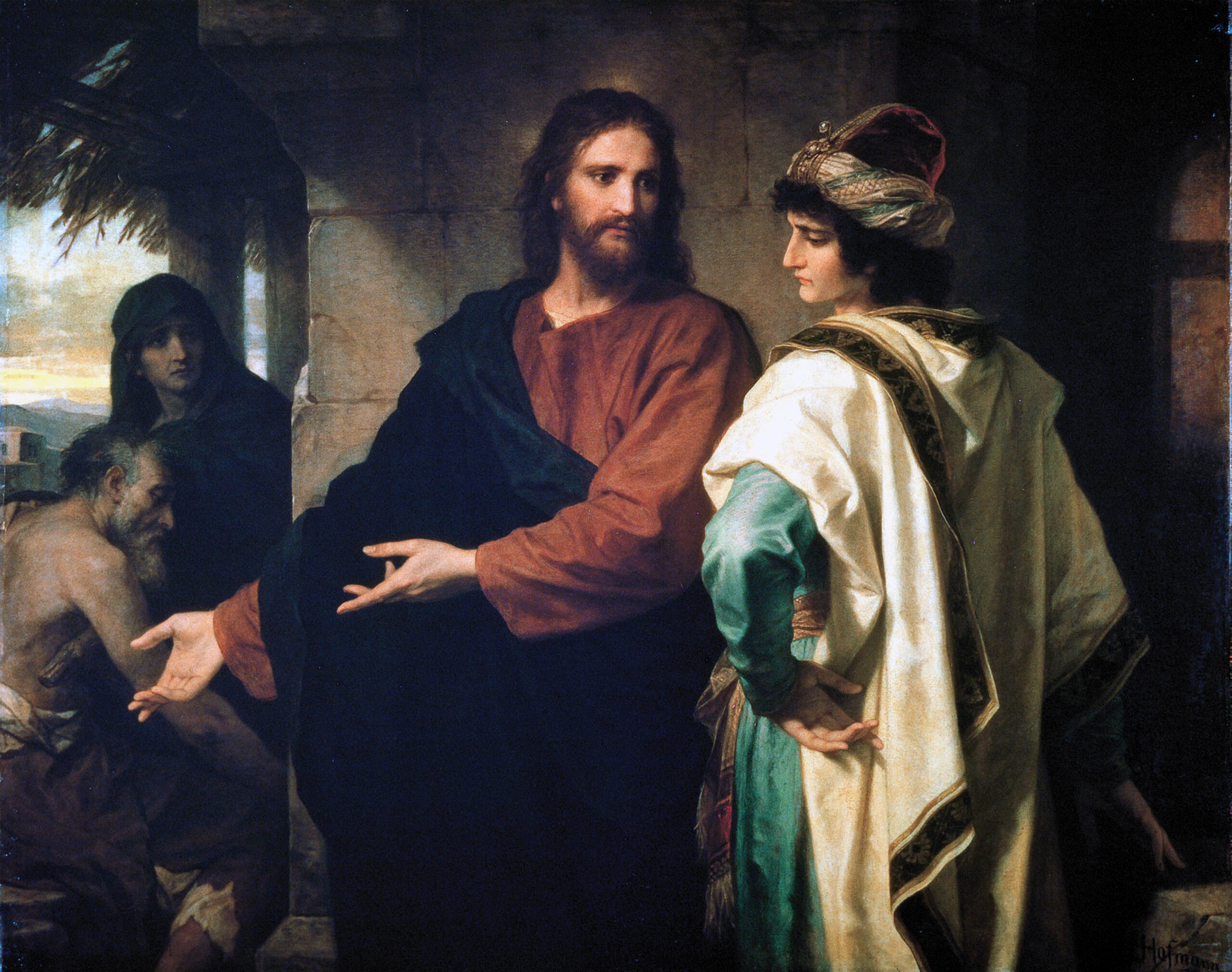
I always find Jesus’s encounter with the “rich young ruler” in the Synoptic Gospels to be one of the saddest episodes of Christ’s itinerant ministry (Luke 18:18–30; Matthew 19:16–30; Mark 10:17–31). It’s also where we see Jesus as a teacher most like Socrates, revealing more by what he doesn’t say than what he does. The rich young man approaches Jesus and asks, “Good teacher, what must I do to inherit eternal life?” After what seems like an enigmatic reply—“Why do you call me good? No one is good except God”—Jesus questions him about his faithfulness to the commandments and rattles off a partial list: “You shall not commit adultery; You shall not murder; You shall not steal; You shall not bear false witness; Honor your father and mother” (Luke 18:19–20).
The young man regards himself as a decent enough person and declares with confidence he has kept these commandments since he was a boy. He doesn’t seem to notice or care that Jesus offered a very selective list that omitted the commandments about the love of God and the final commandments not to covet. But Jesus leaves them out precisely because he wants this man to notice them and to examine himself before them. The stakes become clear that he must choose between God and his idolatrous love of wealth. The Lord implies to this man that if he really understood who Jesus was when he called him “good teacher”—that he is Goodness itself, Goodness for him—then he would drop everything to become his follower.
Jesus doesn’t tell Zaccheus that half his possessions is a half-hearted response.
We never know what happens to this character, and the irresolution invites us as readers to our own self-examination. But one chapter later in Luke’s Gospel, we get a bookend to the story when we meet Zaccheus, also a rich man, who announces to Jesus that he will give away half of his possessions to the poor (Luke 19:1–10). Jesus doesn’t tell Zaccheus that half his possessions is a half-hearted response. Rather, he rejoices and proclaims that Zaccheus has found salvation. Jesus seems unconcerned about the sum itself, keen instead to know where Zaccheus has set his heart.
Again and again in his recent homilies and in Dilexi Te, Pope Leo XIV has followed Jesus’s concern that we can easily place wealth on the pedestal of our highest good. When Jesus says in Luke 16:13, “You cannot serve God and mammon,” Leo hears him asking us to choose “where to place our heart.” Jesus knows that we are needy creatures and “that our lives are full of necessities.” This neediness belongs to our good nature. But Leo warns that it can also drive us to mistake the right order of love when we come to believe that “without God we could still live well” and that wealth will satisfy our deepest longing.
While Dilexi Te at times seems to depict the material condition of poverty as almost sacramental (cf. 79, 103, 104, 110), Leo makes clear in his homilies that poverty bears a special privilege because it reminds us that God alone can give us rest. And it presents to the rich and poor alike, in a way few other things can, the vivid choice between virtue and idolatry: “In the face of hardship, we feel threatened,” he says. And yet “instead of asking for help with trust and sharing fraternally with others, we are tempted to calculate, to hoard, to become suspicious and distrustful.”
Over the past twenty years, social scientists have corroborated this Christian conviction that a disordered love of material goods diminishes the person. Study after study demonstrates that when an increase in income lifts a person or household out of financial insecurity, it brings a corresponding increase in happiness. But beyond a roughly middle-class threshold, while money can still play a part in a person’s well being, it will do so only if the person refrains from excessive attachment to it. It’s not money that makes a person happy, but money’s ability to help support things like family life, religious institutions, charitable causes, and so on.
Meanwhile, therapist Clay Cockrell finds rampant among his most wealthy clientele the distrust and suspicion Leo describes. “Ultra-high net worth individuals,” as Cockrell calls them, approach even the most intimate relationships with chronic apprehension. They find it easy to doubt other people’s motives, constantly wary that this or that person harbors some manipulative scheme toward them. And because these people live in very elite social silos, they often unwittingly cultivate a moral numbness to the plight of the poor. They struggle with “the toxicity of excess, isolation, and deep mistrust.”
To cling idolatrously to wealth, in other words, distorts our humanity. It dulls our conscience and robs us of compassion. As Leo says about the rich man who ignores poor Lazarus, he is “nameless because he has lost himself by forgetting his neighbor. He is lost in the thoughts of his heart: full of things and empty of love.” While he possessed “such great riches,” Leo says, quoting St. Gregory the Great, this nameless man “had become impoverished within” (Dilexi Te 109). Leo describes this impoverishment in Augustinian terms as a turning inward on ourselves that divides us within and “separate[s] us from reality.”
God’s being, in other words, is a being for us, and God constitutes us in his image to find our fulfillment in being for God.
Because reality at its deepest level is God’s yes in Jesus Christ to his good creation and, above all, to us as his human covenant partners. God’s being, in other words, is a being for us, and God constitutes us in his image to find our fulfillment in being for God. In his homilies, Leo is quite clear that it is in and through God’s grace, above all in the Eucharist, that we say yes to God and receive our nourishment as pilgrims in this wounded world. It is only through this grace, Leo explains, that we find the strength to “abandon ourselves without hesitation to the adventure [God] offers,” and empty ourselves of “the things and ideas to which we are attached.”
Otherwise, we will respond with a self-defeating no, acting like our wealth can sustain us, turning our neighbor from a brother or sister into a dubious someone who competes with us in the world’s zero-sum game. The grace of God, by contrast, enriches and enlarges us, making us “an image of Christ” free from the “logic of calculation and self-interest” and open to the logic of love, the only true foundation for our pursuit of the common good (Dilexi Te 27).
That the things we love order how we navigate our lives is for Augustine a basic fact about human nature. “Wherever I go,” he writes, “my love is what brings me there” (Confessions, 13.9). But in this sense, love is a bit like cholesterol: We can’t get rid of it, and it can be either healthy or deadly. Pope Leo understands wealth in this Augustinian sense, as a potentially potent rival to the love and trust we should give above all to God.
He summarizes a beautiful passage from book 10 of Confessions where Augustine describes God’s presence as “a light not bound by space, a voice that never faces, food that is not lessened by eating, and a hunger which is never satisfied.” These words, Leo concludes, “reveal the longing for infinity” that dwells in every human heart, a longing that God alone can fulfill. And we bear witness to the fullness we have found in him when we “offer the gifts we have received to our brothers and sisters with a chaste heart, striving to love everyone with respect and generosity.”