
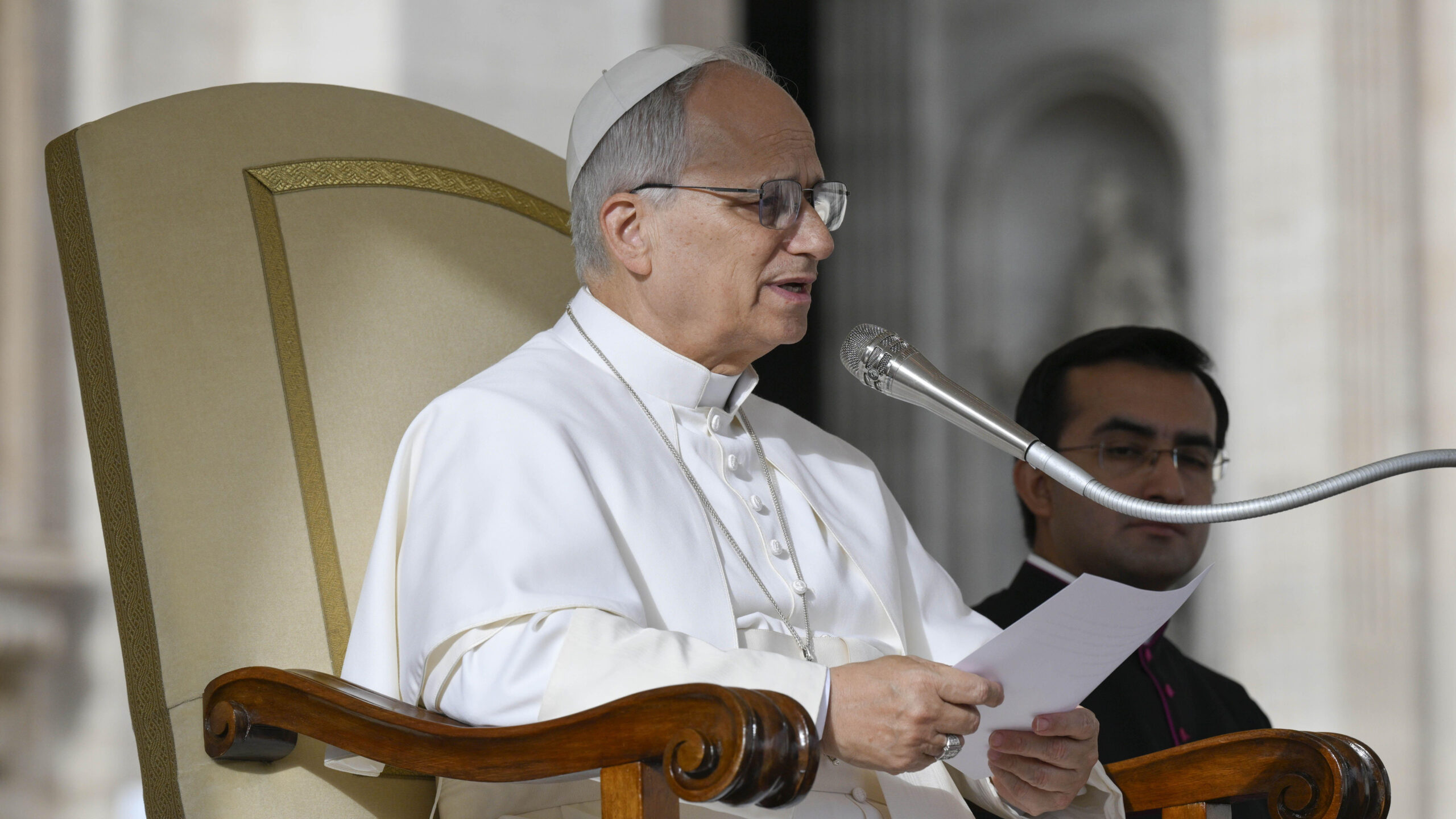
Pope Leo XIV condemned usury in an address to members of the National Anti-Usury Council on October 18, 2025. When I first saw the headlines regarding the pope’s statements, I was thrilled! For a long time, I have thought that usury has been woefully undertreated in the Church and in the world. Since I am not an economist or moral theologian, it is not a topic I regularly get exposed to on an academic level, but existentially I can see the havoc that usury causes in people’s lives.
Now, this is not to say that there has been no treatment of usury in recent years. Pope Benedict XVI’s 2009 encyclical, Caritas in Veritate, speaks against it. Therein, he writes about “these days when financial difficulties can become severe for many of the more vulnerable sectors of the population, who should be protected from the risk of usury and from despair,” adding that “the weakest members of society should be helped to defend themselves against usury” (65). Before this, Pope Benedict had already decried usury in two general audiences in 2005. On November 2, 2005, he spoke of “the shame of usury which destroys the lives of the poor.” Just three weeks later, on November 23, 2005, he again spoke of the “deplorable social scourge of usury.” For his part, Pope Francis mentioned usury on at least four occasions between 2021 and 2024, including in a general audience (April 3, 2024), but never—that I’m aware of—in a major doctrinal document.
Usury is also mentioned in the Catechism and in the Compendium of the Social Doctrine of the Church. In the former, it alludes to usury in the section on murder: “Those whose usurious and avaricious dealings lead to the hunger and death of their brethren in the human family indirectly commit homicide, which is imputable to them” (2269). The latter, before quoting this passage from the Catechism, states, “Although the quest for equitable profit is acceptable in economic and financial activity, recourse to usury is to be morally condemned” (341).
Pope Leo XIV’s remarks are most welcome, especially since he discusses it at greater length than most recent treatments.
Despite these brief statements about usury, it has not come to the forefront of the Church’s consciousness and certainly is not treated much in broader society. Hence, Pope Leo XIV’s remarks are most welcome, especially since he discusses it at greater length than most recent treatments.
In his recent address, Pope Leo states that “the phenomenon of usury points to the corruption of the human heart.” He even goes so far as to consider it sufficient matter to constitute a mortal sin. “It is a grave sin,” he says, “at times very grave, because it cannot be reduced to a mere accounting issue; usury can bring crisis to families, it can wear down the mind and heart to the point of leading people to think of suicide as the only way out.”
Furthermore, Pope Leo points out that usury can appear—insincerely—to be motivated by a desire to assist those in need. “There is a form of usury that apparently seems to want to help those in financial difficulty, but which soon reveals itself for what it is: a suffocating burden.” Sometimes, even hardworking people are met with “unexpected expenses beyond their means or those of their families. What first presents itself as a helping hand in reality becomes, in the long run, a torment.” Later, he laments an all-too-common reality: “When the pursuit of profit prevails, others are no longer people, they no longer have a face, they are just objects to be exploited; and so we end up losing ourselves and our souls.” There are people who get rich by charging high interest for loans to those in dire straits. They take advantage of people’s misfortune as an opportunity to climb the economic ladder, while putting the poor in an even deeper monetary deficit that they might never be able to climb out of.
Pope Leo points out, however, that usury can be committed not only against individuals or families but whole societies or countries. “Unfortunately, usurious financial systems can bring entire peoples to their knees,” he acknowledges.
In a remarkable turn of phrase, Pope Leo—at one and the same time—is able to call out the sinfulness of usury and call for love of enemies. In a paragraph using the conversion of Zacchaeus the tax collector as a good example, Pope Leo states, “The conversion of those who engage in usury is just as important as closeness to those who suffer from usury.”

For more on this topic of usury, see the 2024 E&C Online article by Michael Humpherys. Also consider spreading this message of our Holy Father by sharing it and articles about it with others.
Personally, I am encouraged by Pope Leo’s attention to this grave issue. In the future, I would like to see more specific treatments of what does and does not constitute usury as well as directives aimed at financial institutions. In the meantime, given the fact that he took his papal name after the father of modern catholic social doctrine (Pope Leo XIII), one can hope that Leo XIV will continue to beat this underutilized anti-usury drum.