
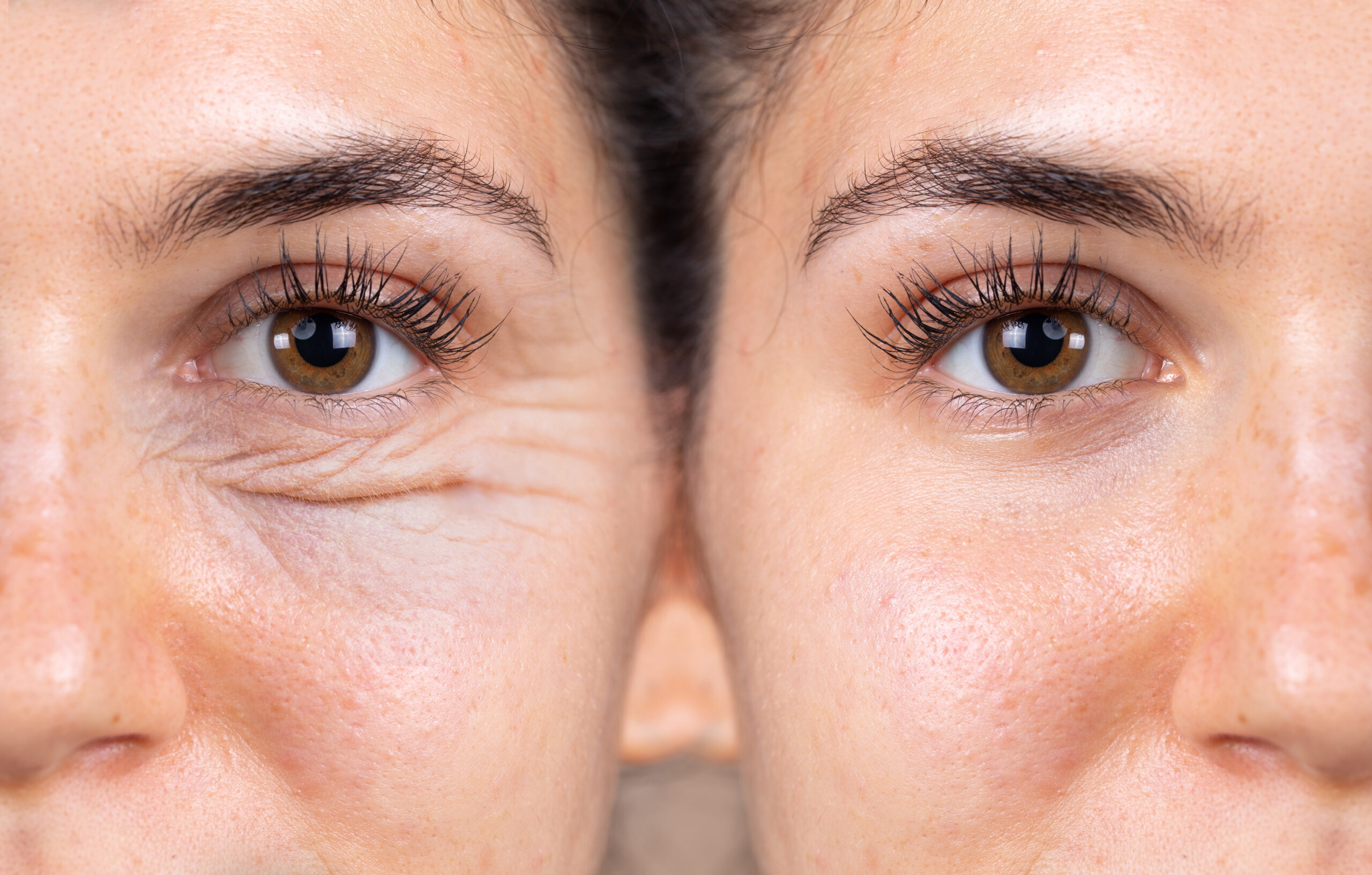
Last year, actress Jamie Lee Curtis made headlines when she decried “the genocide of a generation of women by the cosmeceutical industrial complex, who’ve disfigured themselves.” Sporting short gray hair and seemingly one of the few women in Hollywood to reject serious cosmetic manipulation, Curtis was emphatic in her (arguably incendiary) word choice:
I’ve used that word for a long time and I use it specifically because it’s a strong word. I believe that we have wiped out a generation or two of natural human [appearance]. The concept that you can alter the way you look through chemicals, surgical procedures, fillers—there’s a disfigurement of generations of predominantly women who are altering their appearances. And it is aided and abetted by AI, because now the filter face is what people want.
Is the filter face really what people want, outside of the Los Angeles bubble? The answer might be more complicated than a simple yes or no. In the first part of this article, I noted how the International Theological Commission’s recent document, Quo Vadis, Humanitas?, warned of a “‘cult of the body’, which tends towards a frantic search for a perfect figure that is always fit, young and beautiful.” It turns out that while worshippers in the “cult of the body” may be on display as they walk the red carpet, the rest of us aren’t as far removed as we might think.
Claire Swinarski, who writes the Letters from a Catholic Feminist newsletter, observed, “It’s becoming more and more normal for all women, including Catholics, to do whatever it takes to snatch the jawline and cinch the waist.” At age thirty-three, she said, “It’s surprising to me just how many of my friends have already jumped headfirst into the botox pool.”
She’s not alone in her concern. Gen Z Christian writer Jenna Mindel is worried for her generation, and the next: “Gen Z girls treat wrinkles like they are a disease. And Gen Alpha is following suit, hence the Sephora Kids. Tweens, teenagers and young adults are obsessed with daily sunscreen application, not using straws (I am serious) and having a 9-step skincare routine dialed in before their brain is done developing.”
And while your average Catholic woman may not be responsible for encouraging teenagers to worry about wrinkles, this cultural situation is one worth wrestling with because our personal discernment doesn’t happen in a vacuum. The Church issues no objective moral statements about the use of something neutral like facial moisturizer. Instead, we are left to form our consciences properly through knowing the general moral principles that must guide our actions (addressed in the first part of this article) and through practicing the virtue of prudence, which the Catechism of the Catholic Church says “immediately guides the judgment of conscience. . . . With the help of this virtue we apply moral principles to particular cases without error and overcome doubts about the good to achieve and the evil to avoid” (CCC 1806).
The attraction of adult women to looking as young as possible may have seriously problematic origins.
Each individual is invited to use the virtue of prudence “to discern our true good in every circumstance and to choose the right means of achieving it.” The challenge is, due to the uniqueness of each person’s circumstances, disposition, gifts, difficulties, and a host of other individuating factors, different persons may prudently choose different goods—and all be acting in a truly good way, in accord with their conscience. That is to say, while there are certainly many objectively bad moral actions (mutilation of the body, for example) in which no one may engage, there are also many subjectively good actions, in which the goodness of the action depends primarily on the person’s intention and circumstances because the thing itself is neutral. Two women can both use the same facial serum for vastly different reasons, for example, and each must examine her own action without issuing a blanket moral statement intended to apply to all.
Author Elizabeth Oldfield has done just that, letting readers peek into her own discernment, in which she considers the weight of popular culture and the subconscious pressure it may have been putting on her. After encountering an eight-year-old shopping at the beauty counter, Oldfield began to wonder about her own habitual use of beauty creams and serums. Where did the obsession with youth come from? Certainly it’s always been common to associate youth with fertility and therefore desireability, but the attraction of adult women to looking as young as possible may have seriously problematic origins.
With the release of the Epstein files, Oldfield had to face an uncomfortable truth: The disordered sexual desires behind the atrocities found in those files may have formed the imaginations of an entire generation of women who came of age in the early 2000s, with its beauty standards of extreme skinniness and child-like figures.
Like many women around my age, watching the Epstein tragedy unfold, I recognised myself in these girls. The spaghetti strap tops, and tight jumpers and short skirts, the pigtails. I was clubbing from 14, wearing those exact clothes, off my face on Malibu and lemonade, grabbed and touched and shoved and kissed and now I write it I realise the right phrase here is assaulted, by older men who thought they were entitled to my body.
Even the rise in popularity of the Brazilian bikini wax seemed to sexualize what is normal for a child’s body. A BBC article notes, “The early ’90s had seen a boom in online porn, which increasingly featured hairless actors and models.”
It turns out that the child-obsessed “babydoll” fashion can be traced back to the 1960s, with no fewer problematic associations. In her book The Lost Art of Dress, historian Linda Przybyszewski explains how UK designer Mary Quant brought the look to the US in 1967:
Her babydoll dresses came in pale pink, baby blue, and peach, and her models emphasized “the little kid look” by sucking their thumbs and walking pigeon-toed. She [Quant] explained happily, “There was a time when every girl under twenty yearned to look like an experienced, sophisticated thirty. . . . Suddenly every girl with a hope of getting away with it is aiming to look not only under voting age but under the age of consent.” Looking back decades later, Quant’s husband mused, “I think there was a slightly sort of pedophile thing about it, wasn’t there?”
How much of that disorder has shaped our own approach to beauty? How many of us have been marinating in a culture whose vision of beauty has, in some ways at least, been formed by pederasty and pedophilia?

On the one hand, these questions might seem extreme. Surely the average facial serum user has no desire to disfigure her face into looking like it’s gone through an AI filter, nor any disordered longing to look like a hypersexualized child. A visit to the drugstore makeup counter is a far cry from a trip to Epstein island.
On the other, we do have a duty to consider how our actions affect others. While no single woman can be solely responsible for shaping the zeitgeist, one individual has the power to influence the real people in her real life, just as taken together, one generation has the power to bear witness to the next. Do we factor this into our own individual approach to beauty and aging?
As Brooke Anderson, a Los Angeles–based journalist, wrote:
The notion that stress, experience lines, and the exercise your brow gets from developing mirroring neurons in your baby should all slide off your face like softened butter is remarkably naive. It is not normal to paralyze the microexpressions of the face. This is a rift in the social fabric of what it means to be human. It is not gracious to limit and anesthetize smile lines. It is not cosmetic improvement to steam out the wrinkles and patina of craftsmanship on a woman’s face when one would never dream of doing this to something far less valuable, i.e., a pair of good leather gloves or a favorite purse. When we bend the laws of nature too far, we cannot help but distort reality for vast swathes of women who feel that there is no other higher good than looking 25 at 52, because they do not see the alternative anymore.
When we engage in even the most common, noninvasive, and impermanent of treatments—skin creams, makeup, hair dye—are we simply taking appropriate care of ourselves, delighting in adorning the body given us by God? Or are we contributing to a culture that not only fails to appreciate aging but in fact treats it as a disease? If every woman “of a certain age” allowed herself to age naturally, would it change the vision of generations still to come? Or is this “generation of disfigurement” a response to a previous generation’s natural aging? These are difficult questions that each woman must answer for herself, for there are no universally applicable solutions.
Oldfield’s encounter at the beauty counter, coupled with her reflection on the generally pedophilic zeitgeist, led her to discern a move away from her habitual use of beauty creams and serums.
If I can’t abdicate from this kingdom made by men with some extremely disordered desires, who can? I should stop using the skin stuff that promises to slow down wrinkles, even though I have taught myself to see it as a treat. I believe wrinkled skin can be attractive, hot even, but I am not living as if this is true. I want to try.
Should we all decide to do as Oldfield has done and abandon our skin treatments? For her, such a move represents an admirable desire to align her belief with practice—a goal we would do well to strive for, though prudentially, we may decide to adopt different means.
Prudential differentiation appears even amongst the saints. In the vast communion of men and women who have been declared to lead lives of extraordinary virtue stand both St. Rose of Lima and St. Gianna Molla: the former rubbed pepper on her naturally beautiful face in order to deter suitors and avoid vanity, the latter asked her traveling husband to bring home some French fashion magazines to browse so that she could make herself some nice clothing. These saintly women are joined in eternity by two queens. St. Elizabeth of Hungary was known for her spiritual attraction to poverty, dressing simply and selling many of her own possessions, including jewelry and royal garments, to care for the poor. St. Margaret of Scotland, according to her biographer Bishop Turgot of Durham, arranged to have merchants bring beautiful cloth and ornamentation to her people so that “by her insistence, they thereafter walked about arranged in various styles of clothing, as if they were believed to be adorned with such beauty and renewed.”
Two different women might engage in the same external beauty practices but for very different reasons.
With these sorts of witnesses to a variety of prudential decisions, it’s safe to say that the means we choose to use in our approach to personal beauty will probably depend heavily on our own interior dispositions and circumstances, because basing our decisions on what other women choose to do usually fails to account for the uniqueness of each situation. For some women, the use of creams, or even makeup or hair dye, signify not a rejection of aging but an act of stewardship of the body God has given them. Borrowing Anderson’s analogy, it’s more akin to oiling a pair of good leather gloves than steaming their creases away. Some women love the creative opportunity and artistic challenge of makeup and hairstyling as one might enjoy proper fashion or high art. Just as two different women could wear the same outfit for extremely different motives (one to hide herself, one to dress her body well) or engage in the same physical exercise with different goals (one to punish her body, one to enjoy movement), two different women might engage in the same external beauty practices but for very different reasons. This is why each of us can (and must) discern our own path when it comes to morally neutral things.
In exploring the question of whether there can be virtue and vice in connection with outward apparel, St. Thomas Aquinas notes that preoccupation with our outward appearance can err toward two different extremes: too much consideration (excess) or not enough (defect). He quotes St. Augustine: “Not only the glare and pomp of outward things, but even dirt and the weeds of mourning may be a subject of ostentation.” The challenge in all of this, then, is to avoid extremes, scrupulosity, and unnecessary judgment of another’s conscience.
How can we find a balanced way forward? To that end, I would like to conclude by proposing some questions that women might find helpful as they discern their own approach to beauty:
- Do I take seriously what the Church teaches about the body, including the fact that “life and physical health are precious gifts entrusted to us by God. We must take reasonable care of them, taking into account the needs of others and the common good” (CCC 2288) and “if morality requires respect for the life of the body, it does not make it an absolute value” (CCC 2289)?
- Have I formed my conscience appropriately? Do I know what it means to be human, and do I have a firm moral foundation from which to make prudential judgments? Do I pray and seek wise counsel about nuanced matters?
- Do I know myself and my own struggles? Do I know which extreme I naturally tend toward? Do I know if I’m prone to being scrupulous or unthinking? Have I considered my own beauty standards and where they come from? Do I know why I engage in the things I do?
- Am I aware of whom I’ve let influence my ideas? What shapes my imagination? What shapes my vision of myself? What contributes to my understanding of what a healthy aging body looks like?
- Have I considered my duty toward others and the way that my prudential choices may or may not contribute to a wider cultural approach to beauty?