
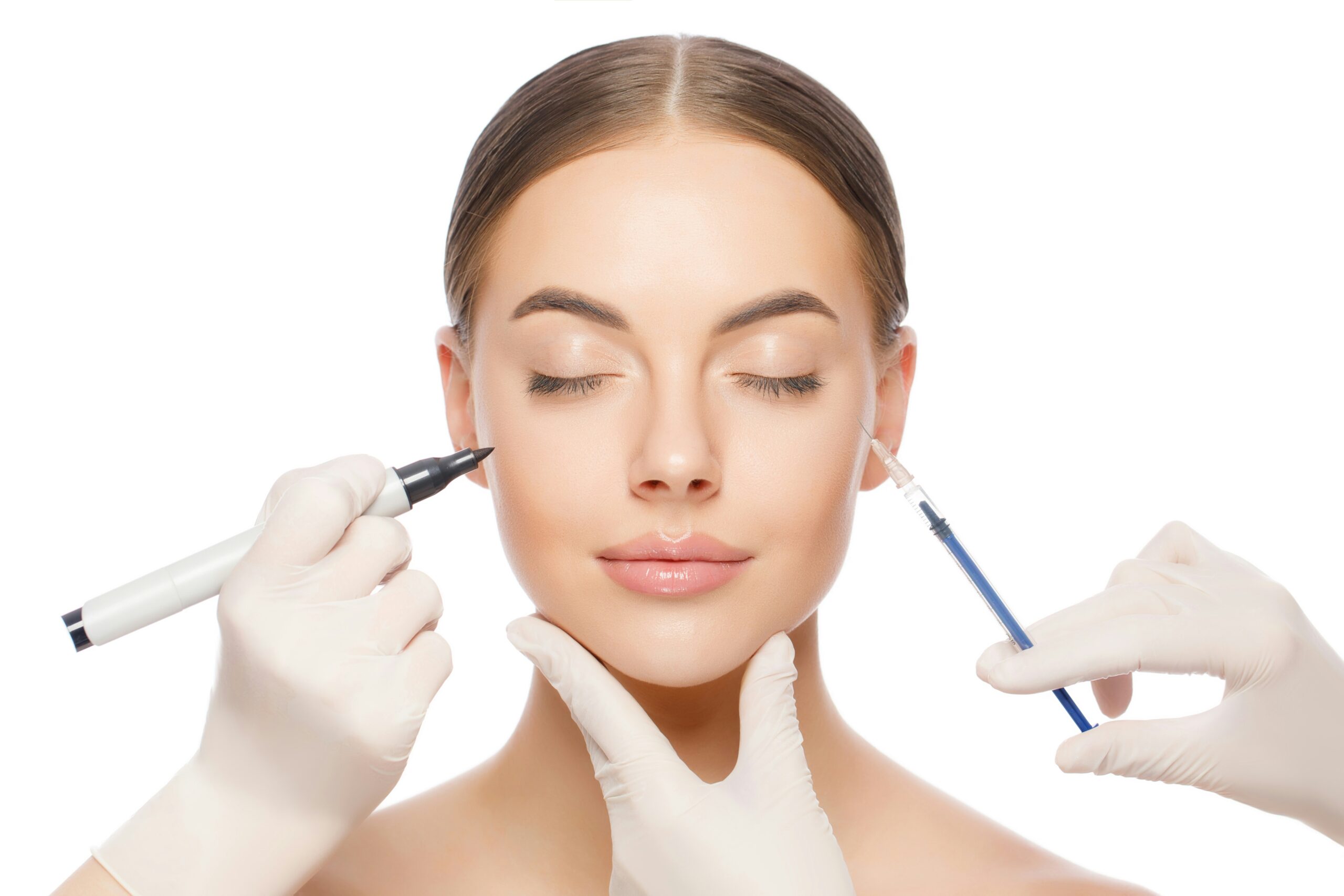
A few months ago, I found myself slightly confused by a character in a new TV series. I couldn’t figure out exactly what type of person the actress was trying to portray. She would say something compassionate, but her face didn’t express compassion. She would say something angry, but the only acting I could see to match was that her eyes would narrow slightly.
I asked my British husband what he thought—perhaps, since she was portraying a ship’s female first officer, this actress was aiming to carry off a stiff upper lip?
“She’s had Botox,” he said simply.
Nothing proverbial about it—she was working with an actual stiff upper lip.
She isn’t the only one. Photos from this year’s Academy Awards revealed a fair number of Hollywood faces altered not only by Botox but by surgical sculpting, as well as bodies clearly affected by use of GLP-1s and/or so-called enhancements. The seeming ubiquity of such treatments has one Substacker asking, “When did getting surgery become the new iOS update?”
Her question gets right to the heart of the issue: When did human beings start treating their bodies like machines? A recent document issued by the International Theological Commission and approved by Pope Leo, Quo Vadis, Humanitas?, links this contemporary approach to the body all the way back to ancient forms of Gnosticism, which seeks to free human persons “from all dependence and limitation, separated from the body, the cosmos, community and history.”
There is a tension between our desire for the completeness with which we were designed and our dissatisfaction with life in a fallen world.
In other words, the technologies and treatments might be new, but the motivations and goals are as old as fallen humanity.
Quo Vadis also warns of
the trends that reduce the body to biological material to be enhanced, transformed and remodelled at will, with the dream of achieving conditions of existence capable of avoiding pain, ageing and death. Especially in the West, advances in cosmetic surgery, combined with pharmacology (hormonal treatments, substances that enhance emotions or concentration) offer tools that greatly change the relationship with one’s own body and therefore with reality and with others. The result is a widespread “cult of the body”, which tends towards a frantic search for a perfect figure that is always fit, young and beautiful. . . . In this dynamic, it is no longer necessary to accept one’s own body in order to realise one’s identity. It can be transformed according to the tastes of the moment. A curious situation is created: the ideal body is exalted, sought after and cultivated, while the real body is not truly loved, being a source of limitations, fatigue and ageing. One desires a perfect body, while dreaming of escaping from one’s own concrete body and its limitations.
Is that a fair critique? News of Quo Vadis, Humanitas? made it into a discussion on the popular morning talk show The View, where a panel of women debated whether or not the pope would blame them for their Botox. Interestingly, their conversation covered many of the questions that most people seem to have: Why is the pope speaking about this? Is there a difference between something like twenty-two cosmetic surgeries in which the person ends up being totally different from their original self versus a desire to look younger through the likes of Botox or false eyelashes? Are these things sins? What about something less permanent, like hair dye? Where do we draw the line?
Although the recent document from the International Theological Commission was approved by the pope, it bears no magisterial weight in itself. Nevertheless, drawing on centuries of wisdom in the tradition, the ideas within it represent an excellent summary of the Church’s “expertise in humanity,” which includes a strong understanding of the human condition and a firm moral foundation for human action.
A Clear Vision of the Human Person
Without a proper understanding of what a human person is, it’s difficult to answer any questions about what a human person should or shouldn’t do.
The “cult of the body” described in Quo Vadis, Humanitas? arises from a mistaken notion that our flesh and blood is nothing more than “biological material to be enhanced, transformed and remodelled at will.” In other words, this understanding of the person fails to properly grasp the unity of body and soul. Our bodies are not just “stuff” upon which the “real” self can act. Our bodies are an integral aspect of ourselves—so much so that to separate body from soul results in death.

Yet one major difficulty of the human experience is the fact that we live in a fallen world. God’s original design for us did not include suffering. In Eden we experienced a unity of body and soul, whereas after the fall, we very often feel disconnected from our frail, aging, and prone-to-illness bodies. There is a tension between our desire for the completeness with which we were designed and our dissatisfaction with life in a fallen world. Yet, as C. S. Lewis wrote in Mere Christianity, such a difficulty is not an obstacle to belief but rather an arrow pointing toward it: “If I find in myself a desire which no experience in this world can satisfy, the most probable explanation is that I was made for another world.”
In fact, we are made for another world. Every Sunday, we proclaim our belief in the resurrection of the body when we profess the creed. Our bodies exist in a fallen world, yes. But Christ took on human flesh, and each of us, at the final judgment, will experience ourselves as body-soul unities once again: only, this time, with resurrected bodies. In other words, as Christians we have always believed that our bodies are not just raw material or machines for us to use however we like. With St. Paul, we believe them to be “temples of the Holy Spirit.” And we believe that there will be a new world—“a new heaven and a new earth”—in which those bodies will be perfectly beautiful (though probably not in a way that we can currently imagine, since we only “see through a glass darkly” now.)
A Firm Moral Grounding
This view of the human person and the body underlies any and all teaching that the Church has to offer regarding the morality of beauty treatments, and leads to a second element of her expertise in humanity: moral guidance. In other words, if the ladies on The View want to understand what the pope hypothetically would say about Botox or any other treatment—if he were to say anything, which he probably won’t, as it’s far too specific a thing about which to make a universal pronouncement—it’s important to know first what the Church teaches about the person and the body. As the Congregation for the Doctrine of the Faith’s document Donum Vitae notes, “An intervention on the human body affects not only the tissues, the organs and their functions but also involves the person himself on different levels. It involves, therefore, perhaps in an implicit but nonetheless real way, a moral significance and responsibility.”
Any medical interventions or treatments ought to be restorative, or “therapeutic,” rather than mutilating the human body.
The vision of the person as a body-soul unity, fallen yet redeemed, made for eternity with a resurrected body, underlies the Church’s approach to any type of bodily treatment or interventions. Donum Vitae explains, “The natural moral law expresses and lays down the purposes, rights and duties which are based upon the bodily and spiritual nature of the human person.” And while certain bioethical questions entail the need for extremely nuanced consideration, one main principle acts as an unchanging foundation: Any medical interventions or treatments ought to be restorative, or “therapeutic,” rather than mutilating the human body. In layman’s terms, that means that any bodily intervention ought to seek to help a person have a healthy, properly functioning body. Bodily interventions that damage or mutilate the body are wrong because the body is always that of a person who has been created in the image and likeness of God and is therefore worthy of respect.
A surgery designed to remove the cataracts from a woman’s eyes so she can see better is therapeutic or restorative in nature. A surgery designed to change the shape of a man’s perfectly functioning nose in order to make it more photogenic is a form of mutilation. To undergo plastic surgery for solely cosmetic reasons (rather than a restorative intervention after a serious accident, for example) entails mutilation of an otherwise healthy body and is therefore wrong. Our bodies are not machines to be tinkered with at will, continually “upgrading” one old part for a new and improved version.
The Challenge of Understanding Health and Aging
But if “restoring health” is a guideline for medical intervention, what exactly is health? Surely youth and health are more clearly linked than age and its various ailments? Is aging unhealthy?
This objection bumps up against the aforementioned tension that we live with: Our original creation did not include sin or its effects. We long to find a fountain of youth, be it discovered through mythical maps or surgical scalpel, precisely because aging as we experience it in a fallen world isn’t what we were meant for. Nevertheless, it remains a fact of life until the eschaton.
And yet, until recently in human history, most people were not confused about what a healthy aging body looked like. They may not have liked it, but they understood it. The path of human health from birth through death was generally understood to be an arc rather than an uphill climb.
Literature bears witness to such a view. Consider the ancient Greek tale of Oedipus Rex, in which the eponymous hero is challenged by the sphinx’s riddle: “What walks on four legs in the morning, two legs at noon, and three legs in the evening?” The answer is man, who crawls as a baby, stands upright in his prime, and uses a cane in old age. Then there is Shakespeare’s second sonnet, in which he implores his female interlocutor to consider the nature of her beauty: “When forty winters shall besiege thy brow / And dig deep trenches in thy beauty’s field, / Thy youth’s proud livery, so gazed on now, / Will be a tattered weed, of small worth held.” (A description that would no doubt send many modern women running to their nearest Botox clinic.) And as recently as the mid-twentieth century, “spinster” sleuths like Agatha Christie’s Miss Marple appear in detective fiction, underrated by authorities and beloved by their clients precisely because of their wisdom won through age, rather than their ability to physically chase down criminals.
An old man in need of a cane, a middle-aged woman with wrinkles, an elderly lady who must sit down fairly often—such persons were not considered unhealthy for their age. In short, humanity has always recognized that a healthy aging body is not designed to look or function like a healthy young body. Why should it? To hold the two as synonymous is to disregard what is a natural process in postlapsarian life. And yet, that’s precisely where we seem to find ourselves today.
Some individual confusion about aging and health is understandable. Perhaps ironically, understanding “health” may be more of an art than a science in many cases, since there is no universal age at which to consider the need for a cane or the appearance of wrinkles to be simply a sign of aging, rather than ill-health per se. Fifteen is too young; eighty is expected. But between those clear sign posts lies a lot of room for the natural process of aging to run its course.
The question is, despite not knowing every little detail of what healthy aging will look like for us, will we allow it to happen, or will we fight tooth and nail (jawline and scalpel?) against its progress? Quo Vadis warns against this desire to ignore or overcome a natural process:
A first element that is problematic is the negative judgement on the human condition as it is, and ultimately on its identity. This leads to the dream of reinventing it, a dream motivated by dissatisfaction with what it is, with its limitations and defects. We must ask ourselves, however, whether “resentment” towards real life is a good starting-point for progress or rather a temptation to rebel against or escape from reality. This is not about the necessary struggle to change unjust conditions and structures, but about the rejection of the nature of things and of oneself.
Do we view our corporality as an integral part of our humanity? Is resentment toward real life driving our cultural obsession with physical perfection? What kind of acceptance is required in our approach to beauty treatments?
Navigating Our Approach to Beauty Treatments
The way we answer these questions is crucial because it affects our ability to discern our own approach to beauty. While some procedures like plastic surgery solely for cosmetic reasons are clearly wrong, the morality of other more neutral, external beauty “treatments” or “enhancements” can depend on our personal motivations or intentions. Moisturizing cream, for example, is a pretty neutral thing in and of itself; it does not carry its own moral weight. Instead, the morality of its use can depend on the user. If someone uses it to blind or harm another person, that act is wrong. If someone uses it to heal their child’s chapped skin, that act is virtuous. But what about the woman who uses moisturizing cream because she is afraid that if she doesn’t, she’ll end up looking “old” or even “middle-aged”?
Author Elizabeth Oldfield found herself wrestling with just this question when confronted by an eight-year-old fellow customer at the beauty counter. “This tiny, blonde-plaited pixie child wanted to buy a bottle of acids that would strip her peach-smooth, poreless skin, because the idea it was somehow in need of improving had been incepted into her.”
Had her own long-time hobby of beauty serum use contributed to a culture in which young girls are afraid of wrinkles? “What is forty supposed to look like?” wondered Oldfield.
She’s not alone. The Church gives us a clear anthropological vision and a firm moral foundation, without which we can easily fall victim to “the cult of beauty.” But the ladies of The View asked some legitimate questions in their discussion: There’s a big difference between cosmetic surgery and hair dye, so where do we draw the line? Could the recent Vatican document have anything to do with concern for the plight of girls, so many of whom are caught in the pressures of a digitalized world and influenced by the many stiff upper lips of Hollywood? And what does that mean for each of us?
In part two, I address the questions of beauty treatments that require personal discernment and how we might begin to discern them.