
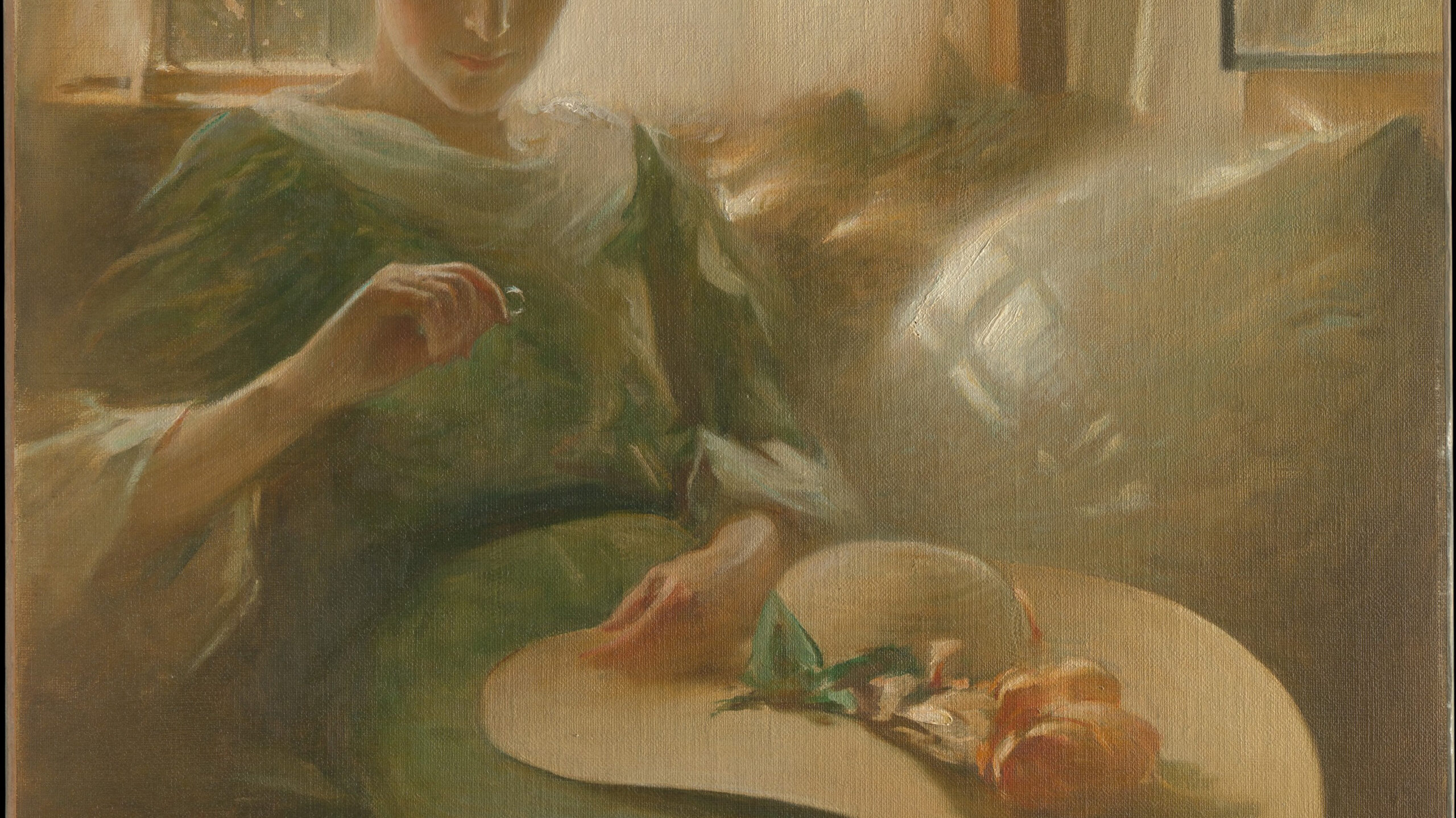
In Italo Calvino’s book Six Memos for the Next Millennium, the Italian novelist writes of the power of objects in narrative. He begins by recounting a legend about an old king named Charlemagne who falls in love with a German girl. Eventually the girl dies, yet Charlemagne’s love for her remains, or so it seems. He is entranced by her, tethered to her embalmed corpse in his chamber. The Archbishop Turpin suspects some malevolent spell might be the cause of the king’s obsession and, after searching the girl’s body, finds under her tongue a gemstone ring. As soon as the archbishop takes the ring, though, Charlemagne falls in love with the cleric. Disturbed by this bizarre transference of infatuation, the archbishop casts the ring into a lake. The tale concludes with “the old king gazing raptly” at the lake’s waters, swept up in contemplative longing.
Calvino introduces the tale to illustrate how an object in a narrative can have great influence—how material things can become “magic objects” that affect characters and events, often in ways not clearly visible. Calvino writes:
We might say that as soon as an object appears in a narrative, it becomes charged with special force, becomes like the pole in a magnetic field or a node in an invisible network of relations. The object’s symbolic value can be explicit or not, but it is always present. We might even say that any object in a narrative is a magic object.
While Calvino is making a claim about a particular craft element of the literary arts, I think his insight finds parallels with our spiritual life. The various objects in the background of our lives can also exhort a type of influence over us—a type of charmed effect—often without our conscious awareness.
An obvious example is the smartphone, a device that’s been so mercilessly flagellated in the last several years that it’s become cliché to critique. Still, it’s useful for illustrating a point. While we often are aware that the device is clearly influencing us, curtailing our attention, fomenting FOMO-anxiety when not looking at it, offering escape from nascent boredom, and so on, it also influences us in subtle and not readily apparent ways. The presence of the object seems to have an effect on us, even if we’re not consciously thinking about it. According to one study, the “mere presence of one’s smartphone may occupy limited-capacity cognitive resources, thereby leading to fewer resources available for other tasks and undercutting cognitive performance.” In the study, students were asked to complete a cognitive test by either putting their phone face down on the desk, in their pockets, or in another room. The students who left their phone in another room performed better than those who left their phone in their pocket, and both those groups performed better than those who left their phone face down on their desk. It’s also been well documented that the presence of a phone can diminish empathy and connection between people. Again, this is relatively old news (some studies on the topic go back over ten years), but the smartphone does serve as an effective example of how a material object can and does exhort a pull in our lives without our knowing.
The material things in our lives can also become for us idols, leading us away from God at the expense of gratifying our egos.
So, what other objects in our lives might be affecting us without our knowing, whether positive or negative? How might the various objects making up our homes or offices, for instance, be influencing our lives?
Let’s consider another example. Call to mind a sterile office: drab watercolor paintings of amorphous bodies of water, headache-inducing fluorescents, artificial plants, bare and medicinally white walls. It’s an environment exaggerated in the popular Apple series Severance, where we see corporate banality taken to its extreme. In such spaces we likely feel oppressed, weighed down by the lack of beauty and color and texture—our souls are tethered, trapped. This might not necessarily be a conscious feeling, and at first we might not realize it. We could think, too, of Stalinist and brutalist architecture in former Soviet countries: heavy, windowless, and menacing edifices thumbing down on the souls of its people. Such examples reveal the power of material objects—specifically, they reveal their danger in such objects not cohering to the reality of our being. Ugly and drab objects that tempt us with feelings of malaise or even despair don’t reflect the true telos of our natures—embodied souls destined for transcendent joy and beauty in God.
The material things in our lives can also become for us idols, leading us away from God at the expense of gratifying our egos. Thomas Merton writes about how objects can be both means for growing closer to God if used properly, and how they can become snares that keep us locked within the brittle nest of our egos. In New Seeds of Contemplation, he writes:
We do not detach ourselves from things in order to attach ourselves to God, but rather we become detached from ourselves in order to see and use all things in and for God. . . . There is no evil in anything created by God, nor can anything of His become an obstacle to our union with Him. The obstacle is in our “self,” that is to say in the tenacious need to maintain our separate, external, egotistic will.
Merton claims that objects in our lives can become obstacles to our relationship with God if they subtly or not-so-subtly serve our egotism. This can occur by surrounding ourselves with a type of ersatz beauty, superficially pleasant objects that foster a type of pride and vanity. These objects can subconsciously foment the idea that our value is somehow tied to them—the decor of our homes, luxury cars, designer clothes, etc.—and that our status or lovability depends on them. We might be pulled by these objects, placing inordinate importance on them, striving after them as a way to prove to ourselves, or others, our intrinsic value. They can become sources of unhealthy attachments, drawing us away from the work of tending to our souls. The desire to signal to others a certain kind of status can become, of course, a temptation that keeps us beholden to the opinions of so-called polite society. In such cases, these too do not reveal the reality of our beings as children of God.
On this point, Merton writes:
We use all things, so to speak, for the worship of this idol which is our imaginary self. In so doing we pervert and corrupt things, or rather we turn our relationship to them into a corrupt and sinful relationship. We do not thereby make them evil, but we use them to increase our attachment to our illusory self.

Of course, this doesn’t mean we must puritanically prune our lives of all things (this would err in the direction of the Soviets) or that the purchasing of and surrounding ourselves with nice and expensive things is inherently wrong (though prudence is necessary). The point is that the very objects and things we allow to fill our lives have power, and this power—like Calvino’s magic ring—often influences us without our conscious awareness.
God is the source of all beauty, and in truly beautiful things we are drawn toward him. This is why surrounding ourselves with truly beautiful—not necessarily expensive or exclusive—objects can be important both for us individually and collectively as a society. I have a friend committed to buying well-made, handcrafted furniture for his house. He often has to pay more money, but it’s an expense he can afford and one he justifies because it funds a carpenter who has spent countless hours at the workbench. But aside from the furniture itself being nice to look at and useful, it subtly charges my friend’s house with certain values: patience, beauty, discipline, and hard work. The presence of the furniture affirms the integrity and value of well-made and beautiful things, pushing against a culture that often values disposable, cheap, and reproducible goods. And this can influence our own approach to work, relationships, and the spiritual life. Purchasing a hand-carved table isn’t going to automatically make us holy or virtuous, of course, but it can gently mark us, reminding us of the esteemable values ingredient to making it—and that awareness can prompt us toward living a more virtuous life.
The Catholic Church teaches about the value of certain objects, one example being sacramentals. The Catechism of the Catholic Church defines sacramentals as objects that, while they “do not confer the grace of the Holy Spirit in the way that the sacraments do, but by the Church’s prayer, they prepare us to receive grace and dispose us to cooperate with it.” It’s an insight that affirms the embodied nature of our beings, and how physical things, rightly understood, can serve as a bridge to living in communion with God. Sacramentals, of course, are not powerful in and of themselves (then they would be idols) but, rather, serve as signs of God’s active grace. This is why the Church also has great respect for the material elements of the liturgy: the incense, the vestments worn by the priest, the crucifix over the altar, and so on. These objects have the power to exhort influence, drawing us out of ourselves and toward God in true worship.
So, the question remains: What objects do we fill our own lives with, and what is the nature of their influence? Discerning the answer requires prayer, a relationship with God, an honest examination of our conscience—all things that constitute a life of spiritual growth. We might ask God to reveal to us how he is working—or not working—in the very things that make up our lives. And in doing so, we might help ensure such “magic objects” are drawing us closer to, and not further away from, our loving God.