
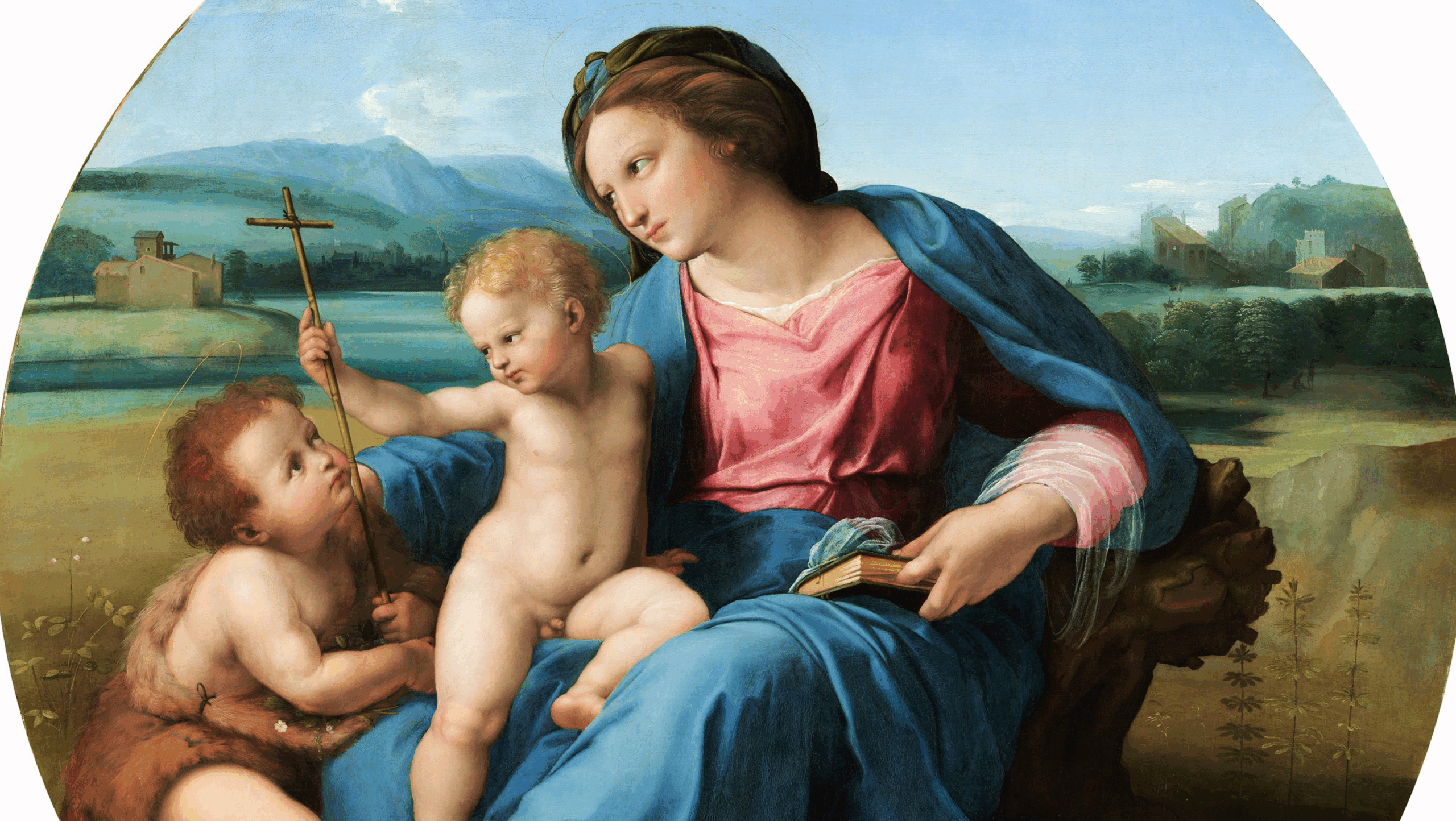
The Metropolitan Museum of Art opened the exhibition “Raphael: Sublime Poetry” on March 29, offering an unprecedented opportunity to view over 170 paintings and drawings by the great Renaissance painter. As the first major international loan exhibition on Raphael in the US, the impressive array includes some of the artist’s finest portrayals of the Madonna and Child, including The Alba Madonna on loan from the National Gallery of Art in Washington, DC.
In an individualistic and secular culture that largely favors unrestricted self-expression over order and beauty in the visual arts, it’s refreshing—and not to say encouraging—to see a major cultural institution celebrate an artist who prioritized both of the latter in his compositions. The exhibition takes on further significance considering that Raphael’s portfolio mainly consists of religious subjects, making his artwork an unusual but welcome choice in a post-Christian society that often fails to appreciate its heritage of sacred art, which has been passed down through the ages since early Christian times.
“Raphael: Sublime Poetry” is intentionally structured as a journey through Raphael’s life and artistic career, visually charting the evolution of his technique. Born in Urbino in 1483, Raphael was the son of Giovanni Santi, a poet and painter. Raphael studied under the Renaissance painter Pietro Perugino (best known for his Sistine Chapel fresco of Christ and St. Peter) and began painting altarpieces and private devotional works. He landed in Florence in 1504, and it was there that Raphael learned from the two men that defined the standards of Renaissance art: Leonardo da Vinci and Michelangelo.
Something that is sublime contains undeniable beauty. It inspires awe and wonder, usually directing the mind of the beholder to the highest moral and spiritual truths.
Raphael’s drawings clearly show that the young artist learned quickly and adapted to the rapid artistic developments occurring during the Renaissance. Leonardo and Michelangelo’s influence becomes apparent in the motion, arrangement, and anatomical accuracy that began to characterize the figures in Raphael’s sketches, which he referenced for his paintings. The progression of his technique reveals that Raphael was a man who strove for perfection—and many would argue that he achieved it to the greatest extent possible within the realm of human capabilities.
Raphael’s continual refinement of his skills in the chase after excellence didn’t stop there. He went to Rome in 1508, becoming the court artist for Pope Julius II (r. 1503–1513) and Pope Leo X (r. 1513–1521). He made drawings of the ancient monuments in the city to learn the ins and outs of classical architecture. This knowledge proved useful for the School of Athens, a fresco that Raphael made for a four-part series in the Stanza della Segnatura in the Apostolic Palace.
We’ll never know how much further Raphael could have gone in his endeavors. Raphael did not enjoy the longer lives of his contemporaries, whose artwork had such a noteworthy impact on him; Michelangelo and Leonardo died at 88 and 67 years of age, respectively. Raphael left this world at 37, making the progression of his artistic career even more remarkable than theirs, at least in regard to time. In 1520, he completed what became his last masterpiece: The Transfiguration, a stunning example of his masterly orchestration of light, color, and human bodies to create a dramatic scene.
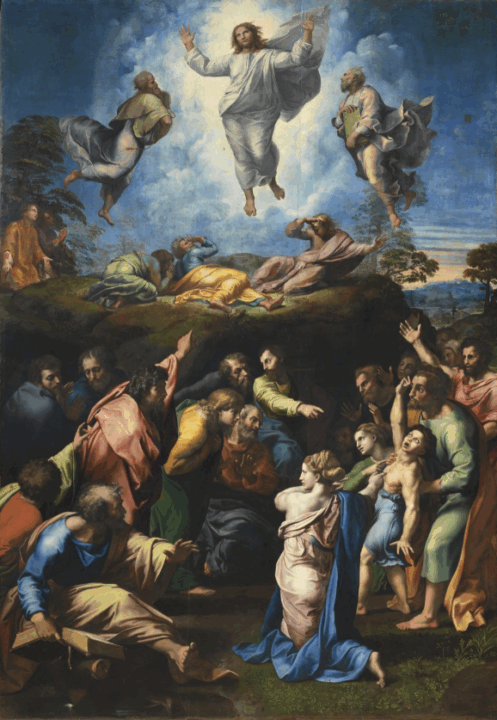
While The Transfiguration was not loaned for the current exhibition, it nevertheless affirms that the Met chose a fitting title for its exhibition on Raphael: His artwork is sublime poetry translated into a visual medium. The choice of the word “sublime” renders the phrase “beauty is in the eye of the beholder” irrelevant and inapplicable. The greatness of Raphael’s work isn’t up for debate. Something that is sublime contains undeniable beauty. It inspires awe and wonder, usually directing the mind of the beholder to the highest moral and spiritual truths.
Raphael tirelessly pursued this degree of beauty in his artwork. His success cannot simply be attributed to his technical skills in painting. While skill certainly contributed to his incredible accomplishments, Raphael’s paintings reached the level of sublimity that they did because of the subjects he portrayed. The fusion of his natural and cultivated talent with the genre of sacred art propelled Raphael to new heights, accessible only to those who search for beauty at its very source: God. In every religious piece that he painted, Raphael depicted a heavenly beauty.
Perhaps this explains why Raphael’s paintings of the Madonna and Child are so beloved and admired by Catholics and non-Catholics alike. The Alba Madonna serves as a good example. The color palette and pyramidal structure of the three bodies make the painting aesthetically pleasing to the eye, and the expressions and gestures of the figures psychologically engage the viewer. However, only the presence of the Blessed Virgin Mary and Christ could elevate this piece above the plane of merely earthly beauty.
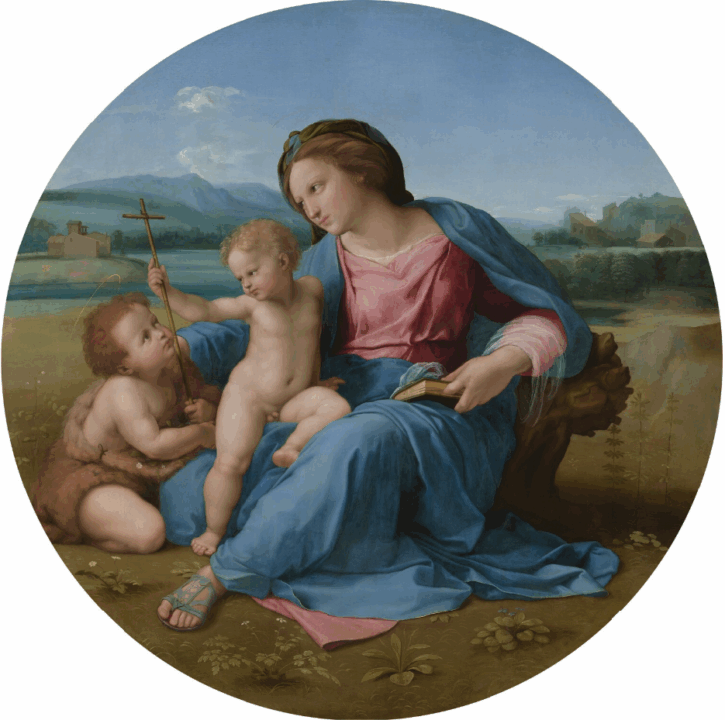
Raphael notably sets the triad of Mary, Jesus, and St. John the Baptist in a realistic landscape. Some might dislike the fact that Mary is basically sitting in the dirt. However, rather than demean these holy figures, the natural setting emphasizes their otherworldly beauty. Raphael communicates that heaven has made contact with earth; the Word has become flesh. The Greeks tried to sculpt the perfect human body, but they couldn’t have conceived of the beauty that resulted from the immaculate conception and the incarnation: Mary, the tota pulchra, and God made man. Raphael thus copied the masterpiece of the Creator when he painted the Madonna, and he painted God himself.
The Met exhibition proves that the passage of time and rise of secular and atheistic ideologies cannot erase or overlook certain manifestations of beauty. Like poetry, Raphael’s paintings possess an inherent timelessness and speak the language of the soul. People cannot but hear this language when they view his artwork, and those unaccustomed to sacred art might find it difficult to understand at first. However, this encounter with the divine will hopefully stir something deep within them, leading them to spiritually imitate Raphael’s pursuit for beauty by seeking Beauty himself.
“Raphael: Sublime Beauty” is on exhibition at the Met through June 28. A 16-minute virtual tour is available for those unable to visit in person.