
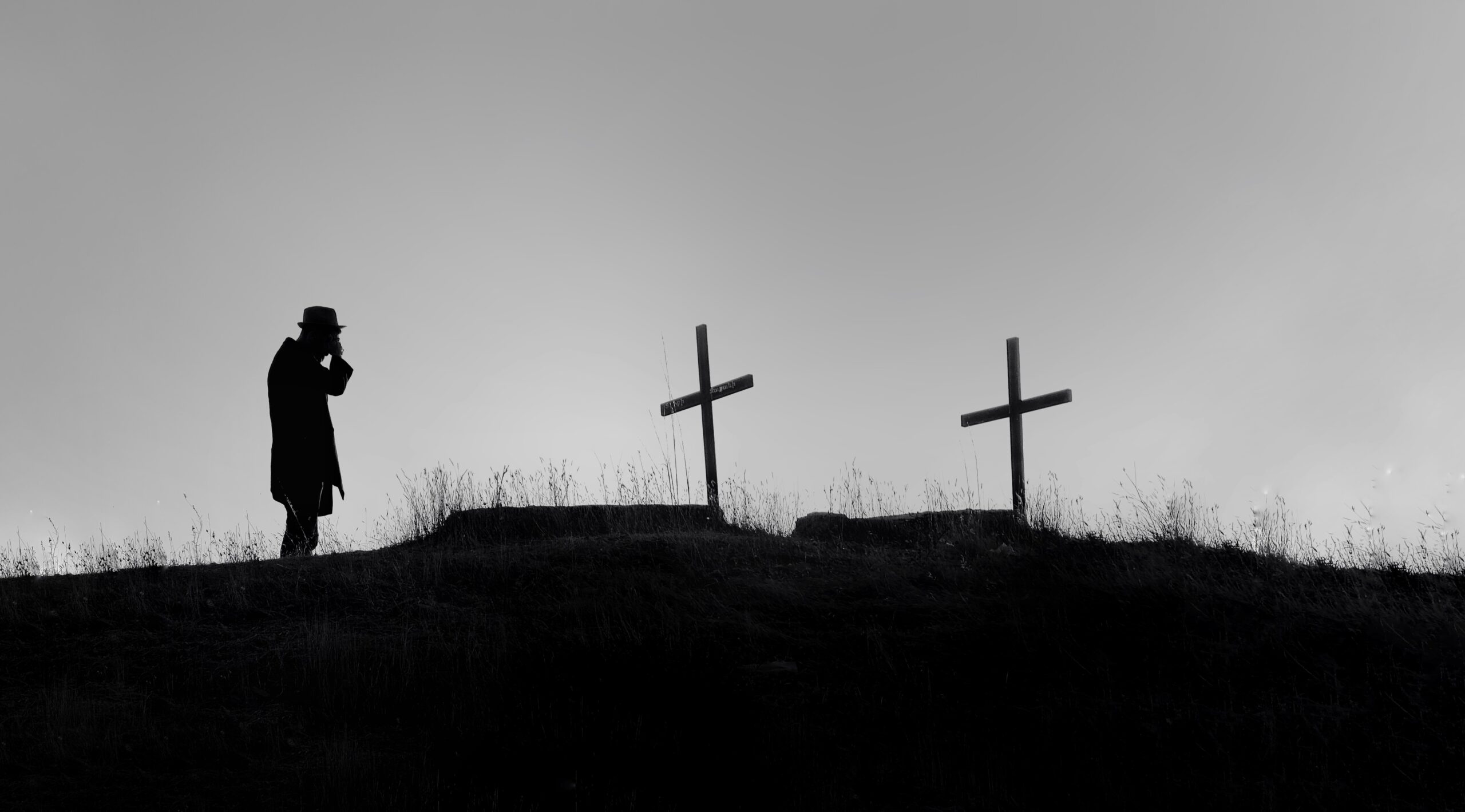
I struggle with the idea of heaven. I don’t claim it’s an entirely rational struggle—it isn’t—but that doesn’t make it any less real. I know I don’t want to go to hell; that much is certain. Yet in my more melancholic moments, heaven doesn’t seem particularly appealing either. This isn’t simply a matter of feeling unworthy; more than that, it is a fear of the eternal. To be sure, there are times when the thought of escaping death and being reunited with loved ones brings me great consolation. But there are other times when the prospect of living forever feels, quite frankly, rather terrifying.
I’ve discovered that I am not alone in these struggles. In chapter 10 of her autobiography, St. Thérèse of Lisieux relates how in Eastertide of 1896, eighteen months before her death, God allowed her to share in the spiritual darkness of all those souls who lack faith in the joys of heaven: “He permitted my soul to be invaded by the thickest darkness, and that the thought of heaven, up until then so sweet to me, be no longer anything but the cause of struggle and torment.”
A more mundane example presented itself to me a couple of years ago in an interview between the journalist Piers Morgan and the well-known atheist Richard Dawkins. When the conversation turned to death and immortality, Dawkins avowed, “I don’t think I’d like to live for all eternity. Would you?” To this, Morgan (a self-professed Catholic) offered the quite sensible reply: “I don’t know, it depends what it’s like.” But Dawkins remained unconvinced: “I think there is something actually rather frightening about eternity.”

Much of our modern society’s apathy toward religion stems from the fact that people today no longer find the promise of eternal life to be an attractive prospect.
Dawkins’s honesty is commendable, and he puts into words the anxiety which many people feel about the whole idea of heaven. Indeed, his discomfort raises the question of how much of our modern society’s apathy toward religion stems from the fact that people today no longer find the promise of eternal life to be an attractive prospect. This phenomenon was noted by Pope Benedict XVI in his encyclical Spe Salvi:
Obviously there is a contradiction in our attitude, which points to an inner contradiction in our very existence. On the one hand, we do not want to die; above all, those who love us do not want us to die. Yet on the other hand, neither do we want to continue living indefinitely, nor was the earth created with that in view. So what do we really want? (Spe Salvi 11; see also 12).
What do we really want? I would suggest that the month of November is an opportune time for reflecting on this question. As well as being the month that begins with the Solemnity of All Saints—a celebration, if you like, of all the holy men and women who knew what they really wanted—it is also the month the Church dedicates to praying for the souls in purgatory. As such, November is an ideal season both for reevaluating our priorities in this life and for preparing ourselves for the next.
During the month of November, I make a point of visiting a cemetery every day. I began this practice three years ago following the recommendation of a friend, and my method is simple. I choose a grave (typically one that appears more neglected) and pray an Eternal Rest for the man or woman buried there. Next, I recite Psalm 130, the great De profundis (“Out of the depths”) prayer that has long been included in the Church’s funeral rites. Finally, I spend a few minutes in silent reflection, before getting on with my day.

I’ve come to love this little tradition. Particularly in England, where I live, there is something enchanting about visiting the old churchyard and discovering graves that stretch back hundreds of years. If I happen to be traveling, I find it equally edifying to seek out the local cemetery while I’m on the road. And if, as occasionally happens, I miss a day or two over the course of the month, I don’t beat myself up about it. But for the most part, I find myself looking forward to the daily 15-minute walk to the village cemetery.
November is a beautiful time of year. The Church’s liturgical year is drawing to a close, autumn is in full swing, and the increasingly bare trees offer a resplendent image of the Christian idea of death and resurrection. (The evergreen yew trees that adorn many English graveyards are an exception to this rule.) Seeing the countless red and auburn leaves lying scattered over the sundry tombstones invariably brings to mind Robert Frost’s doleful words: “Then leaf subsides to leaf / So Eden sank to grief / So dawn goes down to day / Nothing gold can stay.”
My cemetery visits have taught me several things. For starters, they’ve given me a renewed sense of the communion of the saints. One of the most marvelous things about being Catholic is the knowledge that all the members of the Church—whether on earth, in purgatory, or in heaven—are joined by an unbreakable bond of charity “which binds everything together in perfect harmony” (Col 3:14). As one of my college mentors used to remind me, there’s a real sense in which we are more closely united to other members of Christ’s body than we are to our own four limbs.
The Epistle to the Hebrews speaks to this reality when it asserts that “we are surrounded by so great a cloud of witnesses” (Heb 12:1) in the race that is set before us. In its figurative sense, the Greek word for “cloud” signifies a vast, dense crowd. But the literal meaning is also instructive; the epistle’s words conjure up an image of a runner traversing some mountain trail, only to find himself immersed in some enormous cloud. The souls of the faithful departed, in other words, are all around us. As the old saying goes, those who die in grace go no further from us than God, and God is very near.
As the sun sets over the western sky and the leaves rustle gently in the breeze, the embarrassing truth is I often feel a strange sense of jealousy for the souls for whom I pray.
Visiting the cemetery has also underscored for me the immense cultural value of the Catholic worldview. Put simply, it is good for a civilization to remember and pray for its dead, as the beautiful cemeteries of Eastern Europe readily testify. Indeed, if the Church’s teaching on this point were found to be false, then I should consider God somewhat unimaginative for not having thought of it himself. But, of course, we need not fear, for he is the one who came up with the idea. In his wisdom, God knew that it would make for a more loving and more glorious economy of salvation in which the living still pray for the dead, and the dead still pray for the living—for, as it turns out, they are not truly dead.
The third and most impactful lesson I’ve received from my visits to the cemetery is a deeper sense of what I really want. Graveyards are remarkably still places, and there is something hauntingly beautiful about the poignant silence that is to be found there, particularly at dusk or following a light snowfall. Many times I have felt my soul pierced by this beauty as I recite the words of Psalm 130: “My soul is waiting for the Lord. I count on his word. My soul is longing for the Lord, more than watchman for daybreak.” As the sun sets over the western sky and the leaves rustle gently in the breeze, the embarrassing truth is I often feel a strange sense of jealousy for the souls for whom I pray. For it is our Christian hope that they are, or soon will be, resting in the sleep of peace. Surrounded by the dimly lit graves, I find myself longing for that same peace.
I have no doubt that this sense of longing is heightened by my melancholic temperament. Like Eeyore in A. A. Milne’s Winnie the Pooh, I am easily exhausted by the vicissitudes of life, and I often have to fight against a creeping sense of despondency over everything that is imperfect and broken in the world. This might explain why it is that I have discovered consolation—and even the beginnings of a desire for heaven—in the unlikeliest of places: the village cemetery. At the same time, I believe my experience is reflective of something more universal. For the reality is that, whatever our temperament, we all go through seasons where we feel worn down by life. And for all of us, these weary seasons are an opportunity to attune our hearts to heaven.

Oftentimes the sort of weariness that prompts us to aspire to heaven arises through suffering. Indeed, amid all our modern comforts, it sometimes takes an intense encounter with suffering to instill in our hearts a desire for the life to come. Experience attests that the grief of losing a loved one or the heartache that follows a broken relationship can give us a new sense of longing for heaven, even if fears persist. Job’s great trials led him to look forward to that place where “the wicked cease from troubling, and there the weary are at rest” (Job 3:17). While we shouldn’t seek out suffering, our patient acceptance of it can help to heal our affections, and to give us an appreciation for what Tolkien called the gift of death.
Yet suffering is not the only source of weariness. There are other times when our languor stems not from suffering but from what seems like its opposite; sometimes it is the sheer goodness and beauty of life that leaves our souls yearning for more. If this seems paradoxical, we should recall the Scriptural maxim that “[God] has put eternity into man’s mind” (Eccl 3:11). A simple corollary of this is that there is nothing in the temporal world that can fully satisfy our deepest desires. C. S. Lewis articulated this conundrum in The Problem of Pain when he admitted, “There have been times when I think we do not desire heaven; but more often I find myself wondering whether, in our heart of hearts, we have ever desired anything else.” Lewis’s words suggest that the delight I experience in playing board games with my family, ice skating with friends, or even grabbing a Double Quarter Pounder from McDonald’s is nothing but a faint echo of the infinite joy for which my heart was made.
Suffering and bliss: both remind us that we are destined for something far greater than what this weary world has to offer.
Suffering and bliss: both remind us that we are destined for something far greater than what this weary world has to offer. In seasons of suffering, we long for that future time and place when every tear will be wiped away and death will be no more. In moments of bliss, we are reminded that even the most beautiful things in this world cannot fully satiate our spiritual heartache, our existential nostalgia, our deep-seated hunger for a peace that passes all understanding. Hence, whether we feel overwhelmed by life’s pains or dissatisfied with its joys, in both cases we must accept our struggles as an invitation to reorient our hearts toward the “things that are above” (Col 3:2).
I can’t deny that I still have difficulties with the idea of heaven, and I realize it will always remain something of a mystery on this side of the veil (see 1 Cor 2:9). Nevertheless, through my visits to the cemetery, I have come to believe more firmly than before that if heaven really means what our faith assures us it means, then perhaps I can be happy there forever. If heaven really means an end to all labors, all stress, all anxiety, all confusion, all misunderstanding, all self-doubt, all grief, all hurt, all sadness, all shame, then perhaps weary souls can find their peace there. For what the dead have taught me, and what they continue to teach me, is that heaven promises rest: “This is my resting place for ever; here I will dwell, for I have desired it” (Ps 132:14).
For many of us, the image of heaven as eternal rest invokes a related image of heaven as home. I am therefore not the first to wonder whether what follows death will in fact be a kind of coming home. It may yet be that when our souls are at last freed from their necessary purgations, our joyful entry into the Father’s house will call to mind that majestic little phrase that Tolkien employs on the final page of The Lord of the Rings, when Samwise Gamgee returns from his travels to find the fire blazing in the hearth, the evening meal laid out, his loved ones awaiting him—and he was expected.
A Prayer by St. John Henry Newman
May the Lord support us all the day long,
till the shadows lengthen and the evening comes,
and the busy world is hushed, and the fever of life is over,
and our work is done.
Then in his mercy may he give us a safe lodging,
and holy rest, and peace at the last.
Amen.