
While still a bishop, John Paul II was asked to preach the Lenten retreat for Pope St. Paul VI. His preaching was surprisingly grim: “From the moment when man, because of sin, was banished from the tree of life, the earth became a burial ground. For every human being there is a tomb. A vast planet of tombs.” The Earth is a massive graveyard, its face pocked with the graves of all those who have come before us; its face waiting to be pocked by our own. The saintly pope’s vision is reminiscent of that of the prophet Ezekiel: “The hand of the Lord came upon me, and he led me out in the spirit of the Lord and set me in the center of the plain, which was now filled with bones. He made me walk among them in every direction so that I saw how many they were on the surface of the plain. How dry they were!” (Ezek 37:1–2). Ezekiel had this vision during the Babylonian exile, when those of the Chosen People who had survived the slaughter had been carried away in chains. To ancient peoples, the destruction of Jerusalem and of its temple meant the vanquished God had deserted his people.
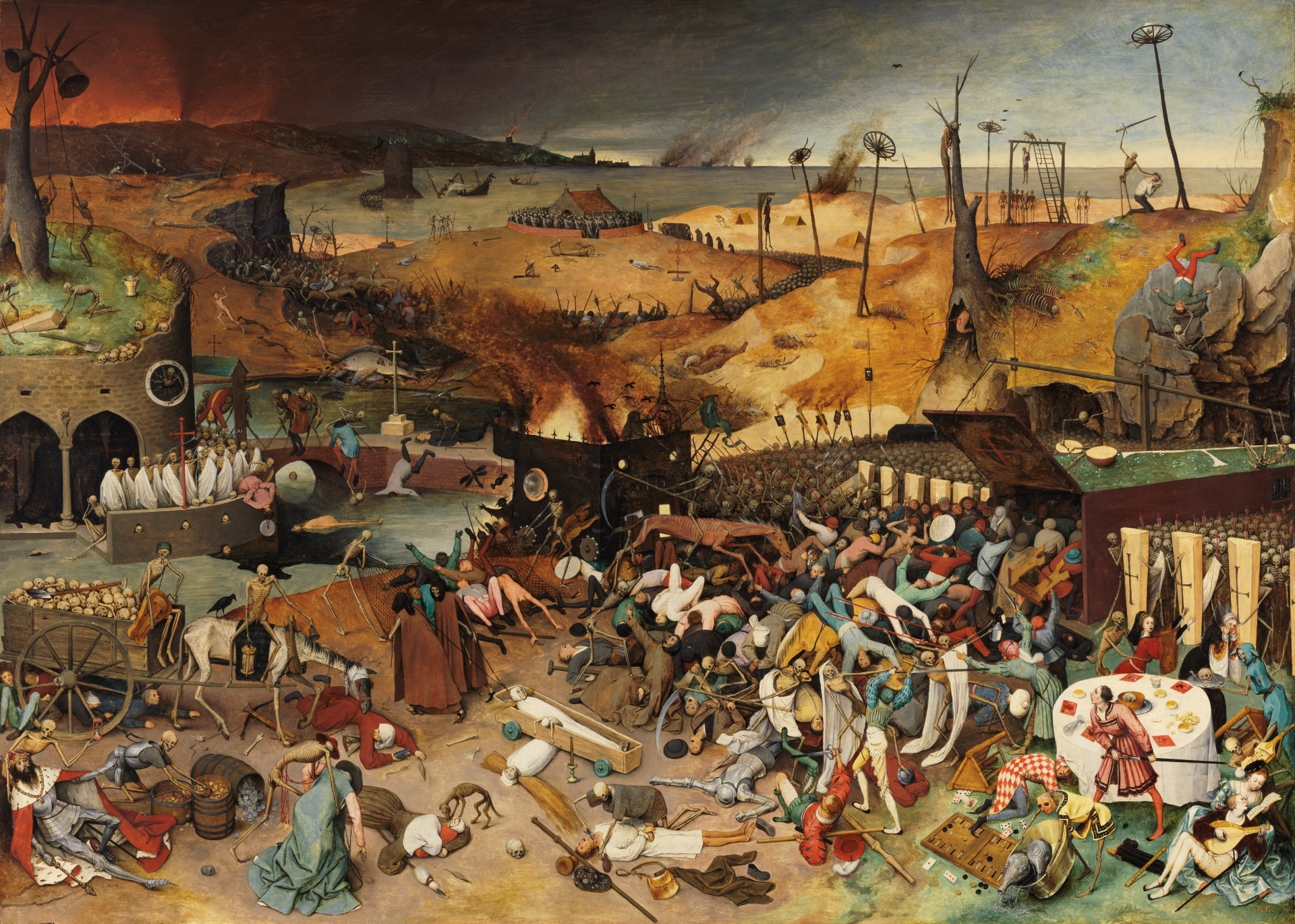
Both these scenes cry out in anguish in the face of God’s abandonment, the same anguish Christ experienced on the cross. As John Paul II noted, “Perhaps the loneliness of dying is best expressed in Christ’s words from the cross, words on which theologians and other writers have pondered: My God, my God, why have you forsaken me?” There is no work in all the Western artistic canon where this cry resounds as loudly as in Pieter Bruegel the Elder’s The Triumph of Death, painted around 1562.
Bruegel portrays a wasted, war-torn landscape; in the distance, burning cities give the darkening horizon an infernal glow. In Ezekiel’s vision, the dry bones are put back together and brought back to life: “I prophesied as I had been told, and even as I was prophesying I heard a noise; it was a rattling as the bones came together, bone joining bone. I saw the sinews and the flesh come upon them, and the skin cover them, but there was no spirit in them. . . . I prophesied as he told me, and the spirit came into them; they came alive and stood upright, a vast army” (Ezek 37:4–10). In Bruegel’s painting, an army is likewise raised from scattered bones, but it is not brought back to fullness of life. It is an army of skeletons and partially decomposed cadavers sent to hunt the living. These flee in terror, trying to stave off death by all means conceivable. Some attempt, courageously but fruitlessly, to fight back. Others despairingly seek to hide and find a place of safety. But there is none. Neither earthly power or riches (a king lies on his back, pathetically trying to stop the plundering of his treasure), nor ecclesiastical rank (a cardinal is carried away by a skeleton wearing his red hat), nor religious piety (a pilgrim is stripped of his pilgrim’s garb while a skeleton slits his throat) offer any protection. Even a mother’s love proves futile: A dead woman lies face down with her child in arms as a ravenous dog approaches. Those who escape a violent fate are herded into a massive coffin.
This painting has intrigued people for centuries.
This painting has intrigued people for centuries. Is it a moral work, inviting viewers to reflect on the shortness of life and the inevitability of death? A gruesome and nightmarish memento mori? Or is it a humanist satire of the religious violence plaguing sixteenth-century Netherlands? Art historians have long speculated about Bruegel’s personal beliefs, whether he was a faithful Catholic, a secret Protestant, or a humanist religious sceptic, each reading his oeuvre according to their preferred theory. What we do know is that Bruegel was born Catholic, married in the Catholic Church, and was buried in the Church of Our Lady of the Chapel in Brussels. Thus, it seems reasonable to read his work in a Catholic, biblical light; we can read it as a biblically inspired meditation on death.
Bruegel’s composition drags the viewer right into the violence unleashed by death’s hordes. Wherever one looks, one encounters fresh horrors and new reasons for despair. Caught in this carnage, the viewer is continually taunted, so that he can only cry out, as perhaps many of the characters in the painting would: “My tears have become my bread, by night, by day, as I hear it said all the day long: ‘Where is your God’?” (Ps 42:4). This seems to be the most appropriate question to ask when in front of this painting. Has God forsaken mankind so that death reigns unopposed? To answer it, the viewer must untangle himself from the confusion and follow Bruegel’s lead through the peripheral figures, which serve as a gloss on the central scene.
Years prior, Bruegel produced a series of drawings on the seven virtues. In Justitia, the familiar representation of justice as a blindfolded woman, holding a sword and a balance, is surrounded by the many cruel punishments by which human justice is meted out. In the distance, a multitude gathers around gallows and breaking wheels to watch the execution of wrongdoers. Closer to the viewer, a man kneels with a crucifix in his hands as he awaits the sword to fall upon his neck. In The Triumph of Death, we find these exact images reproduced in the background. The executioners are no longer men inflicting death upon their fellow men but death’s skeletal agents. Death is, as the Bible teaches, a just punishment. “For the wages of sin is death” (Rom 6:23), a punishment deserved by us all: “Through one person sin entered the world, and through sin, death, and thus death came to all, inasmuch as all sinned” (Rom 5:12). Death is a punishment from God, yes, but all of God’s punishments are also acts of his infinite mercy: “Happy is the man whom God reproves! The Almighty’s chastening do not reject. For he wounds, but he binds up; he smites, but his hands give healing” (Job 5:17–18). The lonely man kneeling with a crucifix in hand is the only figure that seems serene in the face of imminent death. He is like the Good Thief, who during his own execution did not reject God’s chastening, acknowledging his guilt and the justice of the punishment inflicted upon him: “‘Have you no fear of God, for you are subject to the same condemnation? And indeed, we have been condemned justly, for the sentence we received corresponds to our crimes, but this man has done nothing criminal.’ Then he said, ‘Jesus, remember me when you come into your kingdom.’” While human justice is often polluted by vengeance, God’s punishments are always just. Christ’s answer to the Good Thief reveals that his punishment is already effecting its remedy: “Amen, I say to you, today you will be with me in Paradise” (Luke 23:40–43).
At the bottom right corner of the painting, two lovers sing while gazing into each other’s eyes, oblivious to the violence around them, unaware also that it is death that accompanies them with the viola. How can one not see in this couple, singing in each other’s arms, a reference to the Song of Songs, which is precisely the song of two lovers? One in which we hear: “For Love is strong as Death, longing is fierce as Sheol. Its arrows are arrows of fire, flames of the divine. Deep waters cannot quench love, nor rivers sweep it away” (Song 8:6–7). This is a subtle indication that Death, however all-encompassing it may seem, is not the only power in this world: Love is a force at least as strong.
As we move to the opposite side of the panel, we find another puzzling figure. While death’s minions delight in their deadly tasks, one alone among them does not. He sits with his head in his hands, sorrowing over a dead bird. This fallen bird brings to mind Christ’s words concerning the Father’s love: “Are not two sparrows sold for a small coin? Yet not one of them falls to the ground without your Father’s knowledge. Even all the hairs of your head are counted. So do not be afraid; you are worth more than many sparrows”, which he offers following his mandate to “not be afraid of those who kill the body but cannot kill the soul” (Matt 10:28–31). There is an element of foreshadowing in this mourning skeleton, a hint that death’s victory celebration is perhaps premature.
But Christ, by dying on the cross, seized this banner and gave it a new meaning.
Commentators have noted that death’s legions march with shields emblazoned with the sign of the cross. Crucifixion was the most cruel and degrading form of execution. The cross was a sign of Roman power, a power resting on their capacity to bring death upon their enemies. Those who wielded the power of death ruled the world. But Christ, by dying on the cross, seized this banner and gave it a new meaning; the tree of death is now transfigured into the tree of life; “the Son of God, the man Jesus Christ, conquered death with death. O mors! Ero mors tua! ‘O death, I will be your death!’”
After taking us on this circuitous journey, Bruegel brings us back to the central scene, where we can now find an answer to our pressing question. Knowing that the peripheral scenes suggest that God is not absent, we can look upon the central one with a renewed vision. St. Paul’s voice provides the appropriate background for interpreting the fear and suffering of the living as they are overrun by death: “What will separate us from the love of Christ? Will anguish, or distress, or persecution, or famine, or nakedness, or peril, or the sword? As it is written: ‘For your sake we are being slain all the day; we are looked upon as sheep to be slaughtered.’” And his reply resounds all the louder: “No, in all these things we conquer overwhelmingly through him who loved us. For I am convinced that neither death, nor life, nor angels, nor principalities, nor present things, nor future things, nor powers, nor height, nor depth, nor any other creature will be able to separate us from the love of God in Christ Jesus our Lord” (Rom 8:31–39).
If the fallen sparrow tells us that we ought not to fear death, now it is proclaimed that God did not abandon man to suffer his punishment alone but took it upon himself, as we pray in the Liturgy: “For we know it belongs to your boundless glory, that you came to the aid of mortal beings with your divinity and even fashioned for us a remedy out of mortality itself, that the cause of our downfall might become the means of our salvation, through Christ our Lord.” St. John Paul II concludes his meditation on a hopeful note: “In spite of the fact that our planet is constantly being studded with fresh tombs, becoming more and more a burial ground in which man who emerged from the dust returns to dust, nonetheless all who look to the tomb of Jesus Christ live in resurrection hope.” Death has not in fact triumphed. If God seemed absent from the face of the earth it was because he was hidden for three days in its bowels. God, too, was in a tomb. He was there to defeat death: “But now Christ has been raised from the dead, the firstfruits of those who have fallen asleep. For since death came through a human being, the resurrection of the dead came also through a human being” (1 Cor 15:20–21). And so the title Triumph of Death is ironic, a joke even, for “Death is swallowed up in victory. Where, O death, is your victory? Where, O death, is your sting?” (1 Cor 15:54–57).