
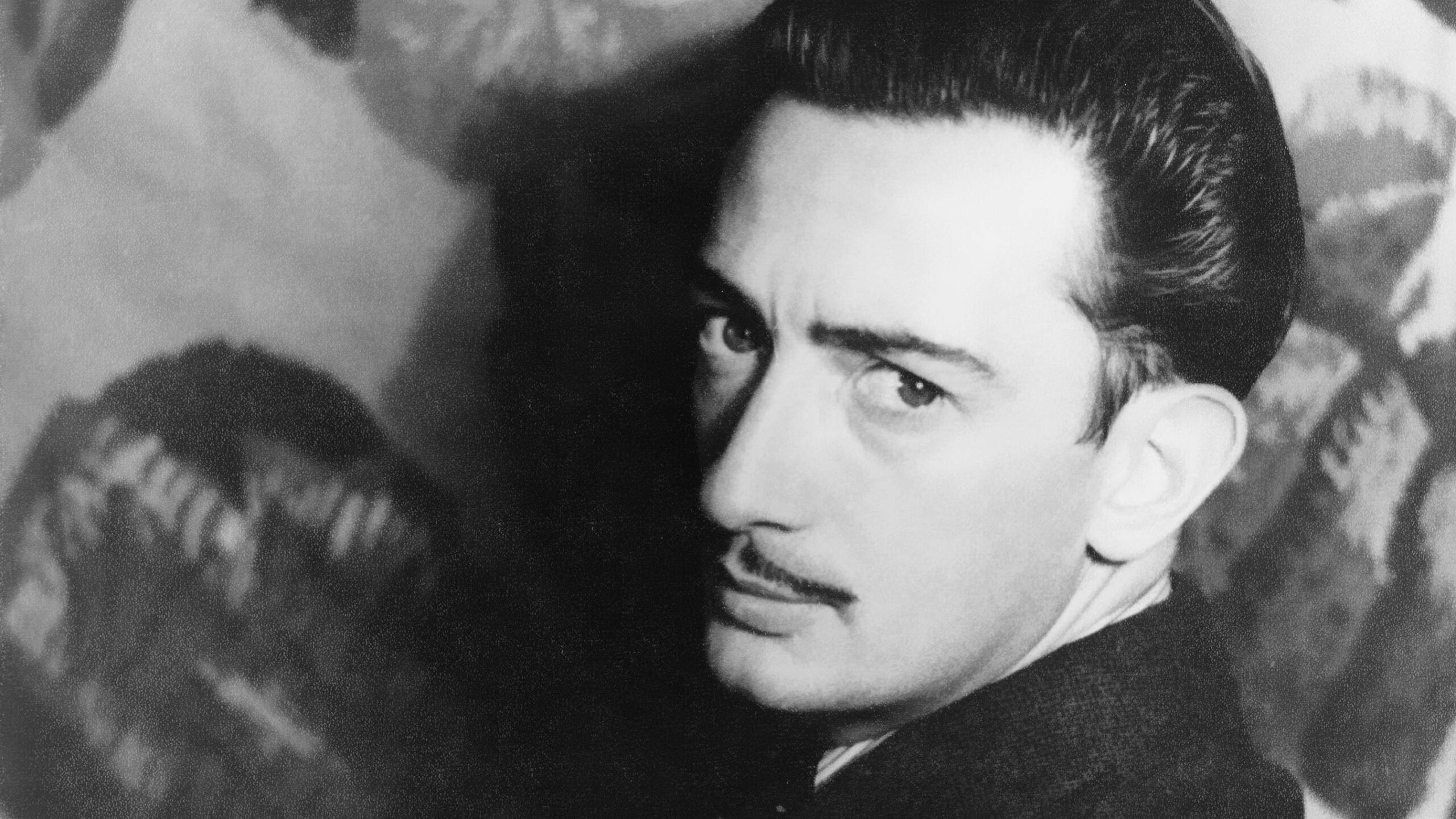
“Heaven is what I have been seeking all along and through the density of the confused and demoniac flesh of my life—heaven! Alas for him who has not yet understood that. . . . And what is heaven? Where is it to be found? Heaven is to be found, neither above nor below, neither to the right nor to the left, heaven is to be found exactly in the centre of the bosom of the man who has faith!”
—Salvador Dalí, The Secret Life of Salvador Dalí
Salvador Dalí is perhaps most well known for his eccentricity, upturned moustache, and paintings of melting clocks, yet ultimately, he was one of the most controversial, influential, and famous artists of the twentieth century. Dalí helped define modernist art and became the icon of surrealism. His work is hugely popular, influencing culture all over the world from fine art and fashion to cinema and advertising. Yet beneath the bizarre and sometimes confrontational public persona was a man grappling with faith and nonbelief dedicated to reconciling modern science with Catholicism through the medium of art. I would like to share some insights into Salvador Dalí’s life, work, and perplexing relationship to the Catholic faith.
Salvador Dalí was born on May 11, 1904, in Figueres, Catalonia, Spain, and baptized in the Church of Sant Pere (St. Peter). His older brother, also named Salvador, died nine months prior and haunted Dalí throughout his life. He created many paintings and drawings inspired by his brother, writing, “[My brother] was probably the first version of myself but conceived too much in the absolute.” Dalí’s father was a staunch atheist and his mother an ardent Catholic. His father’s nonbelief and his mother’s sincere faith formed the foundation for Dalí’s lifelong, complex connection to God and Catholicism. When Dalí was sixteen years old, his mother died of uterine cancer, which he described as “the greatest blow he had experienced in his life.”
A year later, he moved to Madrid and began studying at San Fernando Royal Academy of Fine Arts, where he met future surrealist director Luis Buñuel and modernist poet Federico García Lorca. Dalí began studying the old masters, particularly Velazquez, and experimenting with cubism. He also became acquainted with contemporary avant-garde movements like Dada and futurism, which, along with the cutting-edge psychoanalytic theories of Sigmund Freud, were to have a profound influence on the young Dalí. In 1926, he met Pablo Picasso and later quipped about their similarities and differences, “Picasso is a painter, so am I; Picasso is Spanish, so am I; Picasso is a communist, neither am I.”
From 1927, Dalí became increasingly “surrealist” in his work. The poet Apollinaire coined the term in 1917. The word was adopted by André Breton, who penned The Surrealist Manifesto (1924), defining surrealism as “psychic automatism in its pure state, by which one proposes to express—verbally, by means of the written word, or in any other manner—the actual functioning of thought. Dictated by the thought, in the absence of any control exercised by reason, exempt from any aesthetic or moral concern.”
In a typically paradoxical way, he expressed his sincere Catholicism, nonbelief, and the desire to use mysticism to “penetrate the core of reality.”
Surrealism encouraged the artist to let the unconscious mind express itself free of any aesthetic or moral constraint. It was heavily influenced by the nineteenth-century symbolists and Freud’s writing on the stages of psychosexual development, free association, and dreams. The unconscious mind and dreams became the foundation for the surrealist movement, as Breton expressed the goal of surrealism to “resolve the previously contradictory conditions of dream and reality into an absolute reality, a super-reality.” These concepts had an immeasurable impact on Dalí and formed the conceptual bedrock for his early work, including The Great Masturbator (1929) and The Persistence of Memory (1931). The depiction of melting clocks in a dreamlike landscape became one of the iconic images of not only Dalí’s career but the surrealist movement more broadly.
During this period, Dalí identified as an atheist and blamed Catholicism for his profound guilt about sex, lashing out with various provocative paintings and films. Perhaps most notable is his collaboration with surrealist filmmaker Luis Buñuel on the films Un Chien Andalou (1929) and L’Age d’Or (1930), clearly showing the young Dalí’s negative feelings toward the Church and the priesthood. The surrealists became heavily associated with left-wing political ideologies and parties, most notably the French Communist Party, which led to fractures between Dalí and the group. Ultimately, it was André Breton’s militaristic atheism and Dalí’s vocal shift toward supporting the Catholic Church after Franco’s 1939 victory in Spain that led to Dalí’s expulsion from the group. In 1942, he released his autobiography, The Secret Life of Salvador Dalí, which expressed his increasingly religious convictions:
One thing is certain: nothing, absolutely nothing, in the philosophic, aesthetic, morphological, biological or moral discoveries of our epoch denies religion. On the contrary, the architecture of the temple of the special sciences has all its windows open to heaven.
After World War II, Dalí returned to the place of his birth in Catalonia. He publicly expressed his formal return to Catholicism in 1949. The following year, Dalí was granted an audience with Pope Pius XII. He presented The Madonna of Port Lligat (1949) to his holiness, who approved of the image. The painting is an important turning point in Dalí’s career and set the tone for the subsequent works in his self-dubbed “nuclear mysticism” period. At this time, we see him embracing Renaissance painters like Raphael and particularly the work of Piero della Francesca. Dalí paid direct homage to Piero’s masterwork Brera Madonna (1472) by including the hanging shell/egg (at the top of the image) and employing the geometric compositional structures of which Piero was a forerunner. The Madonna of Port Lligat is an early example of his developing nuclear mysticism, as he expressed about the painting:
Modern physics has revealed to us increasingly the dematerialization which exists in all nature and that is the reason why the material body of my Madonna does not exist and why in place of a torso you find a tabernacle “filled with Heaven.” But while everything floating in space denotes spirituality it also represents our concept of the atomic system—today’s counterpart of divine gravitation.
Nuclear mysticism was a term coined by Dalí, combining his explorations into Catholicism, classicism, physics, math, and art. Dalí became fascinated by the concept of the atom after the bombing of Hiroshima and Nagasaki at the end of World War II. He was drawn to the concept of the atom as the principal particle in the material world and by the image of the spiral, which he thought to be a symbol of cosmic order. After a visionary dream, he likened Christ to “the nucleus of the atom. . . . This nucleus later took on a metaphysical sense; I considered it the very unity of the universe, the Christ.” Much like the concept of atomic fusion, Dalí sought to fuse modern science and traditional religion into a unifying concept. On a psychological level, nuclear mysticism was also an attempt to reconcile his father’s atheism with his mother’s faith. In 1950, he delivered a lecture in Barcelona titled “Why I Was Sacrilegious, Why I Am a Mystic.” In a typically paradoxical way, he expressed his sincere Catholicism, nonbelief, and the desire to use mysticism to “penetrate the core of reality.” Through this lecture, we get an insight into Dalí and nuclear mysticism:
I believe in God, but I have no faith. Mathematics and Science tell me that God must exist, but I don’t believe it. . . . [Mysticism is] the profound intuitive knowledge of what is, direct communication with all, absolute vision by the grace of Truth, by the grace of God. . . . By reviving Spanish mysticism I, Dalí, shall use my work to demonstrate the unity of the universe, by showing the spirituality of all substance.
The next year Dalí composed Mystical Manifesto (1951), expressing the central desire of his nuclear mysticism work:
I want my next Christ to be a painting containing more beauty and joy than anything that will have been painted up to the present. I want to paint a Christ that will be the absolute contrary in every respect to the materialist and savagely anti-mystical Christ of Grünewald!
In Dalí’s view, contemporary crucifixion paintings had drawn inspiration from the grotesque expressionism in Grünewald’s Isenheim Altarpiece (1512). Dalí sought to depict Christ as conventionally beautiful, classical, and imbued with mystical luminosity with an explicit intent to bring more holiness and beauty into the world. This intention corresponds with the aims of sacred art outlined in the Catechism of the Catholic Church: “Sacred art is true and beautiful when its form corresponds to its particular vocation: evoking and glorifying, in faith and adoration, the transcendent mystery of God—the surpassing invisible beauty of truth and love visible in Christ” (CCC 2502).
Dalí’s Crucifixion (1954) depicts his antithesis for expressionistic realism and his desire to combine Catholicism, science, and surrealism into a new modern vision of Christ’s sacrifice. The painting depicts Christ on the polyhedron net of a hypercube, suspended above black and white tiles, with Mary Magdalene staring up at him in a stark landscape. Its sublime combination of geometric shapes, mathematics, and Catholic imagery perfectly express nuclear mysticism, with Dalí describing the work as “metaphysical, transcendent cubism.”
Perhaps the most famous work from Dalí’s nuclear mysticism period is The Sacrament of The Last Supper (1955). Dalí’s work echoes Da Vinci’s Last Supper (1495) with Christ and the twelve apostles spread along a wide canvas. Dalí conforms his figures to the golden or divine ratio, expressing that “the Communion must be symmetrical.” Theologian Paul Tillich famously hated the image, describing Dalí’s Christ as “a sentimental but very good athlete on an American baseball team” and stated simply that it was “junk.” In contrast, Catholic theologian Michael Novak expressed his admiration for the image, stating, “Dalí gives us the real Presence of Christ in the Eucharist.”
Dalí’s explicitly Catholic paintings culminated in The Ecumenical Council (1960). The painting depicts the coronation of Pope St. John XXIII, whom Dalí met in 1959. Dalí shows us a fantastical vision of the pope’s coronation at the intersection between heaven and earth, surrounded by angels and witnessed by the Holy Trinity. It was inspired by the Second Vatican Council, convened by Pope John XXIII to “update” the Catholic Church to better engage with an increasingly secular world, a concept referred to as aggiornamento. Vatican II deeply resonated with Dalí, whose mission to renew Catholicism in modern art ran concurrent with the aims of the council.
For all Dalí’s personal flaws, contradictory statements, and panache for showmanship, his nuclear mysticism was a genuine attempt to create Catholic art in a world increasingly dominated by secularization. In his unconventional way, Dalí wanted to update Catholic art for the modern world. He sought to illuminate Christ within the microcosm of the atom and fuse Catholic theology with modern science through the window of his art.
Salvador Dalí died in the place of his birth in Spain in 1989 at the age of 84. He received last rites and a Catholic funeral at the Church of Sant Pere, where he was baptized. Dalí’s life, work, and legacy remain a cornerstone in the history of modern art and culture, with sold-out retrospective exhibitions all across the world and portrayals in several films, including by Ben Kingsley in Dalíland (2022). Yet I would argue the most important contribution in Dalí’s vast oeuvre is his artistic synthesis of Catholicism with modern science, resulting in some of the most astonishing mystical perspectives of the twentieth century.