
This year, 2025, marks the twenty-fifth anniversary of Word on Fire. Through his numerous speeches, Reddit AMAs, Word on Fire Show episodes, Sunday Sermons, the CATHOLICISM and Pivotal Players series, books, articles, interviews, and more, our founder, Bishop Robert Barron, has arguably become the world’s most renowned Catholic evangelist.
It is no surprise that someone so widely known who is outspoken about the goods and ills in contemporary culture would be applauded by some and despised by others. Regarding the latter, some of his critics come from outside the Catholic Church; others are fellow Catholics. Given that Bishop Barron has probably led to the conversion or reversion of more people to the Catholic faith than almost anyone else alive today, one might think he’d be cut some slack by his coreligionists.
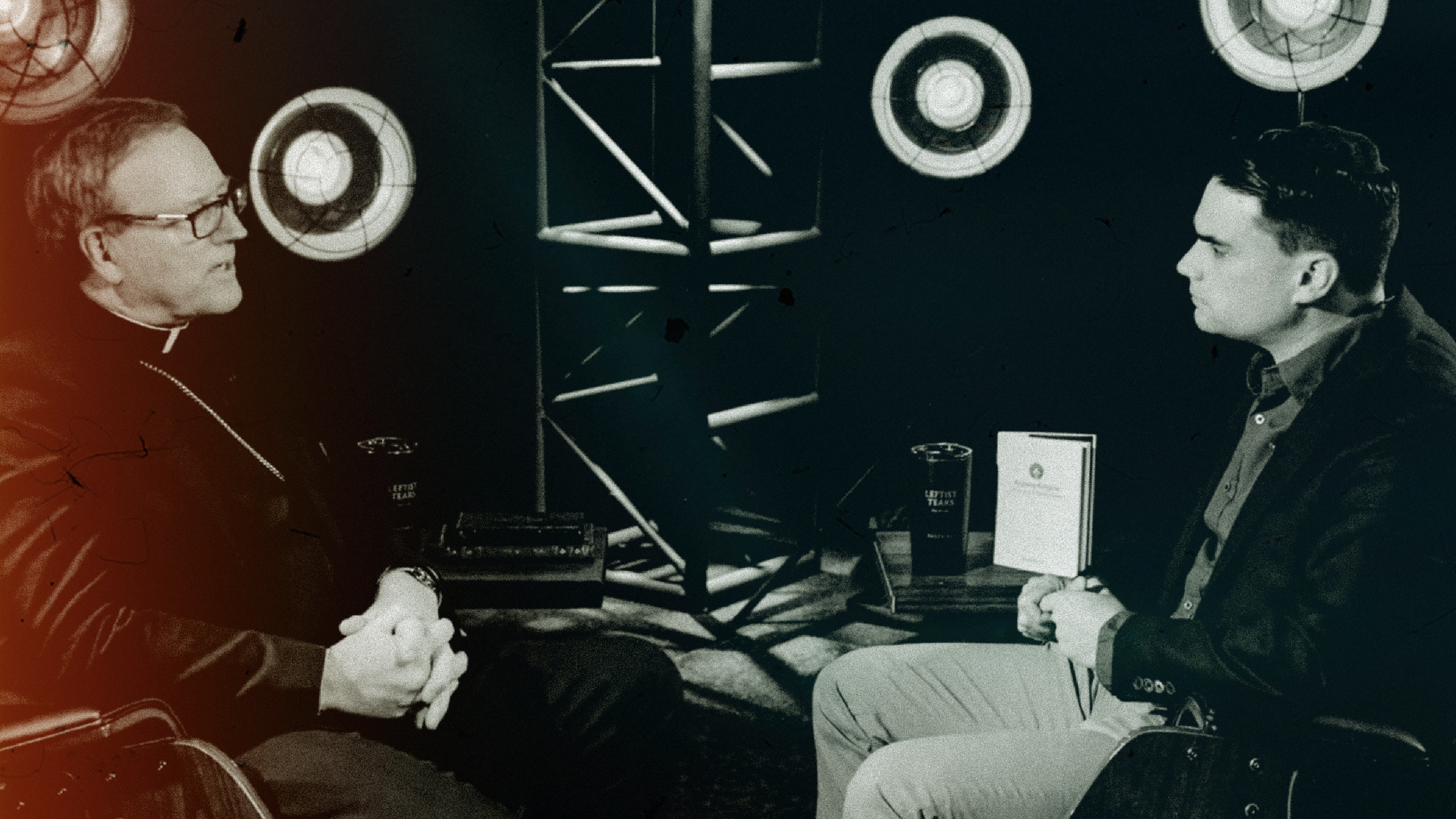
Yet, despite his several decades of public ministry, which predate the start of Word on Fire, some Catholics act as though the good bishop has only ever talked about two things: a book by Balthasar they didn’t read and a single phrase used in a lengthy interview with Ben Shapiro, which they likely didn’t watch in its entirety. Quite frankly, it is tiresome to see those two things brought up repeatedly by fellow Catholics as a means of dismissing the tremendous work of evangelization that Bishop Barron and Word on Fire have accomplished, as if those two points represent his every thought and constitute the essence of his entire ministry.
The book by Balthasar has been addressed here, for those interested, where it is clarified what the bishop means—and does not mean—by “hope.” Given what is often said about Bishop Barron on this topic, some might be shocked to learn that he does not think—nor does he expect—that all will be saved.
However, I would like to focus on the Ben Shapiro interview that took place almost seven years ago but which people still bring up as criticism against Bishop Barron. Specifically, I would like to focus on what Bishop Barron said during the interview to combat the charge that Bishop Barron failed to evangelize or proclaim the gospel. I have encountered this charge many times, and I would like to provide some counterevidence.
Bishop not only bore witness to the good news believed by all Christians but—on more than one occasion—advocated for Catholic Christianity specifically.
After discussing general views about reason and religion, Ben Shapiro asked Bishop Barron a question that Ben said he really did not care all that much about personally, but others raise frequently. Ben is often asked how it feels to know that other people do not think he can go to heaven because he is Jewish and not a member of their religion. So, he asked what the Catholic position was. After professing that he strives to keep not only the Ten Commandments but 603 others and publicly advocates for Judeo-Christian values, Ben asked bluntly: “What is the Catholic view of me? Am I basically screwed here [meaning damned]?”
Some critics of Bishop Barron seem to think that it is a failure to evangelize to say anything short of “Ben, if you don’t become Catholic before you die, it is certain that you will burn in hell for all eternity.” Apparently, despite being a sincerely practicing Orthodox Jew, these folks seem to labor under the delusion that if bishop had simply made that bold statement, Ben would all of a sudden be scared into becoming Catholic. It is more likely that Ben would have begun to take Catholicism less seriously and tune out whatever else the bishop would have to say.
But the crux of the question posed here is this: Did Bishop Barron not evangelize? Did he fail to proclaim the gospel? To answer this question, let’s consider some things that Bishop Barron did say.
First, Bishop Barron stated that those who are saved, including those who are not explicitly Christians, are “saved through the grace of Christ . . . the grace is coming from Christ.” He immediately continues by rejecting relativism, which holds that all religions are the same and it does not matter what religion one adheres to.
Bishop Barron wisely pointed out the importance of the Jewish roots of Catholicism and enumerated problems that arise when this is forgotten. In particular, he emphasized that Jesus is misunderstood when the Old Testament background is not recognized. He then stated, “Jesus is, as Paul said, the yes to all the promises made to Israel. Jesus is the climax to the story of Israel.” He mentioned connections between the Mass and the Old Covenant temple sacrifices. He contrasted this with Protestant worship services that tend to be more didactic in character.
At least twice during the interview, Bishop Barron stated that Jesus Christ is the fulfillment of the promises made to Israel. At the same time, he said he did not want to downplay the differences between the Old and New Covenants, “because I am an evangelist” and “I want everyone to know the Good News, the evangelion, about Jesus.” He then provocatively affirmed that it is the God of Abraham, Isaac, and Jacob that became incarnate in Christ.

Elaborating still further, Bishop Barron proclaimed: “All the institutions of Israel—Torah, temple, covenant, prophecy—their purpose is to bring divinity and humanity together. . . . What is at the heart of Christianity is that divinity and humanity have met, now perfectly, in these two natures. . . . The hypostatic union of two natures, divine and human, in one divine person; that’s who Jesus is.” He then reiterates that Jesus is the fulfillment of the Torah, temple, and prophecy. He said that “what those [elements of Judaism] want has happened fully in him [Jesus Christ].” Remember, he is saying all this to Ben Shapiro, a devout Orthodox Jew, on Ben’s own very popular platform.
When asked about doctrinal development, Bishop Barron gave a response rooted in a soon-to-be Doctor of the Church, St. John Henry Cardinal Newman. While giving his answer, Bishop Barron spoke about the need for the magisterium to act as an umpire. Relatedly, he stated: “The 30,000 denominations of Protestantism is not a good reflection of Jesus’s great prayer ‘that they might be one’ [see John 17:21].” Thus, the bishop not only bore witness to the good news believed by all Christians but—on more than one occasion—advocated for Catholic Christianity specifically.
Let us seriously ask ourselves which words to Ben would be more likely to lead him to consider the Catholic claims more readily: 1) “Ben, become Catholic or go to hell” or 2) “Everything that you hold dear as a devout Orthodox Jew has culminated and reached its fulfillment in Jesus Christ.” Which claim, in fact, should be the greater motivation for Ben to consider the Catholic faith?
Quibble, if one must, with this phrasing or that, given spontaneously during a lengthy interview. Posit all the “could have said this” or “could have said that” hypotheticals one might like as a Monday morning quarterback. Pretend that, if it were oneself being interviewed, that one would have given the perfect answer and that Ben and his entire audience would now be Catholic.
I just ask you not to make the ridiculous claim that Bishop Barron did not evangelize. It is absurd to act as if he did not bear witness to the saving truth of the gospel. He stated that all salvation comes from the grace of Christ and repeatedly emphasized, quite directly, that Jesus fulfills the entire Law, all prophets, and the whole purpose of the temple worship of ancient Israel. That is evangelization. That is proclamation of the gospel.
Some might think telling Ben he’s going to hell would have been more “based,” but it would not have been more effective.