
“Indeed, an essential function of genuine beauty, as emphasized by Plato, is that it gives man a healthy ‘shock,’ it draws him out of himself, wrenches him away from resignation and from being content with the humdrum—it even makes him suffer, piercing him like a dart, but in so doing it ‘reawakens’ him, opening afresh the eyes of his heart and mind, giving him wings, carrying him aloft.”
—Pope Benedict XVI (Meeting With Artists, November 21, 2009)
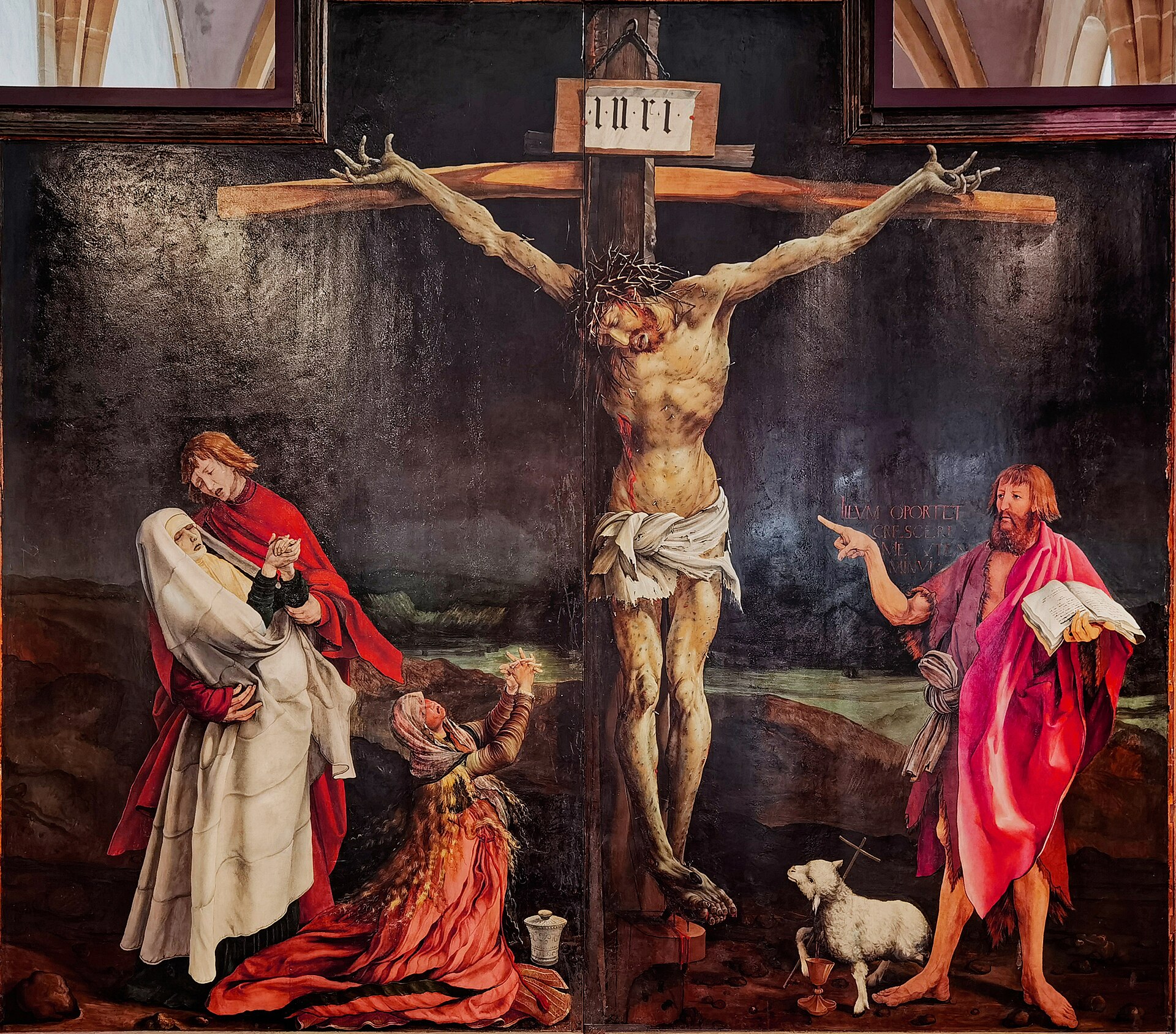
Pope Benedict XVI could have had Matthias Grünewald’s The Isenheim Altarpiece in mind when he made this address in 2009; there has scarcely been another painting in art history that balances shock and genuine beauty as Grünewald’s vision of the Crucifixion does. It is a work whose visceral power for reawakening has not diminished throughout the centuries and continues to speak to us deeply of suffering and redemption. I would like to delve into Matthias Grünewald’s life and The Isenheim Altarpiece, particularly its central panel, which Pope Benedict XVI called “perhaps the most moving painting of the crucifixion to be found in all Christendom.”
Little is known about Matthias Grünewald, whose actual name may have been Mathis Gothart Nithart. He was German and lived from roughly 1470–1528. His first securely dated work is The Mocking of Christ (1503) and demonstrates the young painter becoming a master. According to German art historian Joachim von Sandrart, Grünewald had a melancholic temperament and may have briefly been an apprentice to Albrecht Dürer. In 1510, he lived in Frankfurt and married eighteen-year-old Anna, who was later institutionalized for demonic possession. In 1511, he became the court artist to the Archbishop of Mainz, Albrecht von Brandenburg, an early opponent to Martin Luther. Grünewald depicts Brandenburg as St. Erasmus in Meeting of Saint Erasmus and Saint Maurice (1517). Unfortunately, only ten paintings and thirty-five drawings from Grünewald have survived; many were believed to have been lost in the Baltic Sea on a voyage to Sweden as war loot. His art has been described as continuing the late-medieval Central European tradition, favoring spiritual and mystical intensity over Renaissance classicism.
The Isenheim Altarpiece was commissioned as a work for the monastery of St. Anthony in Isenheim near Colmar, France. The Hospital Brothers of St. Anthony was a congregation in the Catholic Church founded by Gaston of Valloire and confirmed by Pope Urban II after Gaston’’s son was miraculously cured in 1095 from a poisoning known as “St. Anthony’s fire.” Antonine monks of the monastery were renowned for their care of plague sufferers and their treatment of skin diseases, most notably St. Anthony’s fire or ergotism. The Isenheim Altarpiece was inspired by Christ’s Passion, the Antonine monks, the ergot plague, and the mystical visions of St. Bridget of Sweden.
It’s a deeply moving image that shocks and astonishes the viewer with its violence, intensity, and profound beauty.
St. Bridget (1303–1373) began having visions at the age of ten, calling them revelationes coelestes. These celestial revelations deeply impacted art in the Middle Ages. Her account of the Nativity with Jesus radiating light before a blonde-haired and kneeling Virgin Mary became hugely influential during the sixteenth and seventeenth centuries. So, too, were her visions of the Passion and Crucifixion. The violent intensity and graphic detail of St. Bridget’s account must have been in the forefront of Grünewald’s mind when painting his Isenheim Crucifixion scene. St. Bridget recounted:
While I was at Mount Calvary weeping bitterly, I beheld my Lord, naked and scourged, led out to be crucified. . . . Joyfully ascending, like a gentle lamb led to the slaughter, when he was on those steps, he extended his arm, not forced, but voluntarily, and opening his right hand, laid it upon the cross, which his cruel torturers barbarously crucified, driving the nail through the part where the bone was most solid. Then violently drawing his left hand with a rope, they affixed it to the cross in a similar manner. Then stretching his body beyond all bounds, they fastened his joined feet to the cross with two nails, and so violently extended those glorious limbs on the cross, that all the nerves and veins were fairly broken. This done, they replaced on his head the crown of thorns, which they had taken off while affixing him to the cross, and fastened it on his most sacred head. It so wounded his venerable head, that his eyes were filled with the blood that flowed down. His ears, too, were closed, and his face and beard, as it were, covered and stained with that rosy blood.
Grünewald began work on The Isenheim Altarpiece in 1512. The work has two sets of wings displaying three configurations: the first view, the Crucifixion and entombment of Jesus; the second view, the Annunciation, Incarnation, and Resurrection; and the third view, Christ enthroned with the disciples, flanked by St. Anthony’s temptation in the desert. The paintings are composed of oil and tempera on limewood panels with gold-gilded and polychromed embellishments, giving an illuminated effect.
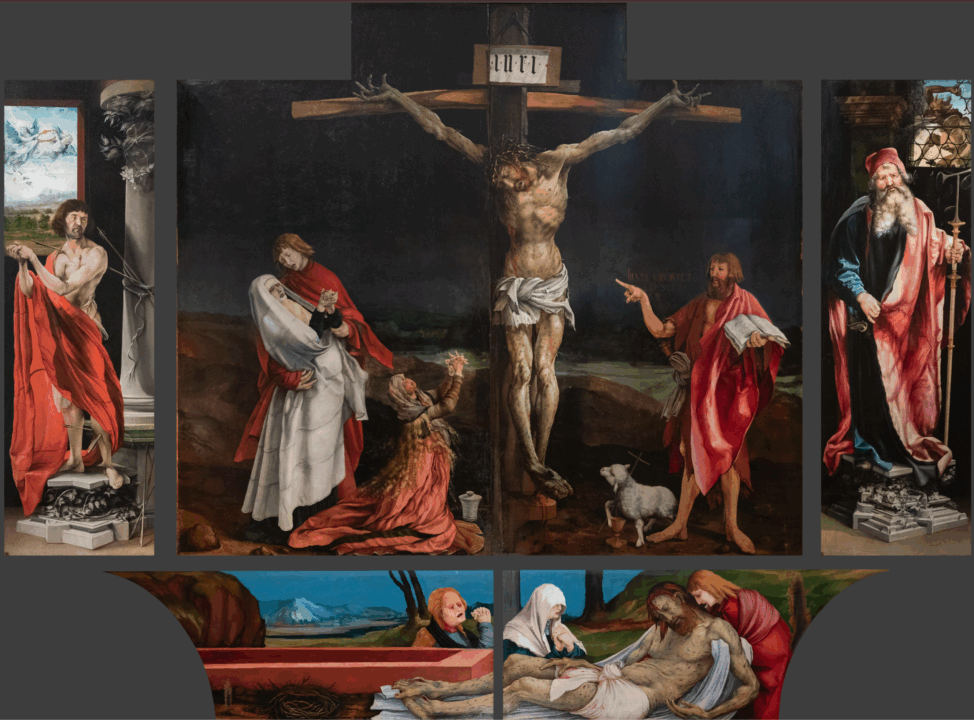

Focusing on the first view or Crucifixion panel, the background is painted in dark greens and browns, as we see low mountains amidst a desolate landscape and framed by a blackened sky. Christ’s Crucifixion is central and immediate in its intensity. Grünewald’s Christ is suffering incarnate—his hands are contorted, his arms are torturously long, his feet are folded beneath an iron nail, his body is yellowed and covered with sores, blood pours from his thorny crown as his face hangs limp, pallid and devoid of life. Even the horizontal crossbeam bends at the weight of his suffering. It’s a deeply moving image that shocks and astonishes the viewer with its violence, intensity, and profound beauty. This juxtaposition between horror and beauty foreshadows Edmund Burke’s reflections on the sublime in A Philosophical Enquiry into the Origin of Our Ideas of the Sublime and Beautiful (1756):
The passion caused by the great and sublime in nature, when those causes operate most powerfully, is Astonishment; and astonishment is that state of the soul in which all its motions are suspended, with some degree of horror. In this case the mind is so entirely filled with its object, that it cannot entertain any other, nor by consequence reason on that object which employs it. Hence arises the great power of the sublime, that, far from being produced by them, anticipates our reasonings, and hurries us on by an irresistible force.
The grotesque realism of the painting was meant as a source of consolation for the ergot sufferers entering the monastery who could see their own pain and affliction in Grünewald’s tormented portrayal. Hans J. Hillerbrand touched on this in his work “Christology, Jesus in The Visual Arts”: “Grünewald depicts Jesus’ body ravaged by crucifixion yet evokes pointedly the Christian message of Jesus’ horrible suffering; originally intended for a hospital, the altar painting may have been designed to provide comfort and solace to the sick.”
Within the Crucifixion scene, Grünewald includes Mother Mary, the disciple John, Mary Magdalene, and—anachronistically—John the Baptist with a lamb. John the Baptist had been beheaded by order of King Herod in c. 29 AD and could not have physically witnessed Christ’s death. Yet he is included as the prophet announcing in Latin, “Illum oportet crescere me autem minui” (He must increase but I must decrease), with the lamb beside him representing Christ as sacrifice and suffering triumphant (John 3:30).
“Astonishment is that state of the soul in which all its motions are suspended, with some degree of horror.”
Grünewald’s Crucifixion profoundly reflects the Catholic emphasis on the redemptive power of suffering. The Paschal Mystery (the suffering, death, Resurrection, and Ascension of Christ) is the central truth of Catholicism outlined in the Catechism of the Catholic Church, 613:
Christ’s death is both the Paschal sacrifice that accomplishes the definitive redemption of men, through the Lamb of God who takes away the sin of the world, and the sacrifice of the New Covenant, which restores man to communion with God by reconciling him to God through the ‘blood of the covenant, which was poured out for many for the forgiveness of sins.’
The Isenheim Crucifixion reflects the Paschal sacrifice and reminds us that Christ, Mary, and his followers endured the same darkness, violence, pain, and grief we all experience in this life. The painting invites us to conform our own personal suffering to Christ. If we draw our hearts closer to Christ and unite our pain with his cross, we can endure and transcend the suffering and evil of this world. In Salvifici Doloris, Pope John Paul II states:
Suffering, more than anything else, makes present in the history of humanity the force of the Redemption. In suffering there is concealed a particular power that draws a person interiorly close to Christ, a special grace.
This interpretation of suffering, not as punishment but as a particular power to draw a person closer to Christ, is echoed by St. Ignatius of Loyola:
If God causes you to suffer much, it is a sign that He has great designs for you, and that He certainly intends to make you a saint.
Suffering conformed in proper relationship to the cross, as outlined through Church teaching and tradition, can have a purifying effect on the soul and deepen a person’s relationship to Christ and God. The Isenheim Crucifixion calls us to greater conformity, unity, communion, and relationship not only with Christ and his Passion but with the suffering of all mankind. Through Grünewald’s Crucifixion, we see not only our own pain but the pain of all our brothers and sisters suffering throughout the world. The Isenheim Crucifixion appeals to our hearts and demands not only our attention but our compassion and empathy, becoming an extraordinary window into God’s love and our own capacity for love.
After Grünewald’s death in 1528, he disappeared into obscurity, with many of his works being attributed to Albrecht Dürer. He was rediscovered and championed during the height of nineteenth-century Romanticism by Joris-Karl Huysmans, Vermeer, and modernists like Marcel Proust. The more Gothic, visceral, exaggerated elements of Grünewald’s work anticipated German Expressionism, particularly the work of Otto Dix and Ernst Ludwig Kirchner. The composer Paul Hindemith based his 1938 opera Mathis der Maler on the life of Grünewald and included reenactments of scenes from The Isenheim Altarpiece. I believe you can see Grünewald’s influence on Mel Gibson’s The Passion of the Christ (2004) where Christ’s suffering is depicted in severe detail to shock, reawakening modern audiences to his sacrifice. Yet it is Grünewald’s legacy in the Christian world that has perhaps had the deepest impact. Pope Benedict XVI wrote extensively on Grünewald and The Isenheim Altarpiece, notably in his work The Spirit of the Liturgy (2000):
Though Grünewald’s altarpiece takes the realism of the Passion to a radical extreme, the fact remains that it was an image of consolation. It enabled the plague victims cared for by the Antonians to recognize that God identified with them in their fate, to see that he had descended into their suffering and that their suffering lay hidden in his.
The Isenheim Altarpiece transcends art and is an icon of suffering, proclaiming the redemptive power of Christ and his sacrifice, offering the consoling message to us all: “By his wounds, we are healed” (Isaiah 53:5).