
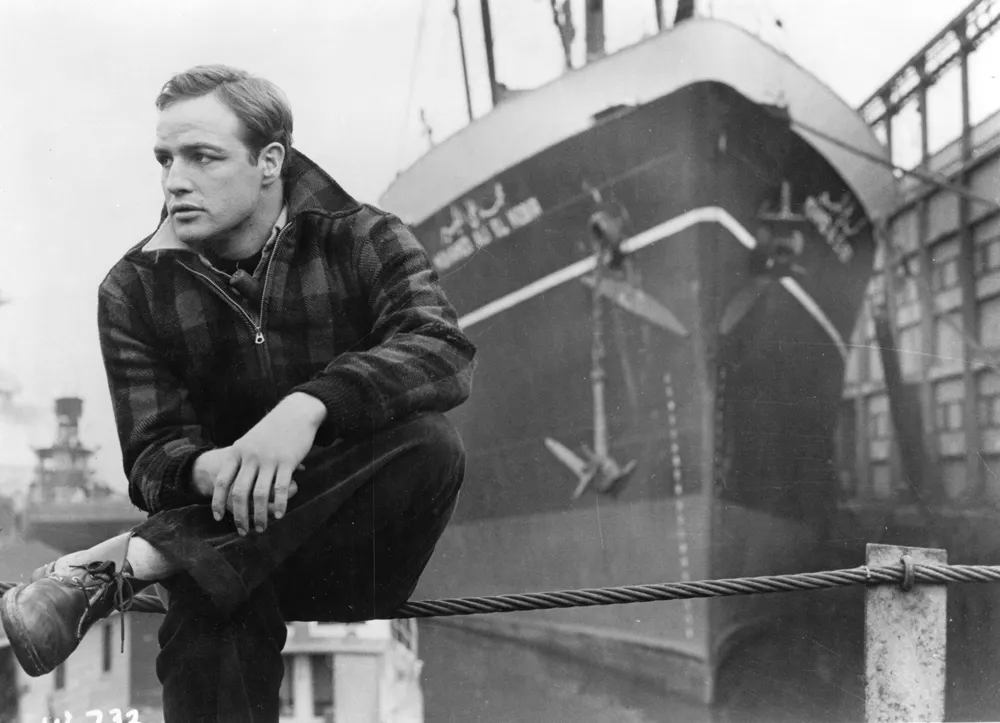
On the Waterfront (1954) is among the most influential films in Hollywood history. Renowned film critic Roger Ebert wrote in 1999, “The acting and the best dialogue passages have an impact that has not dimmed; it is still possible to feel the power of the film and of Brando and Kazan, who changed American movie acting forever.”
The film became the definitive work of “actors’ director” Elia Kazan, inspiring countless artists, including Martin Scorsese and Robert De Niro, who called Kazan “a master of a new kind of psychological and behavioral faith in acting.” Marlon Brando’s powerful, complex, and vulnerable performance as Terry Malloy set the standard for acting in the generations to come, with Kazan concluding, “If there is a better performance by a man in the history of film in America, I don’t know what it is.”
As On the Waterfront was included in the Vatican’s 1995 Alcuni film importanti list, here are some of the Catholic themes woven throughout the film.
Elia Kazan (1909–2003) was a Greek-American filmmaker, producer, screenwriter, and actor, described by Stanley Kubrick as “without question, the best director we have in America, and capable of performing miracles with the actors he uses.” Kazan started his career in acting and was an early adherent to the new “method acting” school under the direction of Lee Strasberg. From the outset, Kazan had a particular attraction to stories exploring personal and social issues, including racial prejudice, domestic violence, and union corruption: “I don’t move unless I have some empathy with the basic theme.”
He acted in a few films but found acclaim for his directorial work at the helm of classics like Gentlemen’s Agreement, Pinky, A Streetcar Named Desire, East of Eden, and On the Waterfront. Kazan and the young Marlon Brando first worked together on the Broadway adaptation—and subsequent film adaptation—of Tennessee Williams’s play A Streetcar Named Desire, the story of Blanche DuBois who leaves her wealth to live in the working-class apartment of sister Stella and brother-in-law Stanley (Marlon Brando).
Brando later wrote:
I have worked with many movie directors. . . . Kazan was the best actors’ director by far of any I’ve worked for . . . the only one who ever really stimulated me, got into a part with me and virtually acted it with me. . . . He was an arch-manipulator of actors’ feelings, and he was extraordinarily talented; perhaps we will never see his like again.
After the success of Streetcar, Kazan and Brando collaborated again on Viva Zapata! before embarking on their most ambitious project to date, On the Waterfront. The film was inspired by the 1948 New York Sun article series “Crime on the Waterfront” by Malcolm Johnson, which outlined corruption on the New Jersey waterfront.
He reflects the Church’s prophetic duty never to stay silent in the face of evil, to confront injustice even when it is unpopular and dangerous.
The production was controversial from the outset. Hollywood was in the grip of post–World War II anti-communism, dubbed “McCarthyism” after its best-known advocate Senator Joseph McCarthy. Kazan was a former member of the American Communist Party, and in 1952 he was asked by the House Un-American Activities Committee (HUAC) to identify under oath communists he knew sixteen years prior. Kazan eventually provided the HUAC with eight names, including Clifford Odets, Phoebe Brand, and J. Edward Bromberg. He received widespread criticism and took out an ad in the New York Times to shed light on his decision to testify:
I believe that Communist activities confront the people of this country with an unprecedented and exceptionally tough problem. . . . Firsthand experience of dictatorship and thought control left me with an abiding hatred of these. It left me with an abiding hatred of Communist philosophy and methods and the conviction that these must be resisted always. It also left me with the passionate conviction that we must never let the Communists get away with the pretense that they stand for the very things which they kill in their own countries. I am talking about free speech, a free press, the rights of property, the rights of labor, racial equality and, above all, individual rights. . . . I believe these things must be fought for wherever they are not fully honored and protected whenever they are threatened. The motion pictures I have made and the plays I have chosen to direct represent my convictions.
The HUAC testimony cast a long shadow over Kazan’s career. The controversy resurfaced in 1999, when he was invited to receive a Lifetime Achievement Academy Award and the audience split between emphatic applause and disdainful silence.
On the Waterfront tells the story of Terry Malloy (Marlon Brando), an ex-boxer/dockworker who confronts the corrupt union/mob boss Johnny Friendly (Lee J. Cobb) after feeling guilty over his involvement in a neighborhood murder. With inspiration from Catholic priest Fr. Barry (Karl Malden) and the murder victim’s sister, Edie Doyle (Eva Marie Saint), Terry finds the profound courage to testify, risking life and livelihood to confront evil. These three characters—Terry, Fr. Barry, and Edie—form the crucible at the film’s heart.
Edie Doyle embodies a Marian quality in the film, acting as a light in a fallen world and representing innocence, truth, and forgiveness. She is a source of inspiration for both Terry and Fr. Barry. Edie is deeply affected by her brother Joey’s murder and seeks justice in a world where injustice rules. In the scene where she discovers Fr. Barry giving the body of her brother the last rites, she confronts the priest’s initial reservations to confront injustice—“What kind of saint hides in church?”—setting Fr. Barry on his journey to confront evil.
Equally, the flawed romance between Terry and Edie acts as a stirring spirit of conversion in Terry’s heart: As his love for Edie grows, so does his desire to conform to her moral and spiritual standards. During the scene of their first date, the viewer is clearly introduced to Terry’s character and Edie’s Catholic formation. Throughout this conversation, Terry cynically references Fr. Barry as a man with a racket or a corrupt agenda to push, whilst Edie responds with authoritative innocence: “But he’s a priest.”
Through Kazan’s direction and Malden’s sublime performance, Fr. Barry becomes one of the greatest portrayals of a Catholic priest in cinematic history. The station of the Catholic priest is given correct sovereignty, and he is depicted as a deeply human, compassionate, courageous, and awe-inspiring figure. He embodies the Church’s authority and is the moral leader and shepherd of the community. He’s down in the streets educating “his parish” in Catholic social teaching—human dignity, solidarity, and the common good—while showing his conviction that faith must be lived out in action, not only in word. He reflects the Church’s prophetic duty never to stay silent in the face of evil, to confront injustice even when it is unpopular and dangerous. Fr. Barry’s spine-tingling speech in the docks strikes at the heart of Catholicism and the gospel, becoming one of the most inspiring speeches ever put to celluloid.
Fr. Barry is down in the darkness, in the pit of corruption, sin, and murder, defiantly speaking out only to be mocked, ridiculed, and despised, evoking the fervor of Christ overturning the money lenders’ tables in the temple (Matthew 21:12–13). The unification of the dockworkers’ suffering with Christ’s passion reminds us of the gospel’s profound power to inspire the subjugated to faith, freedom, and justice. It calls to mind Lech Wałęsa’s Solidarity movement and its significant contribution to overthrow Soviet rule in post–World War II Poland.
Terry Malloy begins the story as an accomplice in evil. He helps lure a fellow dockworker to his death and lives passively under corrupt union rule. He sins through omission and cooperates with the morally bankrupt union and mob bosses. He was a participant in what Hannah Arendt called “the banality of evil”: the suggestion that sinful acts are committed by ordinary people who abdicate their responsibility to question the morality of their actions and instead conform to a corrupt system or culture. In the famous “I coulda been a contender” scene, we see how long this moral decay has eaten away at Terry’s soul and how he has betrayed his conscience for the “short-end money.”
Yet while he comes to this realization through his own spiritual evolution, his conscience is awakened by his relationships with Edie and Fr. Barry. It is important to emphasize the role these relationships have in Terry’s moral and spiritual conversion, from his orientation to self-survival and easy money to personal and community-wide redemption. The profound scene where Fr. Barry confronts Terry to search his conscience and reveal the truth to Edie so eloquently and tragically shows Terry’s inner battle. As he confesses to Edie and later testifies in court, he takes responsibility for his actions and seeks to repent. By standing up to Johnny Friendly, Terry receives a savage beating and reflects Christ in his passion, enduring physical, psychological, and spiritual suffering to redeem not only himself but the workers around him.
Through his personal self-sacrifice, he moves from sin and complicity in evil to faith, love, and profound moral courage, a contemporary prodigal son who finds redemption by choosing truth over fear.
Upon its release, On the Waterfront earned an estimated $4.2 million. Contemporary New York Times film critic A. H. Weiler called it “an uncommonly powerful film, exciting, and imaginative use of the screen by gifted professionals.” The film won eight Academy Awards, including Best Motion Picture, Best Director, and Best Actor for Marlon Brando, whose performance has been regarded as a watershed moment in acting history. Martin Scorsese noted, “Everything that we know about the power of great screen acting relates back to him: when you watch his work in On the Waterfront . . . you’re watching the purest poetry imaginable, in dynamic motion.” As mentioned, the film was included as one of the forty-five films in the Vatican’s Alcuni film importanti list in 1995 under the heading “Values”; it was also voted fifth-best religious film in a Church Times poll in April 2007.
I have long counted On the Waterfront one of my favorite films. It’s the combination of Brando’s mercurial performance, Kazan’s masterful direction, Saint’s radiant beauty, but above all Fr. Barry’s sermon in the darkness, where he unites the suffering of working class people to Christ’s passion:
Some people think the crucifixion only took place on Calvary. Well, they’d better wise up. Taking Joey Doyle’s life to stop him from testifying is a crucifixion. And dropping a sling on Kayo Dugan because he was ready to spill his guts tomorrow—that’s a crucifixion. And every time the mob puts the crusher on a good man, tries to stop him from doing his duty as a citizen? It’s a crucifixion. . . . You want to know what’s wrong with our waterfront? . . . It’s forgetting that every fella down here is your brother in Christ. But remember, Christ is always with you. Christ is in the shape-up; he’s in the hatch; he’s in the union hall; he’s kneeling right here beside Dugan. And he’s saying to all of you: “If you do it to the least of mine, you do it to me.”