
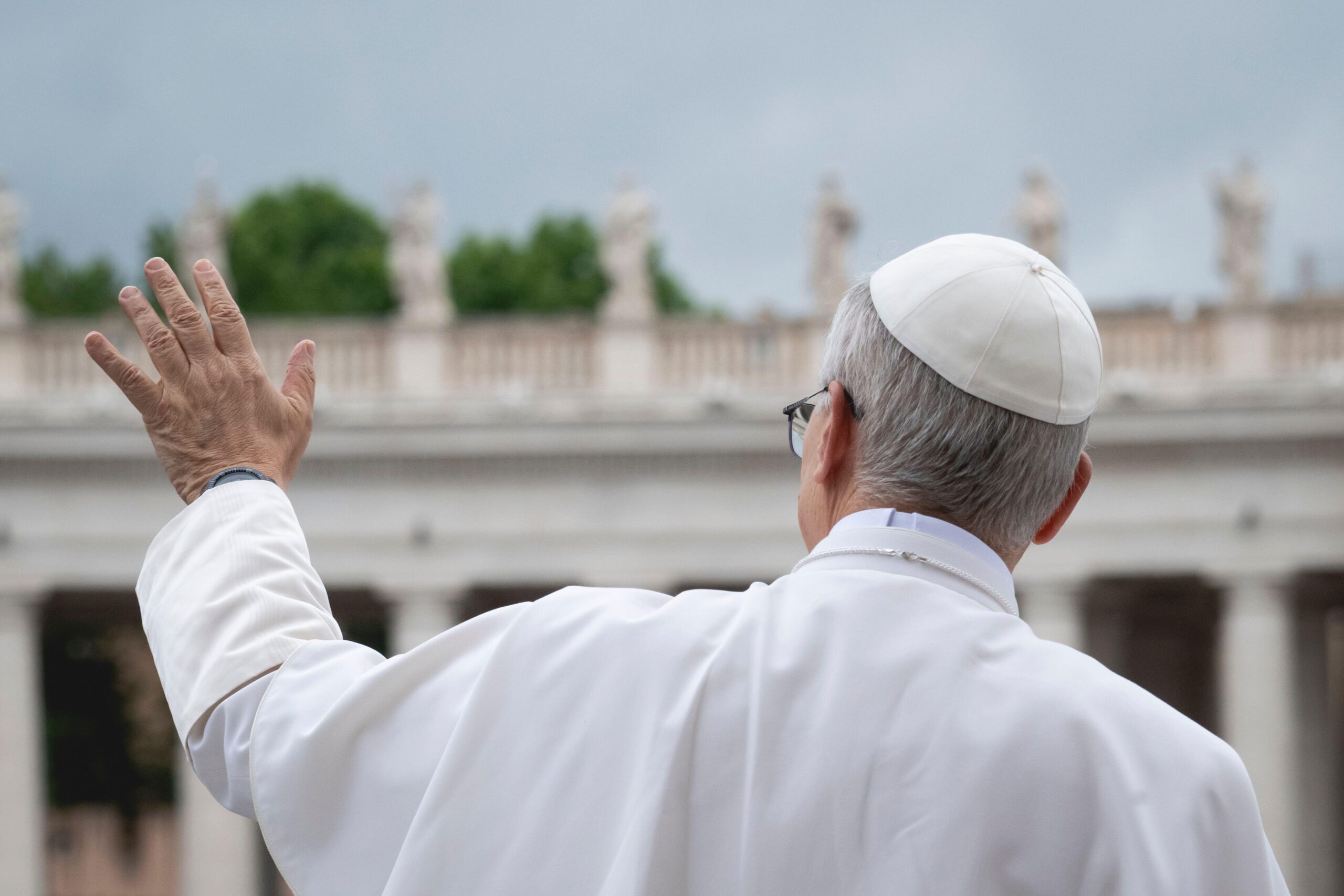
In recent times, media coverage of papal remarks—especially in the Wild West of social media Catholicism—has come to assume a regrettable pattern. The pope gives a speech or grants an interview, and opposing factions predictably amplify selected lines to support preexisting positions they want to advance.
In the case of Pope Francis, for example, some progressives treated his commentary on global warming in Laudato Si’ as if it were infallible, wielding it as a cudgel against conservatives while conveniently ignoring the encyclical’s many pro-life statements (some of which are among the boldest ever articulated by a Roman pontiff on the inalienable dignity of human embryos). Meanwhile, it was not uncommon at the time to find conservatives roundly dismissing the same encyclical’s environmental teaching, so intent on rebutting progressive claims that they overlooked its many pro-life pearls.
While it remains vital to assume good motives on the part of one’s interlocutor, such discrepancies suggest that the handling of papal teaching is often more about political jockeying than a genuine effort to follow the mind of the Church.
Fast forward to the present day, and the same thing is happening in the pontificate of Leo XIV. As I have observed both in person and in the frenetic and fragmented world of social media, papal comments on issues as wide-ranging as economics, climate, migration, and war are routinely seized upon by opposing camps as opportunities for pressuring consumers of their content into conformity. A statement is leveraged by one side as a “gotcha,” while it is dismissed by the other as non-authoritative. The next papal remark is then interpreted in precisely the opposite manner, readily foreseeable if you knew the prior ideological commitments of the individual pontificating about it. Within the obfuscating dynamics of the social media cloud, the aim is to apply maximum rhetorical pressure, score quick points, and win others to your side in 280 characters or fewer.
In this climate, it is convenient for the purveyor of a particular agenda to elevate a passing comment by the pope on a geopolitical situation to the level of binding authority—and to frame it in maximalist terms calibrated to game the algorithms, attract attention, and convert it into profit. This pattern—found among progressivist as well as traditionalist circles—tends to follow a predictable logic whereby any disagreement with the author’s claim is framed not merely as a difference of prudential judgment but as heretical opposition to the pope himself.
The authentic voice of the Roman pontiff is obscured as the papacy is conscripted into the service of competing political and ideological agendas.
Judging by what one finds in comment boxes, this tactic is often highly persuasive. In an age where the faithful have a deep hunger for authoritative clarity yet have a hard time identifying its proper sources amid the deluge of online content vying for their attention, one is tempted to latch onto whichever outlet blares its position with the most aggressive confidence. At times, this results in private podcasters being invested with an authority on par with or even eclipsing that of the pope himself. In such cases, the authentic voice of the Roman pontiff is obscured as the papacy is conscripted into the service of competing political and ideological agendas.
While the yearning for certainty is understandable, the way it plays out in practice frequently reflects a misunderstanding of what the Church actually teaches about papal infallibility. Clearly, we must do better, and thankfully the Church offers solid resources for doing so if only we are willing to attend to them. The modest task that follows is to bring some of these resources into clearer focus.
Newman vs. Ultramontanism: Then and Now
To set this matter on firmer footing, one can hardly do better than turn to the writings of St. John Henry Newman. In looking to the work of the newly minted Doctor of the Church, the following is neither a critique of particular contemporary voices advancing errors, nor a scholarly primer on infallibility,1 but simply a brief distillation of the Church’s teaching concerning the parameters of infallibility.
Misunderstanding the scope of infallibility, between prudential judgment and binding teaching, can lead to a subtle but real distortion of Catholic faith: the replacement of doctrinal fidelity with ideological allegiance. Newman confronted precisely this tendency in correspondence with Catholic hardliner William George Ward, one of the era’s most ardent ultramontanists known for pressing a maximalist account of papal authority. Critiquing an approach he saw as making “much out of such natural difference of opinion,” Newman described Ward’s posture as “utterly uncatholic” and told his interlocutor: “You will persist in calling the said unimportant, allowable, inevitable differences (which must ever exist between mind and mind,) not unimportant, but of great moment.” According to Newman, Ward was guilty of “making a Church within a Church, as the Novatians of old did within the Catholic pale” and of imitating certain Evangelical preachers of the day who insisted that everyone “profess the small shibboleths of their own sect.” In other words, Newman perceived that Ward was reproducing a sectarian Protestant impulse under a Catholic banner:
You are doing your best to make a party in the Catholic Church, and in St Paul’s words are “dividing Christ” by exalting your opinions into dogmas, and, shocking to say, by declaring to me, as you do, that those Catholics who do not accept them are of a different religion from yours.
I protest then again, not against your tenets, but against what I must call your schismatical spirit. I disown your intended praise of me, viz. that I hold your theological opinions “in the greatest aversion,” and I pray God that I may never denounce, as you do, what the Church has not denounced.2
With these striking words, Newman recognized long before the age of social media that exaggerating papal authority beyond its proper bounds ultimately weakens genuine Catholic unity.
The Meaning and Limits of Infallibility
The 1875 Letter to the Duke of Norfolk, penned by Newman shortly after Vatican I’s Pastor Aeternus defined papal infallibility, is especially valuable for countering the sort of mentality that he encountered and which remains very much with us today on the internet. His account of papal authority in this classic work stresses that the Roman pontiff’s singular charism is carefully circumscribed and does not extend to casual remarks, prudential judgments, or political preferences.
Newman’s treatment of infallibility is inseparable from his own intellectual and spiritual journey. As a convert whose studies in the development of doctrine led him to conclude that “to be deep in history is to cease to be a Protestant,” he approached the question with unusual historical sensitivity.3 Prior to 1870, he thought that a formal definition would be better reserved for a later moment, fearing that it would encourage exaggerated views of papal authority that would provoke backlash and ultimately undermine the Church’s credibility. Indeed, in a strikingly Newmanian vein, then-prefect of the Congregation for the Doctrine of the Faith, Joseph Ratzinger, once observed that although pastoral missteps do not undermine the infallibility of popes, the Vatican has at times issued statements that “overextended the range of what faith can guarantee with certainty,” with the result that “the Magisterium’s credibility was injured.”4
Of course, Newman would not be a Doctor of the Church had he not wholeheartedly embraced Vatican I’s definition of infallibility once it was promulgated. And, indeed, this is precisely what we see in the aforementioned 1875 letter, written in response to the anti-Catholic polemics that followed the council—especially UK Prime Minister William Ewart Gladstone’s charge that Catholics were deprived of “mental freedom” and had become “captives and slaves of the Pope.”5
Aiming to clarify the scope and proper interpretation of Vatican I’s teaching that the pope is infallible only when speaking ex cathedra—that is, when, as universal shepherd and teacher, he “defines a doctrine concerning faith or morals to be held by the whole Church”6—Newman explains that the exercise of the charism of infallibility is rare and carefully delimited. “His infallibility,” the saint writes, “is not called into exercise, unless he speaks to the whole world,” adding, “In order to be dogmatic, it must involve what is necessary to salvation and necessary for everyone. Accordingly, he makes it clear that directives concerning “particular countries, or political or religious classes, have no claim to be the utterances of his infallibility.”7
The pope, in other words, is not an oracle whose every casual opinion or preference carries doctrinal force. His authority exists to safeguard and faithfully transmit revelation, not to expand indefinitely into every domain of life. This is by no means to say that the pope’s ordinary statements constitute merely one opinion among others or that they should not be received with charity and filial receptivity. Rather, we Catholics are called to approach the successor of Peter with the same sort of trust and reverence we would show to our own father or mother, whose word we ought to respect even when not being expressed with the full weight of a solemn definition. For this reason, as Vatican II teaches, “Even when he is not speaking ex cathedra,” the Roman pontiff’s authentic ordinary magisterium calls for “religious submission of mind and will”8—a teaching later echoed in the Catechism’s distinction between the assent of faith proper to divinely revealed doctrine and respectful religious assent to the ordinary teachings that deserve reverence but do not bind the conscience of the faithful under pain of sin.9
Conscience, Prudence, and Legitimate Diversity Within Catholic Unity
This clarification also grounds Newman’s famous defense of conscience. Because the pope is not infallible in matters of prudential governance or political judgment, Newman argues that no absolute conflict can arise between papal authority and a properly formed conscience that finds itself at odds with a given statement made by a pope. “Conscience,” he famously wrote, “is the voice of God in the nature and heart of man,” indeed “the aboriginal Vicar of Christ.”10 At the same time, the Doctor sharply distinguishes conscience from subjectivism or self-assertion. It is not “a long-sighted selfishness, nor a desire to be consistent with oneself,” he writes, but a genuine participation in God’s moral law.11 Accordingly, Newman’s defense of conscience should not be mistaken for a license to dismiss papal teaching selectively whenever it proves personally or politically inconvenient. On the contrary, he stresses the indispensability of docility to the Church’s teaching office at all times.
Papal authority exists to serve the truth and moral law rather than to override a properly formed conscience.
Thus, while Catholics owe submission of intellect and will even to the pontiff’s ordinary magisterial teaching, Newman insists that the First Vatican Council “left him just as it found him”—which is to say that he possesses the charism of infallibility in matters of faith and morals when formally exercised, while charitable and prudential disagreement among the faithful remains possible in matters of his legislation, administration, and public policy.12 It is in this carefully delimited context that one must understand Newman’s famous quip that if he were ever obliged to offer an after-dinner toast, “I shall drink—to the Pope, if you please,” but “to Conscience first, and to the Pope afterwards.” Far from subordinating the authority of the papacy to the judgment of private individuals pontificating their personal opinions as dogma, Newman’s remark underscores the Church’s conviction that papal authority exists to serve the truth and moral law rather than to override a properly formed conscience.
This point remains just as relevant today in our own cultural moment as it did a century and a half ago. As Newman explicitly maintains that Catholics may legitimately hold differing views where no dogma has been defined, so we believers must resist treating every disagreement as a rupture in communion. “When the Pope by letters approves of one writer who writes one way, and of another who writes in another,” Newman observes, “he makes neither opinion dogmatic, but both allowable.” In this crucial respect, the English Doctor stands firmly within a broader Catholic tradition reflected in Thomas Aquinas’s acknowledgment that in certain disputed matters “even the saints may see things differently” and the ancient Augustinian appeal for “unity in necessary things, freedom in doubtful things, and charity in all things.”13 With this in mind, the collective wisdom of the tradition offers a perennial corrective to contemporary tendencies to elevate every papal comment, interview, or prudential judgment into a test of orthodoxy.
Conclusion: Authority in Service of Truth
Newman understood that the Church’s authentic teaching concerning papal authority is marked by a wisdom and restraint often absent in popular misconceptions of it. Far from reducing every papal utterance to a litmus test of orthodoxy, the venerable English Doctor reminds us that the Church carefully circumscribes the conditions of this charism even as she calls the faithful to maintain a spirit of filial reverence toward the successor of Peter. I hope this brief essay has contributed, in some small way, to providing greater clarity on a question urgently in need of greater clarity amid the escalating polarization and interminable online disputes that characterize so much of contemporary Catholic discourse. At a moment when it seems every passing papal comment is just waiting to be amplified into an ideological weapon, Newman’s wise and sober vision offers a needed reminder that authority in the Church exists to ground our exercise of charity in the truth and to ensure that our devotion to truth never becomes detached from charity.
1 For a dedicated treatment of Newman on papal infallibility, see Ryan J. Marr, “Infallibility,” in The Oxford Handbook of John Henry Newman, ed. Frederick D. Aquino and Benjamin J. King (Oxford University Press, 2024), 335–54.
2 John Henry Newman, Letter to William Ward, May 9, 1867, in The Letters and Diaries of John Henry Newman, ed. Charles Stephen Dessain and Thomas Gornall, SJ, vol. 23, Defeat at Oxford; Defence at Rome, January to December 1867 (Clarendon Press, 1973), 216–17. I am grateful to my colleague Matthew Muller for drawing this letter to my attention.
3 Newman, An Essay on the Development of Christian Doctrine (Longmans, Green, and Co., 1909), Introduction, §5.
4 Joseph Ratzinger, “Exegesis and the Magisterium of the Church,” in Opening Up the Scriptures: Joseph Ratzinger and the Foundations of Biblical Interpretation, ed. José Granados, Carlos Granados, and Luis Sánchez-Navarro (Eerdmans, 2008), 133. For an extensive treatment of this theme in the context of Ratzinger’s hermeneutic of renewal and reform—as distinct from both a hermeneutic of rupture and a naive hermeneutic of strict continuity within the Church’s tradition—see Matthew J. Ramage, The Essential Guide to Ratzinger: The Man and His Meaning (OSV, 2025), especially Ch. 2.
5 For a brief overview of Gladstone’s claims, see Newman, Letter to the Duke of Norfolk, in Certain Difficulties Felt by Anglicans in Catholic Teaching Considered, vol. 2: Letter Addressed to His Grace the Duke of Norfolk on Occasion of Mr. Gladstone’s Recent Expostulation (Longmans, Green, and Co., 1900), Ch. 10.
6 Vatican Council I, Pastor Aeternus, Ch. 4, §9. As the Catechism later reiterated, this infallibility obtains when a pope “proclaims by a definitive act a doctrine pertaining to faith or morals,” while canon law adds the crucial qualification that “no doctrine is understood as defined infallibly unless this is manifestly evident.” Catechism of the Catholic Church, 891; Code of Canon Law, Can. 749, §3.
7 Newman, Letter to the Duke of Norfolk, Ch. 9, §10.
8 Second Vatican Council, Dogmatic Constitution Lumen Gentium, §25. The council immediately underscores that filial respect for the pope at all times “must be shown in such a way that his supreme magisterium is acknowledged with reverence, the judgments made by him are sincerely adhered to, according to his manifest mind and will.” It then elaborates: “His mind and will in the matter may be known either from the character of the documents, from his frequent repetition of the same doctrine, or from his manner of speaking.” For an important later magisterial clarification distinguishing three levels of teaching and the corresponding forms of assent that they command, see Congregation for the Doctrine of the Faith, “Doctrinal Commentary on the Concluding Formula of the Professio fidei” (1998).
9 Catechism of the Catholic Church 892.
10 Newman, Letter to the Duke of Norfolk, Ch. 5.
11 Newman, Letter to the Duke of Norfolk, Ch. 5.
12 Newman, Letter to the Duke of Norfolk, Ch. 5, §3.
13 Thomas Aquinas, In II Sent., Lib. 2, d. 12, q. 1, a. 2 (my translation). For a modern papal reception of the latter maxim typically attributed to Augustine, see John XXIII, Ad Petri Cathedram, §72. For a sustained engagement with the theme of discerning and remaining faithful to the essential core of the faith, see Ramage, The Essential Guide to Ratzinger: The Man and His Meaning (OSV, 2025), especially 37–50.