
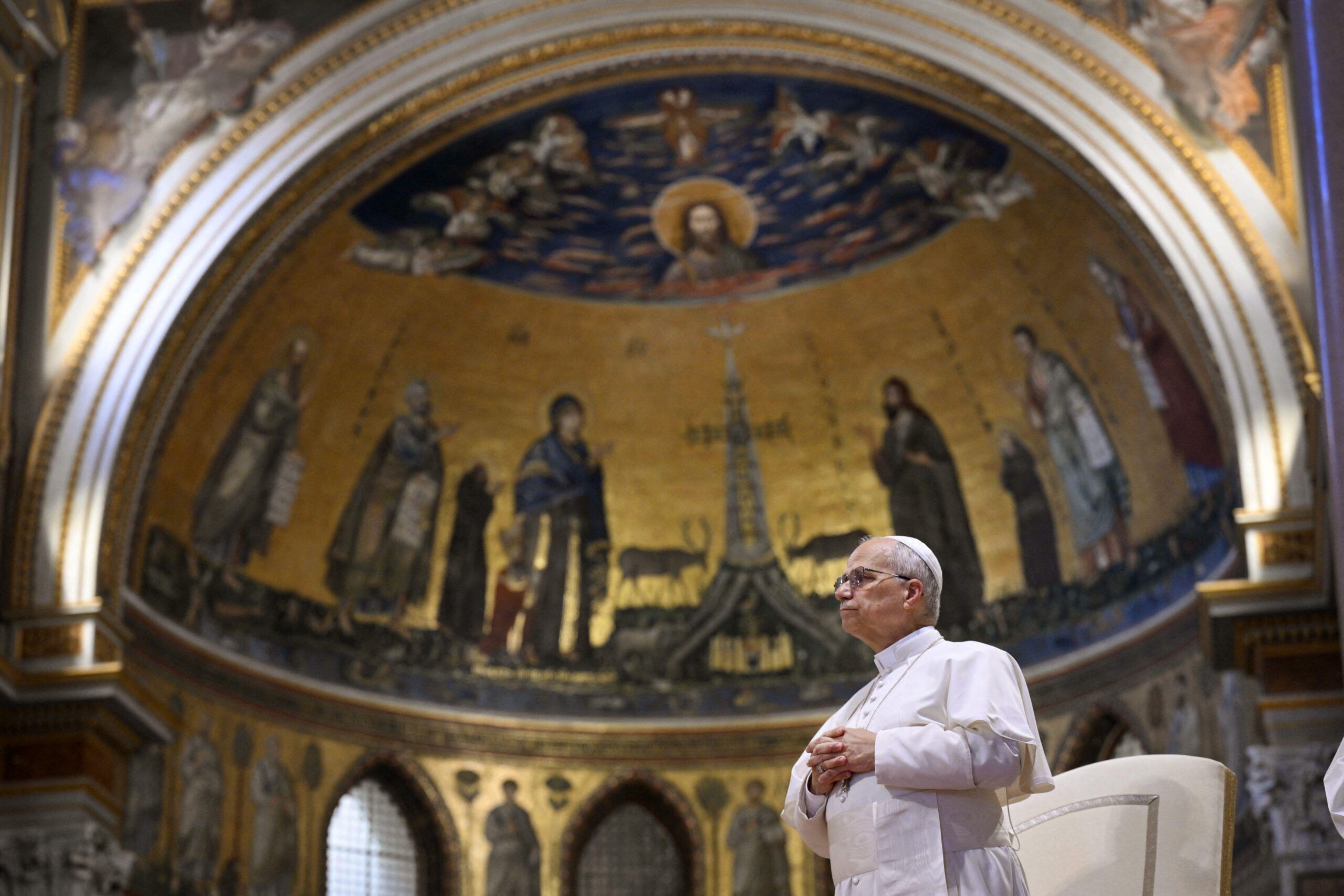
No computational system, however sophisticated, can create a heart that gives itself, or a conscience that discerns good from evil. Even when machines excel in efficiency, a human face that asks to be gazed upon remains the center of our history. This human face is the fullness toward which history is moving. It is the history of “recapitulation”: the certainty that the Father has decreed to bring all things, those in heaven and those on earth, back to Christ, the one Head.
—Pope Leo XIV, Magnifica Humanitas
The endless cycle of idea and action,
Endless invention, endless experiment,
Brings knowledge of motion, but not of stillness;
Knowledge of speech, but not of silence;
Knowledge of words, and ignorance of the Word.
All our knowledge brings us nearer to our ignorance,
All our ignorance brings us nearer to death,
But nearness to death no nearer to GOD.
Where is the Life we have lost in living?
Where is the wisdom we have lost in knowledge?
Where is the knowledge we have lost in information?
The cycles of Heaven in twenty centuries
Bring us farther from GOD and nearer to the Dust.
—T. S. Eliot, Choruses from “The Rock”
You shall be like gods.
—Genesis 3:5
In the fourth chapter of his spiritual autobiography, Orthodoxy, G. K. Chesterton writes,
We have all read in scientific books, and, indeed, in all romances, the story of the man who has forgotten his name. This man walks about the streets and can see and appreciate everything; only he cannot remember who he is. Well, every man is that man in the story. Every man has forgotten who he is. . . . We are all under the same mental calamity; we have all forgotten our names. We have all forgotten what we really are.
It’s been all too easy to forget what we really are.
This is, in part, because the devil has been whispering lies about our identity since his debut in the Garden of Eden. At one moment, we are told that we are magnificent, infallible, and devoid of any need of a God. At another, we are condemned for being worthless, hopeless, and undeserving of God’s grace. We are either above help or beyond help. We are anything, the father of lies spits, but how God truly sees us: dignified, fallen, redeemable.
In an age of anthropological uncertainty—of technological wonder, intellectual confusion, and spiritual apathy—Pope Leo’s first encyclical, Magnifica Humanitas (Magnificent Humanity), has as its foremost priority the pressing need to remind us what we are: beloved children of God. He writes,
In the era of artificial intelligence when human dignity is threatened by new forms of dehumanization, ours is the pressing duty to remain profoundly human. We must lovingly safeguard the grandeur of humanity bestowed upon us and revealed in its fullness in Christ, the splendor of which no machine can ever replace. True progress always stems from a heart open to others, an intelligence willing to listen and a will that seeks what unites rather than what separates.
Reading Magnifica Humanitas quickly reminds us what a spiritual visionary and intellectual powerhouse Pope Leo XIV truly is. In outlining the evolution of the social encyclicals—ranging from Pope Leo XIII’s Rerum Novarum to Pius XI’s Quadragesimo Anno, from John XXIII’s Mater et Magistra to Paul VI’s Populorum Progressio, from John Paul II’s Laborem Exercens and Centesimus Annus to Benedict XVI’s Caritas in Veritate, plus Francis’s Evangelii Gaudium and Fratelli Tutti (as well as commenting on Pope Pius XII’s Christmas addresses, the Vatican Council’s Gaudium et Spes, and the declaration Dignitatis Humanae)—Pope Leo XIV provides a historical and philosophical tour de force of modern Catholic social teaching. These works, he reminds us, didn’t arise in a vacuum. Rather, they were written in urgent response to seismic socio-politico-economic phenomena such as the industrial revolution, the Great Depression, totalitarian ideologies, extreme poverty, and hyperconsumerism. In Archimedean fashion, these encyclicals articulated the place where the Church stands and, as a result, moved the world.
Magnifica Humanitas spends a great deal of time reminding us of who we are and what is at stake in a hyper-technologized society. And it is justified because, somehow, we have forgotten.
Likewise for Magnifica Humanitas. Pope Leo XIV’s encyclical arose in critical response to the hope and threat of artificial intelligence. Why, you may ask, does the Church possess the responsibility or credibility to pronounce on the blindingly fast-paced, dizzyingly high-tech field of artificial intelligence? Because, as Chesterton says,
There is no other case of one continuous intelligent institution that has been thinking about thinking for two thousand years. Its experience naturally covers nearly all experiences; and especially nearly all errors. The result is a map in which all the blind alleys and bad roads are clearly marked, all the ways that have been shown to be worthless by the best of all evidence: the evidence of those who have gone down them.
The British sage would add, “We do not really need a religion that is right where we are right. What we need is a religion that is right where we are wrong.”
Leo XIV begins by offering us two biblical images, either of which could be our future: the construction of the Tower of Babel or the rebuilding of the walls of Jerusalem. Will we, in the name of arrogance and appetite, defy God and erect a tower of self-asserting dominance? Or will we, in the name of solidarity and subsidiarity, re-assemble (as under Nehemiah) Jerusalem’s ruined walls to re-establish hope and hearth? The pope writes,
In light of these two images, the Holy Spirit challenges us today regarding our relationship with technology and the ongoing digital revolution. Scientific discoveries are talents entrusted to humanity that they may bear fruit (cf. Mt 25:14-30). Technology has the power to heal, connect, educate and protect our common home; but it can also divide, exclude and generate new forms of injustice. In the abstract, technology in and of itself is not a solution to humanity’s problems, just as, in and of itself, it is not inherently evil. In practice, however, technology is never neutral, because it takes on the characteristics of those who devise it, finance it, regulate it and use it. Therefore, the primary choice is not between a “yes” or “no” to technology, but rather between constructing Babel or rebuilding Jerusalem; between a power that claims to dominate the heavens and a people who work together in the presence of God to rebuild the walls of fraternal coexistence.
Magnifica Humanitas addresses something grander than that proposed by German sociologist Ulrich Beck. Beck’s “Risk Society” is a fearsome theory that society risks breaking down under the uncontainable devastation that awesome technology forever poses. The pope doesn’t speak of Chernobyl-style nuclear carnage or Ultron-esque AI domination. Rather, he hopes for the good of artificial intelligence while warning that, ill-considered and unmanaged, it risks defacing man and deforming the society in which he lives and breathes.
“In the era of artificial intelligence when human dignity is threatened by new forms of dehumanization, ours is the pressing duty to remain profoundly human.”
Magnifica Humanitas spends a great deal of time reminding us who we are and what is at stake in a hypertechnologized society. And it is justified because, somehow, we have forgotten. We are children of God, made in the image and likeness of our Creator. We are infinitely valuable and dignified simply in our being. We have ineradicable rights conferred by God and not by society or its power brokers. We have gifts that we ought to use, but we ought not be used for our gifts. We should never be exploited for our strength or jettisoned in our weakness. As such, our gnawing hunger for solidarity, subsidiarity, justice, and the common good is warranted and deserves to be satisfied. As the pope notes,
It is important to ensure that this growth in appreciation of human dignity is not obscured by the pressure of new ideologies or certain highly powerful interests in today’s world. Among these ideologies, I consider particularly insidious the one that suggests that every person must earn or justify his or her own worth, to the point of attributing greater value to those who are more efficient or effective. From this perspective, persons end up being reduced to a means of achieving results, a resource to be used and exploited, and are no longer recognized as a proper end in themselves who should never be instrumentalized. The value of persons, however, does not depend on what they achieve or produce. There are rights that apply to everyone simply by virtue of being human, and no human power can legitimately deny or arbitrarily limit them.
To be sure, the pope recognizes the many gifts that can come from artificial intelligence, including streamlined goods and services, rapid access to information, and new frontiers in employment and discovery. But he seems to be one of the few mature voices in the public square who dares to “stand athwart history and yell ‘Think!’” if only to ask the necessary moral and ethical questions that undeniably accompany this technologic revolution. What happens, he seems to wonder, if we answer these questions too late? He writes,
The danger of humanity becoming a victim of its own achievements was already clearly recognized by St. Paul VI, who warned that “the most extraordinary scientific progress, the most astounding technical feats and the most amazing economic growth, unless accompanied by authentic moral and social progress, will in the long run go against man.” For this reason, technological progress—valuable in itself—requires careful discernment of the anthropological vision that guides it and the ends it pursues. If technological development advances without a corresponding ethical and social progress, the result may be an increase in means without a growth in humanity: “having more” without “being more.” In such a scenario, there is a risk that individuals will be evaluated principally according to the outcomes they produce.
What will become of our society if a technology like artificial intelligence eliminates massive numbers of jobs (and, with them, paychecks to needy families)? If our expedited information is overrun by scurrilous misinformation? If efficiency and utility become premium values that harshly judge and heartlessly debate the fate of those deemed inefficient and useless? If civic connections languish, families atrophy, and children flag for want of authentic human connection eclipsed by technological distraction? If wars are easier for their impersonality and alliances are discarded for their difficulty? If technological power achieved by public or private actors exceeds that present during nuclear arms races or economic showdowns? Are we to become a culture of power or a civilization of love? Will we follow Nietzsche or Christ?
But Pope Leo XIV is no Cassandra; he is a man of hope. In fact, he is the antithesis of those condemned by W. B. Yeats, who muttered in his poem “The Second Coming,” “The best lack all conviction, while the worst / Are full of passionate intensity.” By reminding us of who we are and what is at risk; by calling us to a keen-eyed engagement with the use and abuse of artificial intelligence; by inviting us to renewed solidarity and subsidiarity, justice and peace, immersion in prayer and the sacraments; the pope asks for nothing more than our reclamation. As Georges Bernanos wrote, “It is a matter of reclaiming man, of restoring to him, along with the awareness of his dignity, faith in the freedom of his spirit.”
So who are we? And what are we to do in an uncertain age of artificial intelligence?
In his concluding paragraphs, the pope tells us,
As we look to the future, I would like to recall the image of Nehemiah, who we chose as our companion and guide at the outset. Nehemiah heard the cry of a devastated city, brought that pain to prayer, discerned before God, asked for help, received permission to return, organized the work, confronted internal and external resistance, and rebuilt the walls of Jerusalem with the assistance of the people, brick by brick. In this era of digital transformation, I see in him a striking parable of our own vocation, which is not to be passive spectators of social and cultural fractures, nor mere commentators on what is crumbling, but men and women prepared to enter the construction sites of history—research laboratories, tech companies, schools, the media, institutions and local communities—in order to rebuild what has collapsed and protect what is threatened. Like Nehemiah, we too are called to unite listening and courage, prayer and responsibility, so that, even when a technocratic mentality or partisan interests seem to prevail, the human city may become a more fitting place to live.
In other words, leave Babel to others. In an inhuman age, let us rebuild the stature of humanity—man and woman, God-kissed and dignified—brick by loving brick.