
I was eleven when the first Toy Story came out—about the same age as the movie’s protagonist, Andy, and one year younger than my son is now. He has always been more than a little obsessed with the Toy Story films. What is probably no surprise to those who know me well is that I was the sort of girl who continued playing with dolls a little longer than most. My Barbies, together with an assortment of stuffed animals, lived elaborate lives filled with high drama. There were weddings and mysteries, betrayals and reconciliations, daring rescues and last-minute plot twists. My bedroom floor became an entire world. As Anne Shirley would say, there was always “scope for the imagination” whenever there were dolls nearby. My son—who may someday begrudge reading this but would no doubt concede its truth—is not much different.
It is little surprise, then, that my favorite moments in Toy Story 5 appear in both its opening and closing scenes. Bonnie’s toys are swept into one of her wonderfully overcomplicated adventures involving romance, villains, explosions, weddings, and all the joyful chaos only a child can invent. Watching those scenes, I felt immediate recognition. The film captures imaginative play not merely with affection but with remarkable attentiveness to the way children actually inhabit the world. They are loving, but they are also chaotic. If Bonnie’s playtime had a theater marquee, it might read: “Love! Drama! Mystery! Heroism! Intrigue! Impossible Rescues!” Every object she touches suddenly possesses a double life. Every room becomes a kingdom waiting to be explored. Somehow, through all of it, the ordinary world begins to shimmer with something larger than itself. I have come to believe that imagination is one of our first steps toward transcendence.
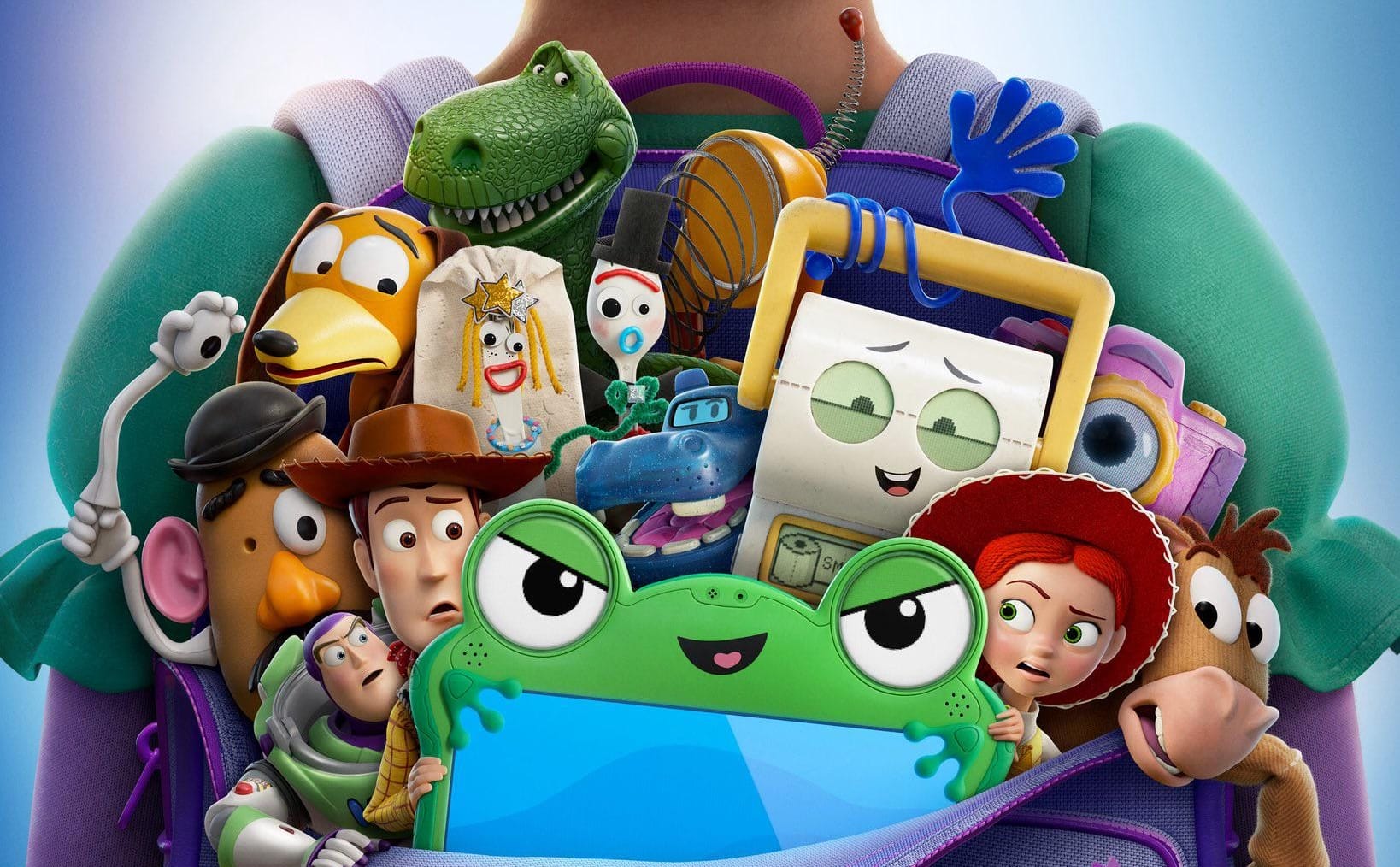
For readers who have not yet seen the film, Toy Story 5 follows eight-year-old Bonnie as she grows increasingly attached to Lilypad, an interactive device designed to educate, entertain, and accompany children through nearly every part of the day. Jessie, Bonnie’s beloved cowgirl toy, fears history is repeating itself. Once loved by her first owner, Emily, and later abandoned when childhood passed, Jessie worries Bonnie is beginning to outgrow her as well. What follows is less a battle between good and evil than between two visions of childhood: one increasingly mediated by technology and another sustained by imagination, friendship, and play.
With Lilypad, Bonnie receives a finished world. With Jessie, she becomes its author.
The contrast is striking. Each time Bonnie plays with Jessie and the other toys, she leaves animated, laughing, and utterly absorbed in the world she has created. Each time she spends hours with Lilypad, by contrast, she seems noticeably more drained—a difference obvious to the audience even if Bonnie herself cannot yet perceive it. The toys notice it, too. After one especially elaborate adventure, Jessie can only stare in amazement before breaking into one of her exuberant “Yee-haws!” The toys have not simply entertained Bonnie; they have participated in a world she imagined into being. The film suggests that the difference is not merely between two forms of entertainment. One consumes Bonnie’s attention; the other calls forth her imagination. With Lilypad, Bonnie receives a finished world. With Jessie, she becomes its author.
As viewers, we experience something similar. Children watching the film likely recognize their own games reflected on the screen. Adults perhaps remember their own childhood play—and something else besides: Wonder is not merely found in childhood. It is cultivated there.
Watching Bonnie’s imaginative adventures, I found myself returning to C. S. Lewis’s essay “On Three Ways of Writing for Children,” Lewis argues that the best stories for children arise from the part of the adult imagination that still delights in the same things children love. Adults differ from children not because they have abandoned wonder but because wonder now lives alongside many other interests. The best children’s stories—and movies, I would add—remind us that imagination is not something we are meant to discard with age.
Around the time the first Toy Story was released, I began wondering whether my own enthusiasm for imaginative play was something I ought to outgrow. The other girls around me seemed to move on more easily. They wanted to talk about dating and middle school social life while I still wanted to invent stories. I knew St. Paul had written, “When I became an adult, I put an end to childish ways” (1 Cor 13:11), and I wondered whether I was late in doing so.
Looking back, I realize I misunderstood St. Paul. First Corinthians is a meditation on maturity in love, not an argument against wonder. The chapter concludes by reminding us that “faith, hope, and love abide, these three; and the greatest of these is love.” Long before I could explain those virtues, I was practicing them through stories. My dolls taught me to imagine reconciliation before I understood forgiveness, courage before I encountered suffering, and hope before life gave me reasons to need it. Play was never an escape from reality. It was one of the first ways I learned to love reality.
Perhaps that is why, when my son started kindergarten, he insisted on carrying a Woody backpack to school despite never having seen a Toy Story movie. My husband wisely observed that if Woody was going to accompany our son every day, perhaps our son ought to know who Woody actually was. One of his earliest trips to the movie theater became Toy Story 3. Before long, our living room was filled with Woody, Buzz, Jessie, Rex, Hamm, and Bullseye undertaking adventures that bore only passing resemblance to the films themselves. Now, the movies may have supplied the characters, but my son supplied the stories.
My dolls taught me to imagine reconciliation before I understood forgiveness, courage before I encountered suffering, and hope before life gave me reasons to need it.
Screens can tell wonderful stories; toys invite children to become storytellers.
Ironically, seeing Toy Story 3 in the theater was something of an anomaly in our house. Like many young parents, I was determined to do everything “right.” Screen time was tightly limited. We read books before bed. Toys lived in baskets rather than on tablets. I imagined that enough intentional parenting could largely determine the influences shaping my children.
Then life happened.
When the pandemic arrived, I was teaching college courses through Zoom while my son completed first grade from our dining room table. Church, birthday parties, Scout meetings, visits with grandparents, and ordinary conversations with friends were suddenly mediated through glowing rectangles. Technology was no longer simply a convenience; it became the infrastructure of daily life.
I remain grateful for it, though. Without those devices, many of us would have endured those pandemic years in profound isolation. Screens allowed my students to continue learning, my son to remain connected to classmates, and families to see loved ones they could not visit. Technology served a deeply human purpose.
Yet once the crisis passed, many of those habits remained. Families like mine had not consciously decided that screens should occupy so much of our lives. They simply had. The tools that had served us so well became the place where work, school, entertainment, shopping, conversation, and leisure increasingly occurred. As Woody observes early in the film, “Toys are for play, but tech is . . . tech is for everything.”
Our phones have become maps, calendars, cameras, libraries, classrooms, televisions, and conversation partners. Their strength lies precisely in their versatility. Yet because they can do so much, they also threaten to crowd out slower practices that have long formed us.
That, I think, is the real concern of Toy Story 5. The film is not a Luddite’s dream. Lilypad is never portrayed as malicious. On the contrary, she genuinely wants what is best for Bonnie. She listens, learns, and eventually helps Bonnie meet Blaze, another imaginative child who becomes a real friend.
In other words, technology helps create communion, but it cannot sustain it.
And once Bonnie and Blaze meet, the screen recedes into the background. Indeed, the girls immediately begin doing what children have always done. They imagine. They laugh. They invent stories together. Technology has served its purpose by bringing them together, but friendship itself requires presence. This concluding segment of the movie strikes me as one resplendent with Catholic ideals about encounter and the value of human dignity.

In his recent encyclical, Magnifica Humanitas, Pope Leo XIV reflects on the extraordinary promise of artificial intelligence while warning that technological progress must never eclipse “the grandeur of humanity.” The question is not whether we should develop extraordinary tools but whether those tools continue to serve the human person. (Watching Bonnie and Blaze meet one another face-to-face, leaving the screens behind, I could not help but think that this was precisely the sort of ordinary, embodied encounter the pope had in mind.) After all, our task is “to remain profoundly human,” he asserts, in this era of artificial intelligence.
How do we remain “profoundly human” when technology increasingly becomes “for everything,” as Woody put it?
It might help to recall here that Catholics have long understood that we are formed by practices. We gather around tables. We keep holy days. We kneel. We pray. We sing. We receive Christ in the appearance of bread and wine rather than merely think about communion. Love is not sustained accidentally. It is cultivated.
Driving home from the theater with my now-twelve-year-old son, I realized the film had given us far more than a conversation about screens. It had reminded us of something we had, at least in my family, allowed to slip away over time without cognitively realizing it simply because we had not attended to making a habit of it. During the pandemic, technology entered our lives out of necessity. Afterward, it remained out of habit. Somewhere along the way, evenings increasingly ended with each of us retreating to our own devices—not because we loved one another any less but because that had become our default. Somewhere along the way, we had stopped playing together. Our stories were increasingly being told by our devices instead of by—and with—one another.
So, when we got home that evening, we made a different choice. We put our phones away.
We talked about Jessie and Woody. We laughed about Bonnie’s wonderfully ridiculous adventures. We imagined what the toys might do next. I won’t lie, it was hardly a dramatic family transformation. By the next morning, our phones were still there, our work still awaited us, and technology still occupied a place in our homes. We’re trying to become more intentional about wonder. Family game nights are back. So are screen limits. More importantly, we’re making room simply to play together again.
Perhaps that is why Jesus tells his disciples, “Unless you change and become like children, you will never enter the kingdom of heaven” (Matt 18:3). He is not asking us to become childish. He is inviting us to recover the openness to wonder that children receive so naturally and adults must intentionally cultivate.
In an age when technology is “for everything,” perhaps Christians have an opportunity—and even a responsibility—to protect the practices that keep us fully human. Wonder is not merely found in childhood. It is cultivated there. And perhaps that is one way we become like little children again.
As Jessie reminds her friends, “Our time ain’t over yet.”