
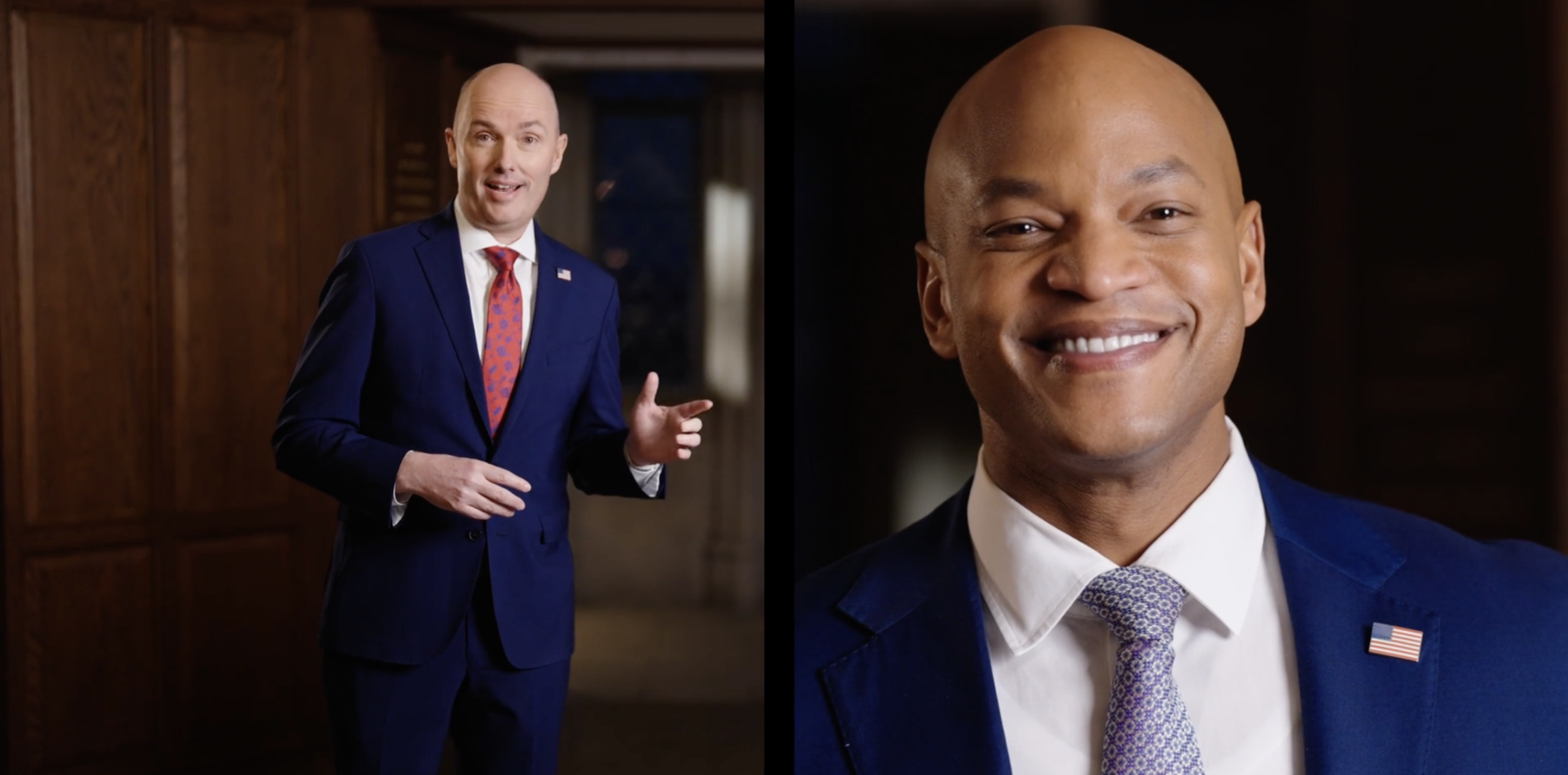
Spencer Cox, governor of Utah, and Wes Moore, governor of Maryland, feature in a viral video in which the two men acknowledge their dissimilarities:
Cox: He’s black.
Moore: And he’s white.
Cox: He grew up in the city.
Moore: And he’s a farm boy from Utah.
Cox: He’s a Democrat.
Moore: And he’s a Republican.
The governors then remark that despite their differences, they have meaningful similarities; they are friends, and they respect each other. Cox states that “politics is important, but it shouldn’t define us or destroy our relationships.”
The video comes from Disagree Better, an initiative that Cox started in 2023 through the National Governors Association. The Disagree Better website states, “Disagree Better isn’t about being lukewarm, acting nice, or giving up your beliefs. It’s about standing strong, having passion, and still seeing the humanity in those who disagree.” Through various initiatives, Disagree Better seeks to model healthy civic disagreement. Over twenty governors have joined the movement.
So far, so good. Disagree Better is what America needs today, especially in light of recent political violence. Still, Disagree Better is susceptible to passing away as a fad if the movement fails to clearly identify the reasons why America currently disagrees poorly. One of the reasons is that our political discourse takes place within a framework of entertainment and emotivism. A real commitment to disagreeing better therefore entails turning down the entertainment dial on our political discourse and returning to a recognition of objective reality.
American Politics in the Age of Show Business
At its founding, America was a thriving intellectual society. Thomas Paine’s Common Sense—by no means an easy read—sold 500,000 copies by the close of the American Revolution (equivalent to sixty million today). The Federalist—Ant-Federalist debates spilled beyond closed doors into pamphlets and newspapers. Large crowds attended multi-hour debates between Abraham Lincoln and Stephen Douglas. In these early days, Americans disagreed well, at least insofar as they engaged in substantive intellectual discourse.
One of the reasons we Americans disagree poorly is that our political discourse takes place within a framework of entertainment and emotivism.
Today disagreeing well has become more difficult, for America has a much less serious intellectual culture than before. Neil Postman, writing in 1985, argued that America had entered an age of show business, where sights and sounds carried greater political weight than words and deeds. For Postman, the decadence of political discourse was brought about in part by the introduction of new media—most prominently, television.
Unlike the written word, television appeals to the senses. For Postman, entertainment is baked into the nature of television, or at least into its common practice. Television programs have short shot lengths, attractive show hosts, plenty of on-screen graphics, a pleasant backdrop, and music—“All television news programs begin, end, and are somewhere in between punctuated with music. . . . What has music to do with the news? Why is it there?” The answer, of course, is show business.
There is nothing wrong with entertainment in its rightful place, but Postman insists that a medium ordered to entertainment cannot accommodate serious intellectual content. Attempting to translate the language of politics (which demands sobriety) into the language of entertainment (which demands charm) is a recipe for disaster.
Said another way, the virtues of the statesman are not the virtues of the showman. Politicians must be intelligent, prudent, measured, and collected. These are not values television is apt to display. Postman notes, “When a television show is in process it is very nearly impermissible to say, ‘Let me think about that’ or ‘I don’t know’ or ‘What do you mean when you say . . . ?’” Such remarks, acceptable in themselves, make for a boring television program. And a boring television program is a dead television program.
Some thirty years after Postman’s critique, our political discourse has further declined. I take the 2024 Republican primary debates as just one example. This televised debate opened with a 3D graphic montage played over music fit for a prime-time college football game; before the candidates spoke, a ten-second clip of President Biden, a twenty-second man-on-the-street interview compilation, and a short video of a man singing with a guitar were all played; the candidates were told they would have one minute to answer each question.
Without addressing the content of the debate, I note that the debate setup alone sends a message to the American people. It tells our country that politics is a spectacle to be watched. It is a showdown to enjoy. It is tonight’s entertainment. Moreover, an entertainment-minded setup provides no incentive for the candidates to proceed in a sober manner. It does, on the other hand, provide incentive to be witty, crass, outlandish, or otherwise memorable. America will not learn to disagree better while public debate is held in such an uncharitable and unserious way. (It is rather curious that the entertainment-ization of politics in America does not lead to its trivialization. Politics, however amusing, still retains its hold over the American mind.)

With all of this said, the television—and the iPhone, for that matter—are not going anywhere. America’s political life will continue to be played out on the screen for the foreseeable future. What is to be done? How can we disagree better in our public square?
Solutions, Logic, and Media Literacy
I have so far offered only a partial diagnosis of America’s inability to disagree better, and in like manner, I now turn to offer only a partial solution. I argue part of the task of the responsible citizen in the face of modern entertainment politics is to become logical and media literate.
To become logical is quite the task, as most have unfortunately not received any formal training in logic (“logic” taken in a broad sense, including rhetoric, dialectic, and critical thinking). This is a serious omission in American education. Logic enables one to recognize and construct sound arguments. If we do not know what a good argument looks like in the first place, it is unlikely we will stumble upon appreciating or making one ourselves.
Logic also teaches us to recognize fallacious argumentation. Red herrings, non sequiturs, sunk cost fallacies, gambler’s fallacies, ad hominem attacks, and other fallacies are much easier to identify once we know what they are. Learning the vocabulary and distinctions of logic enables us to clearly and distinctly identify where we disagree with our opponents. And such intellectual precision is bound to help us disagree better.
From the thirty-thousand-foot view, then, we should work to implement logic courses in primary, secondary, and post-secondary education. There is no telling how much good could come from future generations possessing the ability to construct sound argumentation and call out fallacious reasoning when they see it. From a more personal view, those who do not have logical training would do well to take an online course or read books on logic and critical thinking. This can be a dry, boring endeavor, but possessing a logical mind pays dividends in the long run.
Developing media literacy will also help us disagree better. Media literacy has been described as “the ability to encode and decode the symbols transmitted via media and synthesize, analyze and produce mediated messages.” What this means in practice is the ability to discern the value of any given online post, video, or photo. A ten-second video clip of a politician delivering a spicy one-liner in a debate should not exert the same pull over our thoughts, feelings, and actions as a peer-reviewed research paper, though the former may be far more seductive.
Media literacy entails self-awareness. Do I really think such-and-such political influencer is worth listening to? Or do I just find him entertaining? Do I equate entertainment with truth? Questions like these will reveal our true disposition to politics, and I suspect many of us will need to purify our intentions.
To this end, greater media literacy will mean a greater appreciation of the “new media.” Specifically, the long-form podcast may turn out to be a rather conducive avenue for public discourse about the common good.
The Joe Rogan Experience, though certainly imperfect, could serve as a more helpful investigation of a candidate than much of what is put on cable news. Rogan’s interviews with Bernie Sanders, JD Vance, and his three-hour interview with Donald Trump all eschewed extensive hype music, fancy graphics, flashy lighting, and scheduled commercial breaks. Such a setup emphasizes the person and his or her ideas. This is more of what America needs. Indeed, Americans may learn to disagree better simply by listening to a couple hours of a podcast featuring a guest with opposing views.
The process of learning to disagree better is daunting, but we should avoid pessimism. A greater commitment to logic and media literacy will help more Americans see past the razzle-dazzle strategy of entertainment politics and return to sound thinking. By pursuing these ends, we will learn to disagree better and treat each other as rational, dignified human persons.