
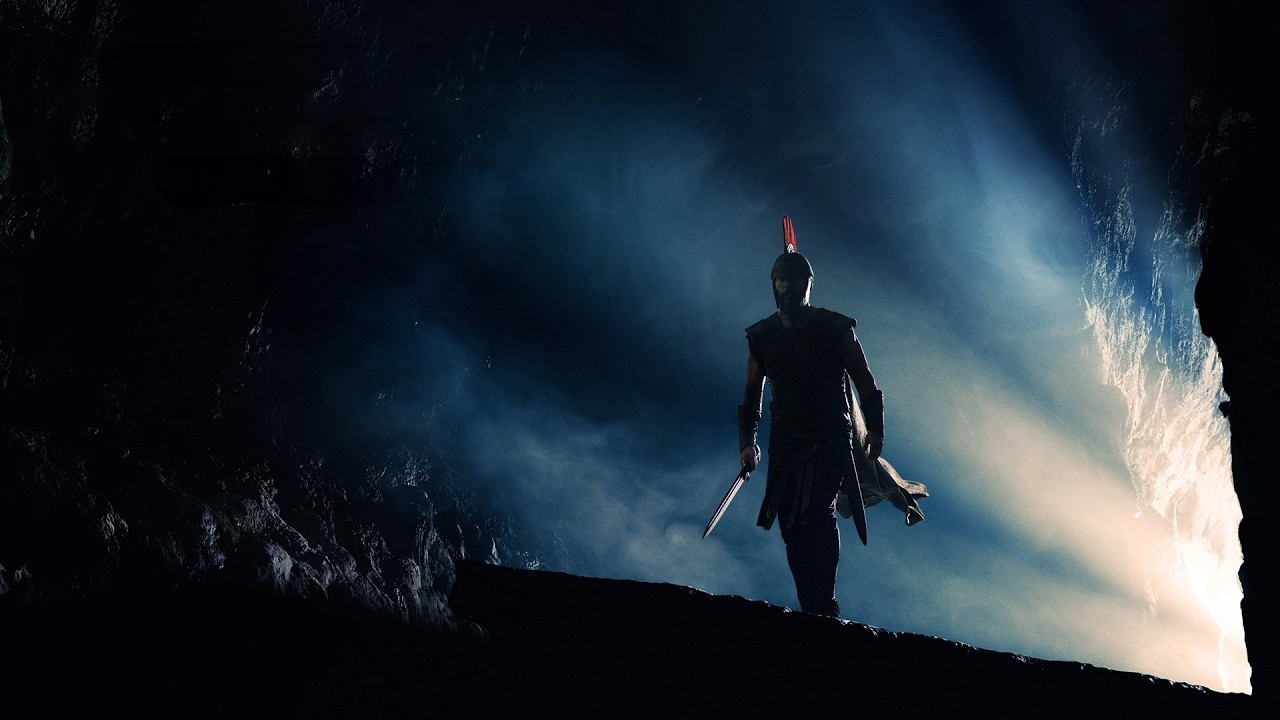
Before the new Odyssey even debuted and the IMAX theaters flickered to life, like the rose-fingered dawn, the critics were circling like hungry gulls who spot a shimmery sheen in the water and dive for a meal but startle when it is not a school of fish but tiger sharks awaiting them, and then they try to escape but cannot and are devoured. Just so, Nolan’s ambitious retelling of the Homeric epic didn’t flop as some predicted; audiences either didn’t care about or overlooked the woke casting, and the naysayers were confounded and wrecked. But why has Nolan’s Odyssey broadly resonated with audiences and critics alike?
In my estimation, it is because Nolan’s Odyssey stays true to most of the essentials of the original epic, which enduringly resonates with audiences in how it compellingly speaks to the unchanging human condition. While there are certain liberties taken, Nolan’s Odyssey is true to the original in three key ways in which it portrays the world of Odysseus and captures the imagination: as moralistic, as providentially governed, and as familistic.
The moral axiom of the film is Zeus’s law, which is a rule of hospitality with a formulation similar to the golden rule. In the original work, Zeus’s law, or xenia, was explicitly invoked by Odysseus when he and his men stumbled upon the cyclops’s lair: “For Zeus is the avenger of all supplicants and foreigners in distress” (Fagles’s translation). The idea was that it was practically reasonable to treat strangers with kindness and respect because one ought to treat others as you would want to be treated. As the wheel of fortuna turns, one never knows when one will be sick, impoverished, a supplicant at the mercy of others. And particularly in the Bronze Age world, where travel entailed meeting strangers in strange lands, without an overarching authority to enforce the moral law, the moral norms of hospitality and reciprocity were essential to basic order.
In the film, Odysseus intends to invoke Zeus’s law, but the cyclops offers no dialogue and simply sets about eating Odysseus’s men. But in the original, the cyclops articulates his rejection of Zeus’s law: “We Cyclopes do not care about Jove or any of your blessed gods, for we are ever so much stronger than they.” Odysseus perceives (correctly) that the beast has monstrously flouted the moral law and blinds him in self-defense. Still, in his triumph escaping the beast, Odysseus cannot resist a taunt that goads the cyclops into a rage that unnecessarily endangers his men. The great man reputed to be the most cunning among men is not immune to hubristic folly.
Hearth and home are the center of human flourishing and therefore threats or harms to its proper functioning drive much of the conflict, sorrow, tragedy, and heroism of human life.
So the moral law is connected to the gods’ apparent concern for and enforcement of it. In the original and the film, this is manifest on the occasion when Odysseus’s ship is grounded on Thrinacia. On the island is a sacred flock of cattle that belong to Helios, the sun god, and Odysseus is warned by a prophet not to eat the cattle. His men promise not to and resist for a time until their provisions run out, then they sneak to eat the cattle while Odysseus sleeps. “Did you think if you ate quietly, the sun god wouldn’t notice?” Odysseus wryly asks.The film does not relate the dialogues among the gods—but Helios complains to Zeus of the injustice, and he punishes the crew by sending a storm to wreck their ship. The island offered them refuge, but they had transgressed the limits placed by the god. This violated Zeus’s law, and Zeus executed judgment by sinking their ship. Odysseus washes up on Calypso’s shores.
So the Bronze Age world of the Mediterranean didn’t lack for an overarching enforcing principle of the moral law. It was providentially governed by the gods or god (Zeus). This doesn’t mean that the gods were necessarily righteous, however, as is apparent through Homer’s epics. In The Iliad, for example, gods like Hera stoke the conflict between the Greeks and Trojans and sabotage peaceful resolution of the conflict out of petty grievance and anger. In The Odyssey, rather than acknowledge that Odysseus justly blinded his son, the cyclops, Poseidon executes petty vengeance upon Odysseus, thwarting his return home for years. And the goddess Calypso effectively turns Odysseus into her sex slave for seven years, echoing the common theme of gods seducing and raping humans.
Assuming, as we can, that there are strong reasons to reject polytheism, what is the underlying reality behind the supernatural forces in Homeric myth? Perhaps, as St. Justin Martyr suggested, the Homeric epics were a pagan echo of the biblical truth that some angels fell, somehow begot children with women, enticed them to worship them, and established dominion over the human race. The various gods, then, are so many demons—albeit, demons subject to a superintending divine power. Or perhaps, as the Stoics and St. Clement of Alexandria contended, the various gods and goddesses were not literal divine beings but symbolic expressions of various aspects of the universal, governing divine logos. In this vein, perhaps Homer poetically veiled the deeper divine mysteries, which would be rash to divulge to the vulgar. So Neoplatonists like Proclus would contend that the various strife between the Olympian gods symbolized the order of providence—e.g., the conflict between Athena and Ares represents the distinction between God’s governance through intellectual causes and through necessary material causes. Or, when Athena appears in mortal forms to guide Odysseus, some Neoplatonists suggested this was actually a daemon, a sort of intermediary angelic entity carrying out the divine will, similar to a guardian angel.
Regardless of which of these is closest to the truth, the Ithacan’s world is clearly providentially governed. For his part, Nolan seems to adopt something like the guardian angel interpretation of Athena. In the original, Athena is portrayed as a pretty active co-belligerent with Odysseus, deflecting enemy spears, co-plotting his revenge, and orchestrating events under the sovereignty of Zeus. But Nolan’s Athena (played by Zendaya) appears as more of a moral guide to Odysseus, taking on the form of a young woman who was killed during the sack of Troy.
The film opens with the bard singing: “A face, a fleet, a war, a man, a thought, a trick—a trick to break the walls of Troy and burn it screaming to the ground!” Athena acts to convict Odysseus’s conscience that his trick, the cunning deceit of the Trojans to accept a sacred religious offering, was a violation of Zeus’s law that would unleash the marauding furies that come with widespread flouting of the golden rule, the destruction wrought by the seafaring peoples. Providential governance is deeply intertwined with moral illumination.
And when Odysseus questions the ways of the gods and the inability of man to understand their communication, Athena replies: “Who doesn’t understand thunder? Or fire? A child’s smile? A good harvest?” In other words, the providence and benevolence of God is manifest not only through conscience but also through secondary causes and the blessings of the created order.
The world of the Achaeans is, finally, familistic. Hearth and home are the center of human flourishing and therefore threats or harms to its proper functioning drive much of the conflict, sorrow, tragedy, and heroism of human life. (This is actually a theme that runs through much of Nolan’s oeuvre, particularly in his best movies. In the Batman trilogy, Bruce Wayne’s fight as Batman is at root in defense of the human home and family against the violent crime that robbed him of his; and the relationship that sustains him is actually his sonship to his adoptive father, Alfred. In Interstellar, the central moral conflict is that Cooper is called upon to sacrifice his relationship with his daughter to save her and the world. And in Inception, Cobb can only return to his home and children if he lets go of the haunting dream-memory of his dead wife.)
In Nolan’s Odyssey, dysfunction and chaos reign in the home of the absent father and king. But the love and devotion of his son, Telemachus, and wife, Penelope, transcend the trappings and deceptions of the nymphean goddess Calypso. The allurements of pleasure, distraction, and sin are placed in the path of every husband and father and must be overcome if he is to perform his most basic duty: to protect and govern his home.
Like when the copper-tendriled dusk first appears, and then the horizon transforms into deep crimson before darkness falls. Or when the flaxen lion stalks the gazelles unseen, contentedly and casually fattening themselves on the amber grains of the field, which are then showered in pools of garnet when the lion pounces. So golden-haired and pinned Odysseus descends upon the wicked suitors and delivers a just and bloody end to their bacchanal. As Homer’s epic fades to black, the clear message is that the hero is the person who risks whatever it takes to save and protect his wife and children. We are reminded of the bard’s words: “A man.”