
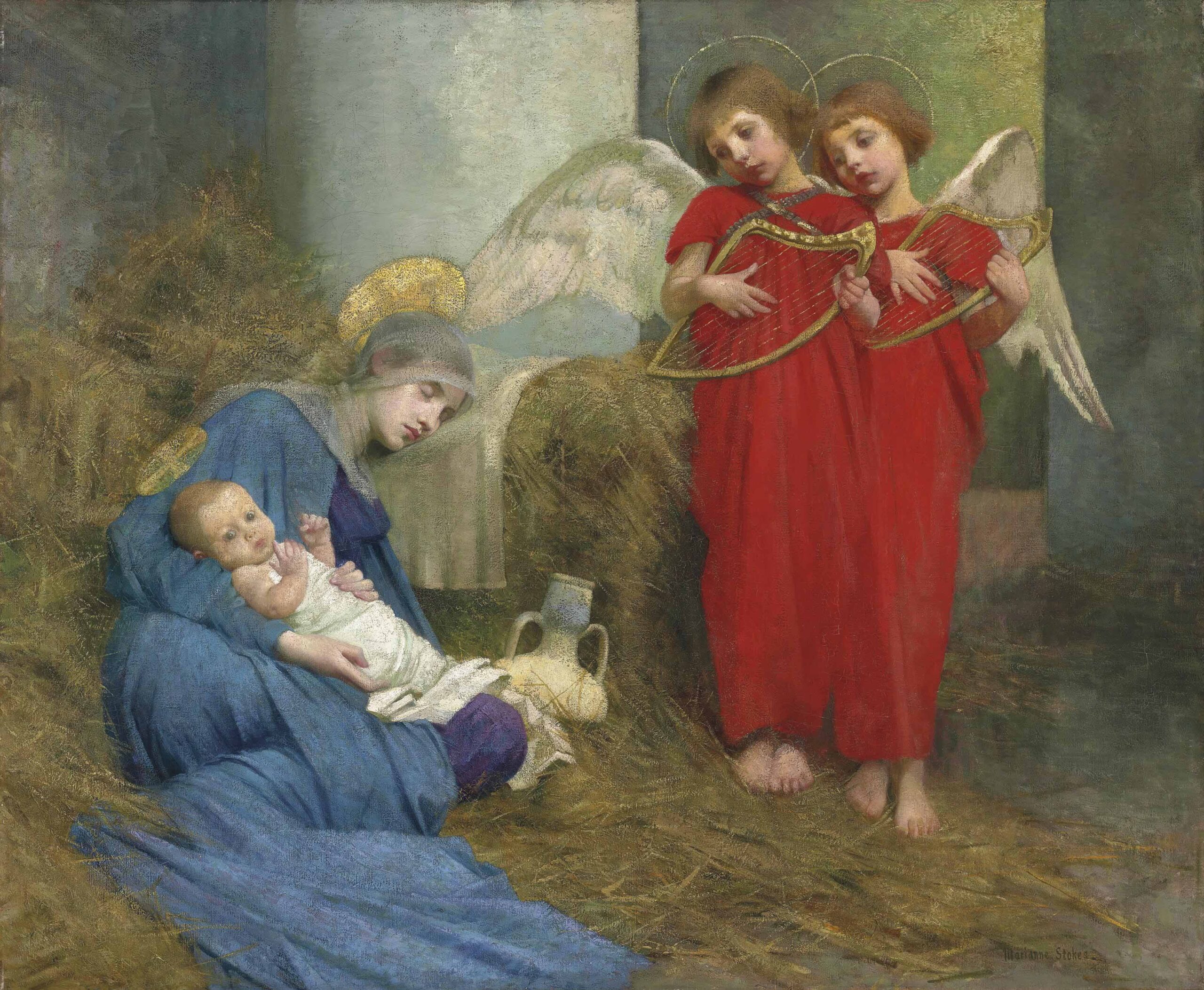
The month of May is dedicated to our Blessed Mother. It is also the month in which we celebrate Mother’s Day. In honor of both of those celebrations, I would like to offer some reflections based upon one of Pope St. John Paul II’s apostolic letters: Mulieris Dignitatem (On the Dignity and Vocation of Women).
Early on in this text, the sainted pope connects the protoevangelium of Genesis 3:15 with St. Paul’s Letter to the Galatians. The former speaks of enmity between the serpent and his offspring, on the one hand, and “the woman” and her offspring on the other. St. Paul sees in Mary (the woman) and her son (Jesus) the fulfillment of this prophetic promise. As John Paul II explains, “‘When the time had fully come, God sent forth his son, born of a woman.’ With these words of his Letter to the Galatians (4:4), the Apostle Paul links together the principal moments which essentially determine the fulfillment of the mystery ‘pre-determined in God’ (cf. Ephesians 1:9)” (3). Mary is both woman and mother, and her particular significance in salvation history is inseparable from these two distinct but related facts.
As the pontiff writes further: “A woman is to be found at the centre of this salvific event [the incarnation]” (3). Mary’s union with God, which exceeds every expectation, takes on a significance for the whole of humanity, which “manifests the extraordinary dignity of the ‘woman’” (4). “From this point of view,” he continues, “the ‘woman’ is the representative and the archetype of the whole human race: she represents the humanity which belongs to all human beings, both men and women.”
In a profound way, Mary’s example is to be followed by all humans. “The dignity of every human being and the vocation corresponding to that dignity find their definitive measure in union with God. Mary, the woman of the Bible, is the most complete expression of this dignity and vocation. For no human being, male or female, created in the image and likeness of God, can in any way attain fulfillment apart from this image and likeness” (5).
Precisely as a woman and a mother, Mary bears specific significance for understanding the value of women and their special mode of service to God and the Church.
Yet at the same time, her distinctive womanly character is not abolished, for “the event at Nazareth highlights a form of union with the living God which can only belong to the ‘woman,’ Mary: the union between mother and son. The Virgin of Nazareth truly becomes the Mother of God” (4). All of this is accomplished through the interplay of God’s special election and grace given to Mary and her free assent, her fiat: “Let it be with me according to your word” (Luke 1:38).
Precisely as a woman and a mother, Mary bears specific significance for understanding the value of women and their special mode of service to God and the Church. Speaking of “the reality ‘Woman—Mother of God,’” Pope St. John Paul II insists that “this reality also determines the essential horizon of reflection on the dignity and vocation of women. In anything we think, say or do concerning the dignity and vocation of women, our thoughts, hearts and actions must not become detached from this horizon” (5).
He expresses concern that this reality is sometimes forgotten, which happens in one of two opposite ways. On the one hand, the dignity and vocation of women can be ignored when men seek not to serve but to dominate women into becoming possessions (see 10). At the same time, there can be an improper reaction to the other extreme, which must be avoided: “In the name of liberation from male ‘domination,’ women must not appropriate to themselves male characteristics contrary to their own feminine ‘originality.’ There is a well-founded fear that if they take this path, women will not ‘reach fulfillment,’ but instead will deform and lose what constitutes their essential richness” (10). More specifically, he warns against “the ‘masculinization’ of women” (10).
The danger here is that the glory and value of womanhood can be lost by trying to make women more like men. That misses something essential about the wisdom of God’s creating humanity as male and female. “The personal resources of femininity are certainly no less than the resources of masculinity: they are merely different. Hence a woman, as well as a man, must understand her ‘fulfillment’ as a person, her dignity and vocation, on the basis of these resources, according to the richness of the femininity which she received on the day of creation and which she inherits as an expression of the ‘image and likeness of God’ that is specifically hers” (10).
To understand the beauty of womanhood, we should turn to “Mary as the full revelation of all that is included in the biblical word ‘woman’” (11). This is especially true since Mary uniquely combines two dimensions of femininity together: She is simultaneously and miraculously both virgin and mother (see 17). She thus stands as an example for both consecrated virgins and mothers.
The Holy Father situates motherhood within the call to self-giving love, which corresponds to humanity as made in the image and likeness of God. “Motherhood is the fruit of the marriage union of a man and a woman. . . . This brings about—on the woman’s part—a special ‘gift of self,’ as an expression of that spousal love whereby the two are united to each other so closely that they become ‘one flesh’” (18). This mutual self-giving of the husband and the wife “opens to the gift of a new life, a new human being, who is also a person in the likeness of his [or her] parents” (18).
Because she is the one that conceives, bears, and gives birth to the child, the mother has a particular openness to this new life and offers a profound gift of herself for this new life. It is precisely in this gift of herself that the mother finds herself, her dignity, her vocation. The hallmarks of motherhood are built into her very biology, as well as through “the psycho-physical structure of women” (18). In being receptive to the generation, gestation, and upbringing of new life, mothers reflect “Mary’s words at the Annunciation—‘Let it be to me according to your word,’” which “signify the woman’s readiness for the gift of self” (18).
As the child-bearer, the mother has a particularly intimate connection with the new life begotten through the marital union. “This unique contact with the new human being developing within her gives rise to an attitude towards human beings—not only towards her own child, but every human being—which profoundly marks the woman’s personality” (18). The father, in some sense, remains “outside” of this process and thus “has to learn his own ‘fatherhood’ from the mother” (18). In the rearing of children, the maternal and paternal contributions are both important, but “the mother’s contribution is decisive in laying the foundation for a new human personality” (18). The self-gift of mothers does not cease with childbirth. Their maternal care throughout the life of the child perdures, often with self-sacrificial suffering for the good of the child and suffering with the child, just as our Blessed Mother, through her compassion, suffered with our Lord in her interiority as he hung upon the cross (compassion means “to suffer with”).
Because she is the one that conceives, bears, and gives birth to the child, the mother has a particular openness to this new life and offers a profound gift of herself for this new life.
In the wonderful mystery of Mary’s virginal conception, the Mother of God also exemplifies the vocation to virginity for the sake of God’s kingdom. “On the basis of the Gospel, the meaning of virginity was developed and better understood as a vocation for women too, one in which their dignity, like that of the Virgin of Nazareth, finds confirmation. The Gospel puts forward the ideal of the consecration of the person, that is, the person’s exclusive dedication to God by virtue of the evangelical counsels: in particular, chastity, poverty and obedience” (20). Thus, consecrated virginity is also “a path on which [women] realize their womanhood in a different way from marriage” (20). Therein, self-gift remains at the core of their vocation: “They realize the personal value of their own femininity by becoming ‘a sincere gift’ for God” (20).
This self-gift in consecrated life, though not “matrimony” in the usual sense, nevertheless cannot be correctly understood apart from the concept of spousal love (see 20). Consecrated women make this self-gift to Christ himself, “the divine Spouse, and this personal gift tends to union, which is properly spiritual in character. Through the Holy Spirit’s action, a woman becomes ‘one spirit’ with Christ the Spouse (cf. 1 Cor. 6:17)” (20).
Just as the union of the consecrated virgin with Christ parallels that of a wife with her husband, so too there is a parallel with motherhood that accompanies feminine religious life. While physical motherhood is not present, there is a “motherhood ‘according to the Spirit’ (cf. Rom. 8:4). For virginity does not deprive a woman of her prerogatives. Spiritual motherhood takes on many different forms. . . . it can express itself as concern for the people, especially the most needy: the sick, the handicapped, the abandoned, orphans, the elderly, children, young people, the imprisoned and, in general, people on the edges of society” (21). Furthermore, this dedication to maternal care for others is not just in the abstract. Rather, “the spiritual motherhood which makes itself felt in this vocation is also profoundly personal” (21).
Given the parallels between the different types of self-gift and motherhood, Pope St. John Paul II sees in these “two different vocations of women . . . a profound complementarity” (21). In either vocation, a woman can exhibit spousal love that—through her gift of self—is life-giving, physically and/or spiritually. Mary, of course, stands at the height of both as the mother of the Incarnate Word and as our mother in the order of grace.
For this reason, Mary, specifically, and mothers, generally, are archetypes of the Church. On this point, Pope John Paul II quotes Lumen Gentium 64: “Moreover, contemplating Mary’s mysterious sanctity, imitating her charity, and faithfully fulfilling the Father’s will, the Church herself becomes a mother by accepting God’s word in faith. For by her preaching and by baptism she brings forth to a new and immortal life children who are conceived by the Holy Spirit and born of God” (22). The Church, as bride of Christ and as our mother, is rightly referred to in the feminine (see 23ff).
In the face of a world that is tempted to think that a woman’s value is found by eschewing her femininity to become more like a man, our late Holy Father reminds us that women have a special and irreplaceable role in God’s design and plan for humanity and the Church. These ought not be devalued. Rather, he calls us to recall Christ’s own “esteem for the dignity of women and for the vocation which enables them to share in his messianic mission” (31). Pope John Paul II continues by insisting that “the Church gives thanks for each and every woman: for mothers, for sisters, for wives; for women consecrated to God in virginity” (31). “The Church gives thanks for all the manifestations of the feminine ‘genius’ which have appeared in the course of history. . . . she gives thanks for all the fruits of feminine holiness” (31).
With Mary as exemplar and intercessor, may all women receive abundant blessings from God so that they too—through their self-sacrificial love—may bring forth new life.