
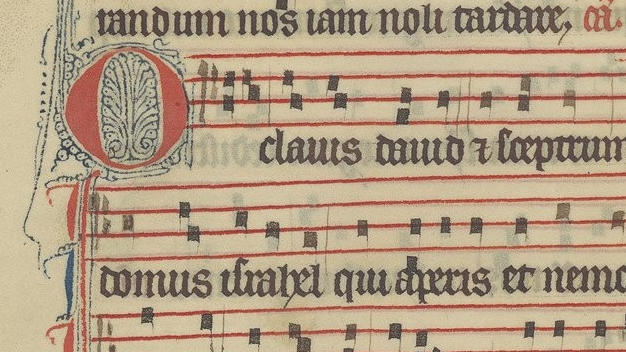
During the season of Advent, from December 17 through December 23, the Church prays the O Antiphons as part of Vespers. The O Antiphons are profoundly biblical. They are a rich treasure trove of messianic names and titles drawn from Scripture, and give wonderful expression to the messianic hope of the Old Testament.
Each Antiphon speaks directly to Christ, attributing to him one of the messianic titles of the Old Testament. Many of these are names that, in Scripture, are reserved for God alone. For example, the second antiphon, prayed on December 18, names Christ as Adonai, the Hebrew name for God, who appeared to Moses in the burning bush and who bestowed the law upon Israel. These names and actions, which clearly belong to the Lord God, are now applied to Christ, and the antiphon implores him once again to save his people with his mighty outstretched arm. And so for each of the antiphons.
The O Antiphons help us see the identity of the Child in the manger.
In this way, the O Antiphons help us see the identity of the Child in the manger; he is identified with the Lord God of Israel. In so doing, the antiphons show us also that the unity of the two testaments subsists in the person of the Christ Child, the long-awaited Messiah who spoke even to Moses, and is Emmanuel, God-with-us.
O Oriens and the Exeter Book: Christ I
The O Antiphons are important also for some of the early Catholic literature in Old English. In a collection of hymns and poems known as the Exeter Book, there are a number of poems that praise and reflect on the life of Christ. One of these poems offers a beautiful reflection on Advent. It is known as Christ I, and is structured by the O Antiphons. As it turns out, Christ I greatly influenced the work of J. R. R. Tolkien, who was himself a scholar of Anglo-Saxon literature.
The lines of Christ I that are of interest here are lines 104-29 of Lyric 5. These lines speak to Christ directly, and tell him of his beauty and majesty, and also tell him of our great need for a savior. Thematically, Lyric 5 speaks of the light of Christ, and tells how his light scatters all darkness. It is structured by the antiphon prayed on December 21, which runs as follows:
O Oriens, splendor lucis aeternae, et sol justitiae: veni, et illumina sedentes in tenebris, et umbra mortis.
O Oriens, splendor of light eternal, and sun of justice: come, and illumine the ones sitting in darkness, and the shadow of death. (My translation)
This antiphon is almost a word-for-word quotation of Luke 1:78-79 from the Canticle of Zechariah. Lyric 5 of Christ I will pick up on the theme of light and illumination from the antiphon in order to speak of Christ. The poem runs as follows:
Hail Earendel, brightest of angels,
Sent to men over middle-earth,
And true radiance of the sun,
Fine beyond stars, you always illuminate,
From your self, every season!
As you, God born wholly of God,
Son of the true Father, were ever
In the glory of heaven without beginning,
So now your own creation awaits you
Through eternity in need, that you send
To us that bright sun, and you yourself come
So that you illuminate those who for the longest time,
Covered by smoke, and in darkness here,
Dwelled in continual night; enfolded in sins,
They had to endure the dark shadow of death.
Now we believe in joyful salvation,
Brought to people through the Word of God,
Which in the beginning was from the Father almighty,
Jointly eternal with God, and now again became
The flesh without sin that the virgin bore
Through suffering to safety. God was with us,
Seen among sins; the mighty child of fate
And the son of man dwelt together,
United amidst the people. We may express
Our thanks to the Lord of victory always through our deeds,
Because he wanted to send himself to us.
Like the O Antiphons, Christ I contains a wealth of allusions to Scripture. The first half of the poem praises Christ, whose radiance is like that of the sun, and whose light and beauty surpasses even that of the stars. Christ does not simply bring a light, but he himself is the light, and he illuminates from his very person. In words that echo the “light from light, true God from true God” of the Nicene Creed, the poem attests that Christ is God born wholly of God, son of the true Father, who comes to give light to fallen humanity.
The light of Christ is invoked in the poem because of the great darkness that has enveloped humanity. The second half of Christ I poetically expands upon the darkness of the human condition evoked by the antiphon. Before Christ, we had for the longest time dwelled in continual night, covered by smoke, enfolded in the darkness of sin and wrapped in the shadow of death. These call to mind passages such as Psalm 23:4 and (especially) Isaiah 9:1.
The darkness in which we sat was the spiritual darkness of sin and death, the bitter fruit of our rebellion against God. Like natural darkness, the darkness of our mind and heart takes away our ability to see correctly. We were like people, the poem says, covered by smoke, which blinds and stings the eyes, and chokes our breath. It would be a powerful light indeed that could dispel such darkness.
What kind of savior comes to us? Christ I is remarkable for the clarity with which it summarizes the faith of the Church in the divinity of Christ. The savior in the beginning was from the Father almighty, jointly eternal with God, who became flesh and dwelt among us. Before the wonder and brilliance of the mighty child of fate, the darkness of sin is utterly scattered.
J.R.R. Tolkien and the Light of Eärendil
One last remark is worth mentioning. There is a fascinating connection between Christ I and the work of J. R. R. Tolkien, one that plays upon the name of Christ found in the great poem.
The poem begins by hailing Christ, to whom it gives the Anglo-Saxon name Earendel. Tolkien was profoundly struck by the beauty of this name. He adapted the name to fit within his own works, and in this way came up with the character of Eärendil. According to Tolkien scholar Humphrey Carpenter, this was in fact the origin of Tolkien’s creation of Middle Earth.
In his letters, Tolkien writes about his encountering the name Earendel in Christ I:
The most important name in this connexion is Eärendil. This name is in fact (as is obvious) derived from A-S éarendel. When first studying A-S professionally . . . I was struck by the great beauty of this word (or name), entirely coherent with the normal style of A-S, but euphonic to a peculiar degree in that pleasing but not ‘delectable’ language. . . . I adopted him into my mythology—in which he became a prime figure as a mariner, and eventually as a herald star, and a sign of hope to men.
There are significant passages concerning the character of Eärendil throughout Tolkien’s work. One passage, however, stands out especially for its relation to Christ I and the light that we await in the season of Advent.
The poem praises the surpassing light and beauty of the Son of God, eternally with the Father, whose advent scatters the darkness and evil that entrap us.
The passage occurs in The Lord of the Rings: The Two Towers. In one of the most terrifying moments of the book, Frodo and Sam find themselves trapped in Shelob’s lair, a place of absolute darkness and overwhelming stench and fear. They are about to be overcome by an ancient evil that they can neither see nor comprehend. At the last moment, Sam cries out to his master, and bids him draw out the Lady’s gift, the star-glass. The passage is worth quoting in full:
Slowly his hand went to his bosom, and slowly he held aloft the Phial of Galadriel. For a moment it glimmered, faint as a rising star struggling in heavy earthward mists, and then as its power waxed, and hope grew in Frodo’s mind, it began to burn, and kindled to a silver flame, a minute heart of dazzling light, as though Eärendil had himself come down from the high sunset paths with the last Silmaril upon his brow. The darkness receded from it, until it seemed to shine in the centre of a globe of airy crystal, and the hand that held it sparked with white fire.
Frodo gazed in wonder at this marvellous gift that he had so long carried, not guessing its full worth and potency. Seldom had he remembered it on the road, until they came to Morgul Vale, and never had he used it for fear of its revealing light. Aiya Eärendil Elenion Ancalima! he cried, and knew not what he had spoken; for it seemed that another voice spoke through his, clear, untroubled by the foul air of the pit.
The words that Frodo speaks are, in fact, inspired by the opening line of Christ I. Tolkien, in the same letter referenced above, writes that Frodo’s invocation:
Aiya Eärendil Elenion Ancalima (II, 329) ‘hail Earendil brightest of Stars’ is derived at long remove from Éala Éarendel engla beorhtast [the opening line of Christ I].
In other words, wrapped in impenetrable darkness and with no hope of escape, Frodo recites a verse that comes to him unbidden, and it is a verse that Tolkien drew from Christ I, the great poem of Advent. The poem praises the surpassing light and beauty of the Son of God, eternally with the Father, whose advent scatters the darkness and evil that entrap us. The unexpected light and power of his coming is, to borrow Tolkien’s phrase, “as though Eärendil had himself come down from the high sunset paths with the last Silmaril upon his brow.” He comes, and we await him in Advent, Christ and Lord, Oriens, Emmanuel, and Éarendel, born for us at Christmas.