
During a meeting recently, a colleague mentioned attending a tree lighting ceremony on November 9—more than a month and a half before Christmas and several weeks before the start of Advent. I was taken aback by the ceremony’s timing, and I said as much to the others on the call. They looked at me strangely (“Must be some weird Catholic thing,” I could nearly hear them thinking), and, after discovering my reaction wasn’t shared, we moved on to the meeting’s agenda.
But the conversation stuck with me. How to explain this cultural moment? A moment in which tree lighting ceremonies have been cut off from the liturgical season and when even noting it seems eccentric?
I’d like to advance a hypothesis that we are in the midst of a cultural struggle that hasn’t been fully appreciated: the war on Advent.
What is the war on Advent?
We’ve heard for years about the so-called war on Christmas. The front lines get drawn differently depending on your interlocutor. Some years back, the plain red holiday cups at Starbucks became a flash point of controversy. Doesn’t the design evacuate the season of Christian content? Others locate the front line in our choice of greeting—“Merry Christmas” getting co-opted by “Happy Holidays.” Personally, I don’t get riled about these issues. Starbucks has never been a bastion of traditional Christianity, and a plain red cup seems a perfectly appropriate vessel for sugary peppermint concoctions. “Happy Holidays” seems a fine greeting, especially in company where it isn’t clear what particular holidays everyone celebrates.
Other fronts in the war on Christmas, however, do seem legitimate battles. The ongoing secularization of Christmas, for example, is patently obvious to anyone who cares to notice. Christ gets swapped for Santa Claus. We cease telling stories about the nativity and instead tell stories about elves and unexpected holiday romances. It should be clear to anyone paying even a little attention: Christmas as a celebration of the incarnation is slowly being eliminated from our cultural imagination, substituted for a wintry holiday season that has little to do with the birth of Christ. This cultural shift, to my mind, is where the war on Christmas is being fought.
However, the war on Advent is something very different.
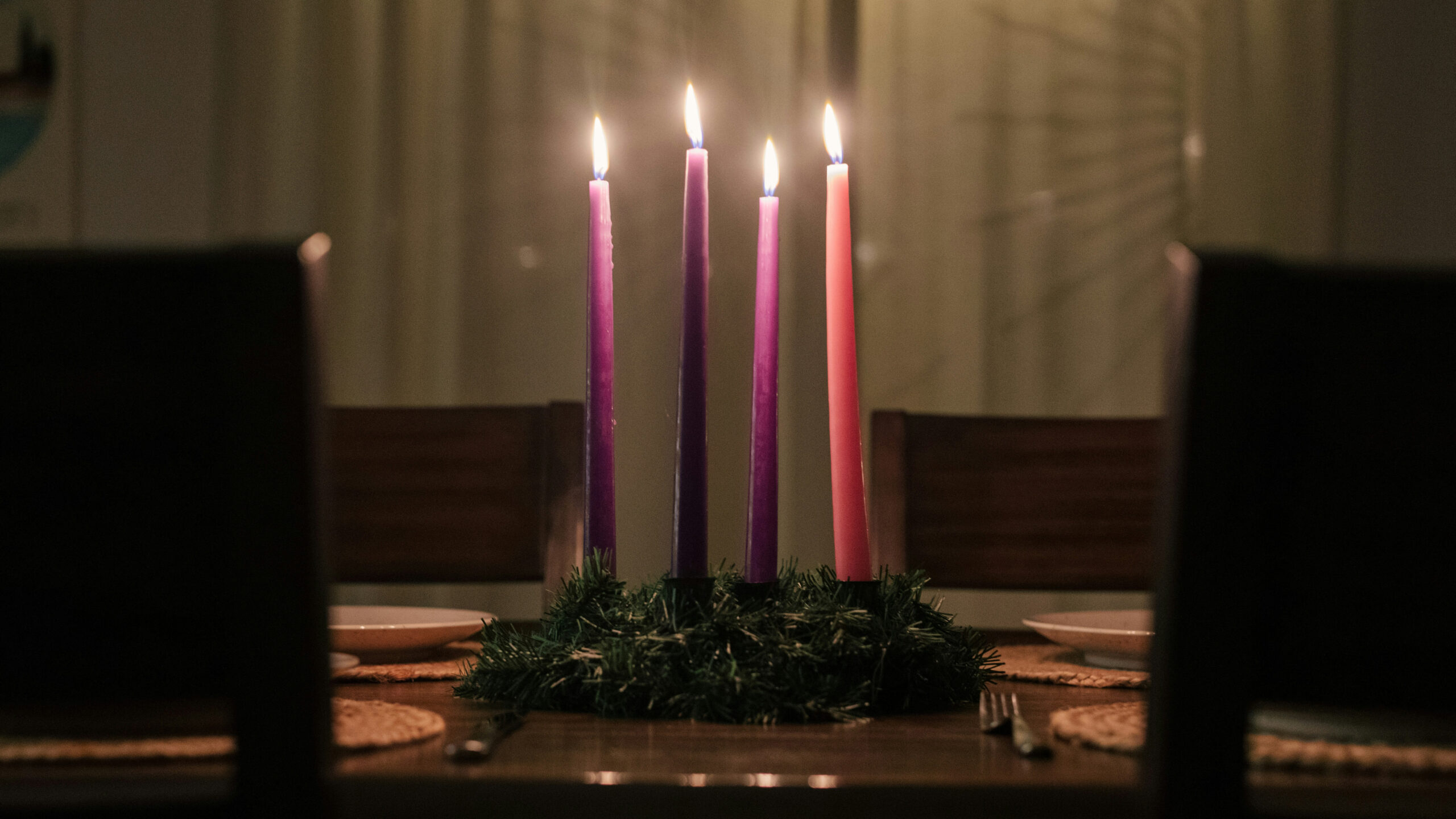
However, the war on Advent is something very different. It’s a kind of liturgical shift backward, so that Christmas gets celebrated during Advent, and Advent . . . well, gets forgotten. Tree lighting ceremonies held in early November are just one example. Others abound. An easy listening station in my home city plays saccharine Christmas tunes until December 26, then quickly shifts back to Billy Joel and Michael Bublé. Christmas decor goes up in homes in early November and is reliably removed far ahead of the Epiphany. Christmas parties—and Christmas feasting—happen during Advent, so that resolutions are made to shed the extra points on January 1, precisely halfway into the season when we should be feasting.
Unlike the war on Christmas, moreover, the war on Advent is fought almost exclusively by Christians, or at least by those who celebrate Christmas and find themselves on the traditionally Christian side of contemporary cultural divides. For it is precisely by leaning into Christmas too soon that we undermine Advent.
Why it matters
What’s the big deal? Isn’t it still a good thing to celebrate Christmas, so long as we resist the temptation of an overly secularized version of it? Of course it is. But not at the expense of Advent.
Advent is, in the first place, a gift given to us by the Church. That’s true of the entire liturgical calendar, and like any gift of the Church, we would be foolish to turn it down.
Among the gifts of the Church, moreover, Advent is particularly needed at our cultural moment, a moment in which we are told to feast at all times. Seek pleasure and gratification, we’re told—if not always in the form of food and drink, then in the form of entertainment and so-called creature comforts. “You do you.” And not only that. “You do you right now.” I needn’t make a trip to Blockbuster to watch a holiday flick; I can stream it on Netflix. I needn’t labor over a holiday feast; I can order it prepared from Costco. Better yet: DoorDash it. Bored at home? Pull out your phone, a window to a world of holiday entertainment, shopping, memes, and social media posts.
Advent counteracts this cultural pull toward immediate self-gratification. Like Lent, Advent is a season of self-denial and penance. More distinctively, it is a season of waiting. It counteracts the instant gratification promised in our digital lives. Christmas, especially in its more secular forms, meshes better with twenty-first-century mores. Advent is at loggerheads with them. No surprise we find ourselves at war with it.
Mounting a response
The good news is that we needn’t simply accept the outcome of the war on Advent as inevitable. We can mount a resistance. There are many ways to do this. Allow me to offer three related strategies.
Observe Advent
Many of us find ourselves celebrating Christmas throughout Advent. That’s probably inevitable, and in a way, appropriate. Many Christmas (ahem, pre-Christmas) traditions are indeed celebrations of anticipation, and so suitably celebrated during Advent. But alongside these traditions, we must add in (and even emphasize) distinctively Advent traditions. Two ideas: First, adopt some penitential practices. Advent doesn’t require the more serious penance of Lent, but it is appropriate to lean into prayer, fasting, and almsgiving during the Advent season as well. Adopt some additional prayer practices; forgo some of the feasting, at least until Christmas; find resources in the Christmas budget or calendar to give to those in need. A second suggestion: Pray a Christmas novena. There are several variations. My family loves the nine-day version, which includes the ancient O Antiphons and culminates on Christmas Eve.
Actually celebrate Christmas
As in, during the liturgical Christmas season. To start, save some of your celebrations until Christmas actually begins. This year, my family is putting up our tree at the beginning of Advent, but not decorating it until Christmas Eve. That’s one strategy among many for preserving the Christmas season. The important thing is to find ways to ensure Christmas isn’t “done” before it has even started. Otherwise, the anticipatory spirit of Advent gets undermined.
Once Christmas arrives, don’t cut the season short! Christmas should be celebrated at least until the Epiphany, but for the more festive-minded among us, it can be extended to Candlemas on February 2. We have to wait until Christmas for Christmas, yes. That’s the whole point of Advent. But once it arrives, we get to celebrate longer than those who have already tossed the Christmas tree into the trash.
Enter more deeply into liturgical life
The best way, however, to mount a resistance to the war on Advent is also the most tried and true: Plug into the liturgical life of the Church. While the rest of the world starts celebrating Christmas before Advent has begun, the Church will always bide her time. We wait until Christmas to sing Christmas carols. The prayers and readings during Advent are Advent prayers and readings. We must wait for the Christmas decor to emerge in our parishes, at least until Christmas Eve Mass. And only then is the Christ child placed in the creche. The best response to the war on Advent, in short, is the best response to most questions: Look to Christ. Look to his Church. And follow her lead.