
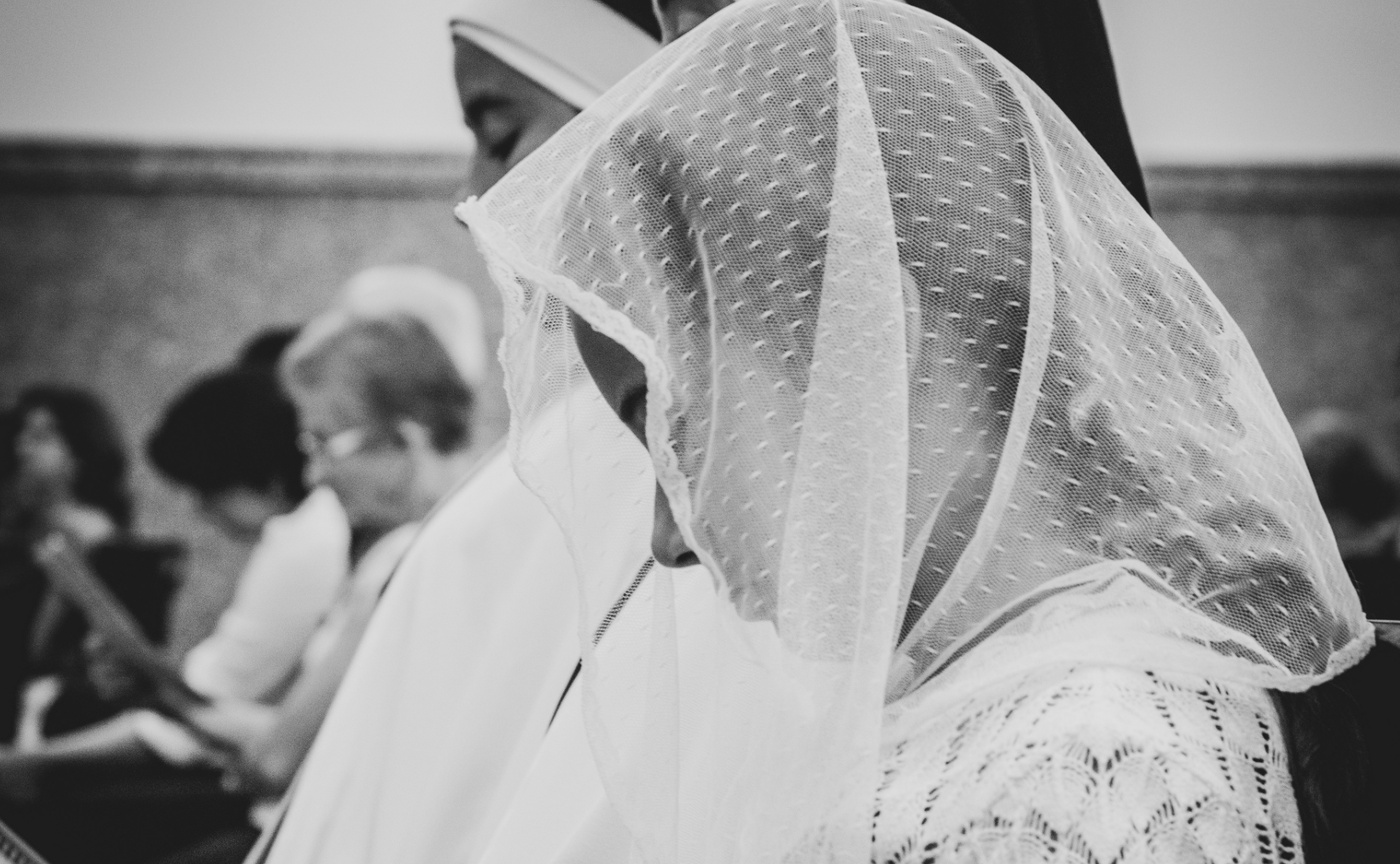
The practice of wearing a veil during Mass has seen a bit of a revival among Catholic women in recent times. Find a Catholic parish at random in which to attend Mass, and odds are that at least some of the women present will be wearing a veil. A quick internet search about veiling during Mass results in many articles and videos from both secular and religious outlets commenting on the practice. Some Catholic outlets even go so far as to recommend the use of the veil as a necessary outward sign of a wife’s submission to her husband.
St. Paul’s words in 1 Corinthians 11:3–16 are often at the center of such discussions. In this chapter of his letter, Paul is concerned to correct numerous liturgical abuses taking place among the Corinthians, and the subject of head coverings is at the top of his list. In the words of one Scripture scholar, “Women in Corinth, at least some of them, had stopped wearing head coverings in worship, and that bothered Paul.” In 1 Cor 11:3–16, Paul tackles this issue.
The Catholic Church, however, clearly teaches that the use of the veil is no longer obligatory for women. Under Pope St. Paul VI, the Church maintains that veils “no longer have a normative value” since in passages such as 1 Cor 11:3–16 Paul is addressing “disciplinary practices of minor importance.” In addition, the current Code of Canon Law has also lifted any obligation concerning the use of the veil for women in church. In classifying the use of the veil as a disciplinary practice of minor importance, the Church sees it as on par with other devotions, or perhaps even as a sacramental. That is, it can perhaps aid in the expression of Catholic piety but is not an essential component of faith.
At the same time, Paul’s arguments in 1 Cor 11:3–16 (and his letter as a whole) ought to be taken seriously. The letters of St. Paul are among the most beautiful and rewarding pages of the New Testament. This is especially true of the First Letter to the Corinthians, which has been called “Paul’s most practical and contemporary letter.”

First Corinthians is a letter about the cross of Christ. Paul has to teach the Corinthians how to govern their lives by the logic of the cross—no easy task, as there is much confusion and discord in the Corinthian church. The light of the cross enables Paul, among other things, to affirm what the first pages of Genesis already reveal—namely, the equality of men and women and the holiness of marriage and sexual difference. In reading First Corinthians, we also learn something about the personality of its author. We see Paul’s affection for the Corinthians, and also his exasperation at their confusion on nearly every aspect—major and minor—of life as members of the body of Christ.
What Does Paul Say About Veils?
In chapter 11, we see Paul’s frustration with the Corinthians when he turns to address the question of women who are no longer covering their heads in worship. Paul writes:
But I want you to know that Christ is the head of every man, and a husband the head of his wife, and God the head of Christ. Any man who prays or prophesies with his head covered brings shame upon his head. But any woman who prays or prophesies with her head unveiled brings shame upon her head, for it is one and the same thing as if she had had her head shaved. For if a woman does not have her head veiled, she may as well have her hair cut off. But if it is shameful for a woman to have her hair cut off or her head shaved, then she should wear a veil.
Notice that Paul takes it for granted that women are praying and prophesying in church. What is of issue here is the use of head coverings (the word “veil” is not used in the Greek). Paul frames the issue in terms of “shame.” By disregarding a traditional expression of gender distinction, women were somehow bringing shame upon the Corinthian community. To underscore the point, Paul makes the provocative statement that if a woman will not cover her head, then she may as well go “all in” and shave her head so as to appear as masculine as possible.
Why should women, and not men, wear a head covering? Paul seems to formulate a theological reason:
A man, on the other hand, should not cover his head, because he is the image and glory of God, but woman is the glory of man. For man did not come from woman, but woman from man; nor was man created for woman, but woman for man; for this reason a woman should have a sign of authority on her head, because of the angels.
Paul’s argument here alludes to the account of the creation of Adam and Eve in Genesis 2. Whereas Adam is created from the dust of the earth, God creates Eve from Adam’s rib, from his side. Scripture recounts Adam’s words when he at last beholds Eve:
This one, at last, is bone of my bones
And flesh of my flesh.
This one shall be called “woman,”
for out of man this one has been taken. (Gen 2:23)
This passage of Genesis, although not explicitly quoted by Paul, is key to understanding his thoughts on head coverings for women. In Paul’s mind, the veil (i.e., “a sign of authority”) is a sort of concrete expression or embodiment of Adam’s words. It is a physical object that points, as it were, to the equality of the woman and the man (they are of the same flesh and bone), while also a reminder of their sexual difference, since the woman is taken out of man. Adam’s words express what the Catholic Church has come to call the “complementarity” of men and women.
It is a physical object that points, as it were, to the equality of the woman and the man (they are of the same flesh and bone), while also a reminder of their sexual difference, since the woman is taken out of man.
Paul, of course, does not use the word “complementarity.” But it is clear that he does not see the use of the veil as a sign of subjugation or submissiveness on the part of women. On the contrary, he concludes his remarks on veils by stressing once again the equality of men and women, and then tells the Corinthians to use their own judgment on the matter:
Woman is not independent of man or man of woman in the Lord. For just as woman came from man, so man is born of woman; but all things are from God. Judge for yourselves: is it proper for a woman to pray to God with her head unveiled? Does not nature itself teach you that if a man wears his hair long it is a disgrace to him, whereas if a woman has long hair it is her glory, because long hair has been given her for a covering? But if anyone is inclined to be argumentative, we do not have such a custom, nor do the churches of God.
Evaluating Paul’s Teaching
A central question regarding Paul’s words in 1 Cor 11:3–16 concerns the number of arguments he is making. Is Paul making one consistent argument, or is he, perhaps unknowingly, offering two separate arguments that are difficult to reconcile?
Several biblical scholars find that in 1 Cor 11:3–16 Paul makes two contradictory arguments. That is, on the one hand Paul insists on the use of the veil for women as a reminder of their subordination to men (“the husband is the head of his wife”), but on the other hand Paul also insists on the equality of men and women (“Woman is not independent of man or man of woman in the Lord”).
J. Paul Sampley is a good example of a biblical scholar who finds two arguments at loggerheads in Paul’s words. He writes:
In the process of writing 11:2–16, Paul discovers that two of his own values are in conflict: On the one side, he wants women believers to accommodate to the culturally aligned practice of wearing head coverings; on the other side, he believes that in Christ the cultural differentiations between men and women are eschatologically challenged by the gospel.
Edith Stein (St. Teresa Benedicta of the Cross) also thinks that Paul offers two arguments that contradict one another. In her reading, Paul has unknowingly confused fashion and theology, the temporal and the eternal. Edith Stein writes:
Coiffure and clothes are matters of fashion, as even St. Paul says. . . . If this judgment regarding the dress to be worn for public worship by the Corinthian women was binding for the community he had founded, that is not to say that by the same token it is also binding for all times.

She argues that Paul’s insistence on the veil for women is inconsistent, both with the example given by Christ but also with Paul’s own teaching on the equality of men and women:
What is said here and what may have been feasible concerning certain improprieties in the Greek community is not to be considered as binding for the principal teaching on the relationship of the sexes. It contradicts too strongly the words and the whole custom of the Lord who had women among his closest companions, and who showed at every turn in His redemptive work that He was as concerned about the soul of woman as the soul of man. It even contradicts that passage of Paul himself which possibly expresses most purely the spirit of the gospel. . . . ‘For you are all one in Christ Jesus.’
The Wider Context of 1 Corinthians
A slightly more nuanced reading of Paul can be found, however, by reading 1 Cor 11:3–16 against the backdrop of the wider context of the letter as a whole. To begin with, scholars have pointed out that Paul’s use of the word “head” in verse 3 is better translated as “source.” This would mean that 1 Cor 11:3 reads:
But I want you to know that Christ is the source of every man, and a husband the source of his wife, and God the source of Christ.
The difference is small but has wide implications. For one thing, it excludes any sense of subjugation of the wife to her husband. More positively, such a translation invites a Trinitarian comparison. Just as the Son is equal with the Father in every way and is only distinguished by being from his Father, so also the woman is equal in every way to the man and is only distinguished by being from him, as we find affirmed in Adam’s words upon seeing Eve. They are equal, but different, in a way analogous to the divine persons of the Trinity (see Paul’s words in 1 Cor 8:6).
It is sexual difference that enables husband and wife to imitate the cross in making a gift of themselves to one another.
What is more, the entirety of First Corinthians is written to address divisions and discord among the Corinthian church. They are divided and confused in every way imaginable. In 1 Cor 7, for example, Paul writes to answer their many questions and problems concerning marriage. He explains to them that in Christian marriage,
a wife does not have authority over her own body, but rather her husband, and similarly a husband does not have authority over his own body, but rather his wife. (1 Cor 7:4)
That is, Paul has to get the Corinthians to stop grasping after power and authority in their marriages and relationships. He teaches them that Christian marriage mirrors the cross of Christ, so that in place of seeking power, Christian spouses—both men and women—are called to a mutual surrender of authority. In so doing, Christian spouses imitate Christ crucified, who in the eyes of the world appears foolish but is paradoxically revealed to be God’s wisdom and power (see 1 Cor 1:18–25).
Paul has already reminded the Corinthians that both his own preaching and the very composition of their community reflect the cross (see 1 Cor 1:26—2:5). He teaches them the same about sexuality and marriage in his letter, and it is from the light of the cross that he will develop his understanding of the Church, though composed of many members, as the one body of Christ united in love. The cross reveals that love is patient and kind, greater even than faith and hope (see 1 Cor 13).
Paul’s concern about the use of veils, then, is not to “put women in their place,” as that would go against the entire theology of his letter. It is, rather, a concern to guard the complementarity of men and women in Christ. Although they are equal, they are different, even as the many members of the body of Christ, though distinct, are nevertheless united by charity and the Eucharist (1 Cor 10:16–17). As the Scripture scholar Michael Gorman reminds us, Paul’s discussion of the use of veils affirms
both culturally appropriate expressions of gender identity (distinctiveness and sexual modesty), grounded in creation, and gender equality and interdependence, grounded in both creation and Christ.
Clothing, writes the philosopher Roger Scruton, “dramatizes the sexuality of the body in the act of concealing it. Sex is hidden, so that it might be revealed as gender. Men and women are able to perceive each other sexually in the veils which hide their sex.” The Catholic Church recognizes the contemporary use of the veil itself as a minor issue, since our cultural setting is much different than that of first-century Greece. However, the Catholic Church is also steadfast and increasingly alone in teaching that sexual difference is a good and holy thing.
What is at stake, then, in Paul’s words in 1 Cor 11:3–16 is not so much a particular item of clothing, such as a veil, but rather the principle of sexual difference. It is sexual difference that enables husband and wife to imitate the cross in making a gift of themselves to one another. In this way, Paul’s letters, and First Corinthians in particular, are of continuing and urgent relevance to our times.