
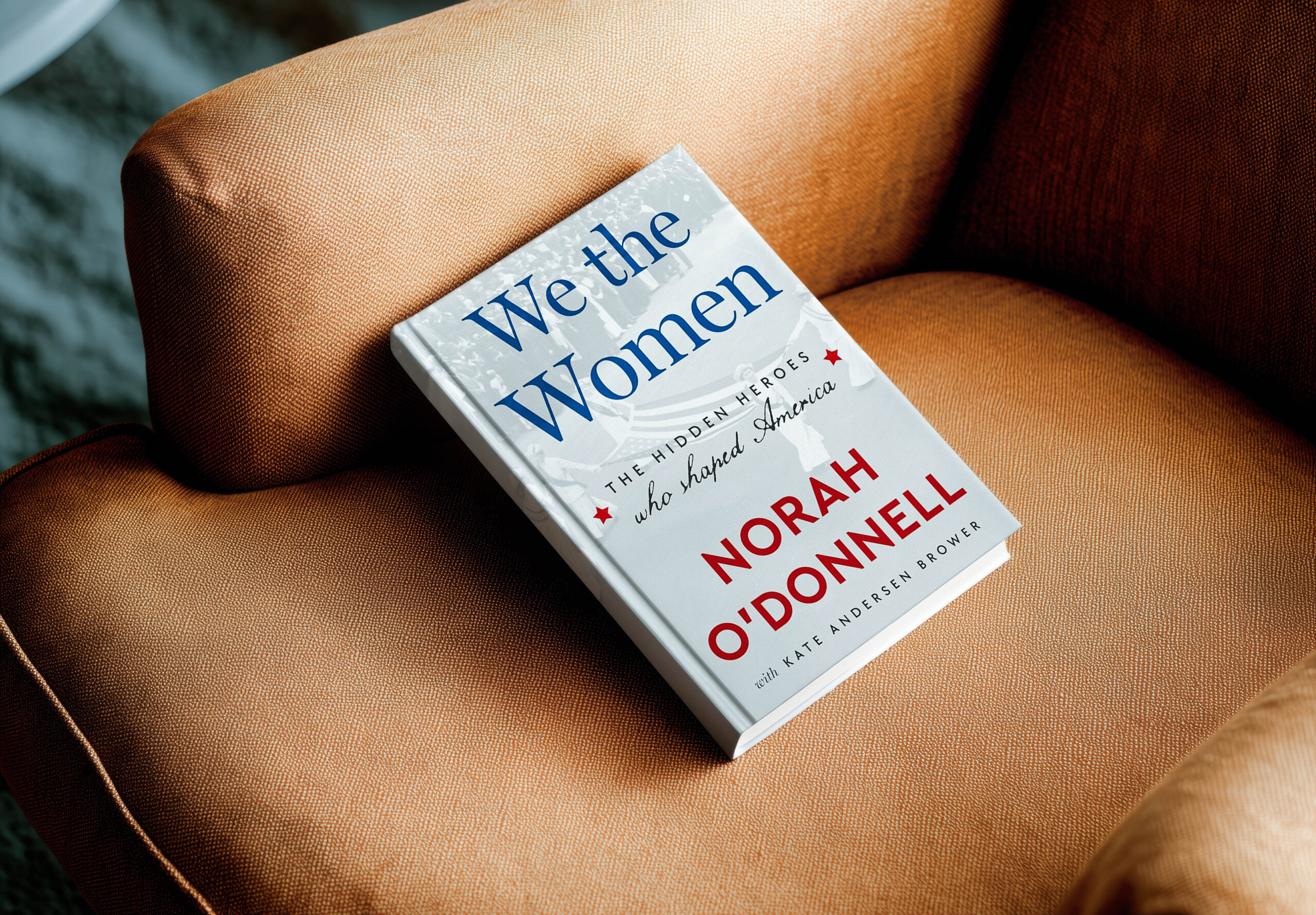
In celebration of the 250th anniversary of the United States, veteran journalist Norah O’Donnell has chronicled the lives of American women whose stories have generally been omitted from the history textbooks of America’s educational system.
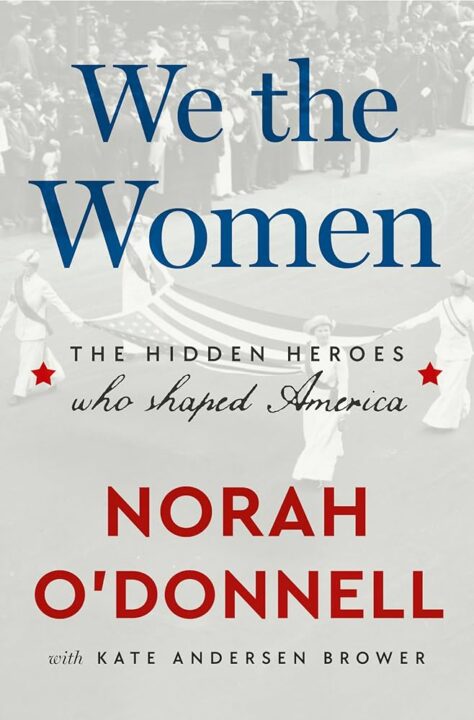
We the Women: The Hidden Heroes Who Shaped America is a handsome volume. And it has been very popular, having spent five consecutive weeks on The New York Times best seller list. We the Women contains thirty-five chapters and is divided into five parts. Each part is introduced by the author and examines a fifty-year span of American history, beginning in 1776 and running to the present day. The individual chapters within each part profile the women who belong to the period of American history under consideration, and the book’s fifth and final part serves as an epilogue, reflecting on the history of women’s rights within the author’s lifetime. The chapters are short but not overly brief and allow enough space to sketch out the lives and contributions of the women O’Donnell examines.
We the Women is a history of the feminist movement in the United States, but one told through the lives of the individual women who, in varying capacities, found ways to overcome the prejudices of sexism and misogyny that so often relegated them to the status of second-class citizens throughout US history. In choosing the title for her book, O’Donnell explains:
“We the People” is the phrase that begins the U.S. Constitution, and is meant to remind us all that the authority of our government comes directly from all of its citizens; that our government is by and for the people. This book is titled We the Women as a reminder of the shared struggle, the collective fight, by women and for women, to make sure that our government recognizes all of its citizens.
O’Donnell is inspired by the women she writes about. And, by and large, they are inspirational women, although most are not well-known outside of feminist studies. O’Donnell has done a good thing, then, in chronicling the lives of these women in a way that is accessible to a wider audience, and in time for the nation’s semiquincentennial.
Readers will be inspired by the faith of the Grimké sisters; by Elizabeth Blackwell, the first woman to earn a medical degree; by Agnes Meyer Driscoll, the brilliant codebreaker and unsung key to the US victory at Midway; by the female soldiers of the Six Triple Eight of World War II, four of whom are buried in Normandy, France; by Constance Baker Motley, a brilliant legal mind who faced the racism of Jim Crow and eventually became the first Black woman to serve as a federal judge; and many others. All in all, We the Women makes one proud to be an American.
The women profiled in O’Donnell’s book offer diverse understandings regarding the nature of freedom in America.
At the same time, readers will encounter chapters sympathetic to women such as Margaret Sanger and Katharine McCormick. While O’Donnell criticizes Sanger’s devotion to eugenics, she leaves the impression that the pseudoscience was entirely separate from Sanger’s work with Planned Parenthood. In reality, however, Sanger’s founding of Planned Parenthood was of a piece with her devotion to eugenics, and McCormick helped finance the development of the birth control pill from similar motives. A chapter is also devoted to Rep. Patricia Schroeder, which highlights her “fierce and consistent” advocacy for abortion and access to contraception. These names, together with the author’s criticism of Elizabeth Blackwell’s lack of progressive views on abortion and contraception, and the praise for Roe and lament for Dobbs, raise anew an important debate regarding the nature of freedom in America.
That is to say, We the Women can be read as taking part in a debate that is as old as the Republic itself. What is freedom, and where does it come from? The women profiled in O’Donnell’s book offer diverse understandings regarding the nature of freedom in America.
Whose Freedom, Which Rationality?
On the one hand, the history of the United States can be seen as the attempt, however slowly, to live up to the high ideal expressed in the Declaration of Independence:
We hold these truths to be self-evident, that all men are created equal, that they are endowed by their Creator with certain unalienable Rights, that among these are Life, Liberty and the pursuit of Happiness.
Liberty—freedom—is here understood as a gift bestowed upon all by the Creator. O’Donnell documents, for example, the natural link that developed between the abolitionists and the suffrage movement in the antebellum United States. These brave Americans recognized injustice as a contagion that affected the nation as a whole, and not simply a subsection of the population. In other words, they understood that freedom was a gift from God, and not the privilege of an elite class.
On the other hand, however, quite another understanding of freedom has also been prevalent in American history. Rather than seeing freedom as a gift bestowed by God upon equals, this contrary view understands freedom as a trophy to be seized only by the strong. Stepping for a brief moment away from O’Donnell’s book, this narrow view of freedom was clearly expressed by John C. Calhoun, a notorious advocate for slavery.
Calhoun fundamentally disagreed with the proposition that all men are created equal and endowed by the Creator with liberty. He took issue with the wording of the Declaration, and so with the very foundation of America. In his famous “Speech on the Oregon Bill,” Calhoun argued:
Instead, then, of all men having the same right to liberty and equality, as is claimed by those who hold that they are all born free and equal, liberty is the noble and highest reward bestowed on mental and moral development, combined with favorable circumstances. Instead, then, of liberty and equality being born with man; instead of all men and all classes and descriptions being equally entitled to them, they are high prizes to be won, and are in their most perfect state, not only the highest reward that can be bestowed on our race, but the most difficult to be won—and when won, the most difficult to be preserved.
Calhoun’s understanding of freedom rests on a number of rebarbative principles. Since freedom is not a basic right of the human person, it becomes an item of conquest. In this conquest, the strong assert freedom over the weak. In this way, freedom always requires a victim, since, in order to fully actualize my freedom, I must assert power over someone else.
Calhoun, of course, is long dead. However, the principles undergirding his view of freedom—namely, that the strong must trample the weak in order to secure freedom—live on, as a recent example makes clear.
During the 2024 presidential campaign, Democratic nominee Kamala Harris made news when she became the first sitting vice president of the United States to visit an abortion clinic. Harris explained the reason for her visit to reporters, saying, “I’m here at this health care clinic to uplift the work that is happening in Minnesota as an example of what true leadership looks like.” Her candidacy advocated for abortion not simply as a right but further—as a positive good for women and for American society. How remote, and how empty, the “safe, legal, and rare” promises of the Clinton era now appear.
Is freedom understood as a gift from the Creator, or is it a prize to be won at the expense of another?
There is no doubt that Kamala would find Calhoun’s advocacy for slavery repulsive. Upon examination, however, her understanding of freedom turns out to be quite similar to her pro-slavery predecessor to the office of vice president.
In advocating for abortion as both a necessary good and fundamental right, Kamala, in fact, echoes Calhoun’s understanding of freedom as a prize for the strong. On this understanding, someone must be vanquished in my quest to achieve freedom—in Calhoun’s case, the African slave; in Kamala’s case, the innocent human life in the womb. Stated more simply, freedom can only be fully realized when the appropriate victim has been sacrificed upon the altar of self-interest.
“Take Their Feet From Off Our Necks” —Sarah Grimké
Returning to We the Women, is freedom understood as a gift from the Creator, or is it a prize to be won at the expense of another? This question runs implicitly through O’Donnell’s book and the lives of the women she writes about.
In terms of narrative theory, O’Donnell arguably tells an “overcoming the monster” story, in which the various heroines she profiles overcome prejudice and patriarchal misogyny. O’Donnell presents a triumphalist view of women’s rights, in which equality is slowly becoming a reality, notwithstanding the work that still awaits the next generation of women who will continue the fight.
Such a narrative, however, is a bit simplistic, since it overlooks the deeper debate about the nature of freedom and the diverse answers given by women. As an example, consider this passage from Sarah Grimké, who in her Letters on the Equality of the Sexes wrote:
Fashionable women regard themselves, and are regarded by men, as pretty toys or as mere instruments of pleasure; and the vacuity of mind, the heartlessness, the frivolity which is the necessary result of this false and debasing estimate of women, can only be fully understood by those who have mingled in the folly and wickedness of fashionable life; and who have been called from such pursuits by the voice of the Lord Jesus, inviting their weary and heavy laden souls to come unto Him and learn of Him, that they may find something worthy of their immortal spirit, and their intellectual powers; that they may learn the high and holy purpose of their creation, and consecrate themselves unto the service of God; and not as is now the case, to the pleasure of man.
It is doubtful that a woman of profound faith like Sarah Grimké would have understood freedom and equality in the reductive and atomistic sense argued for by Ruth Bader Ginsburg. Make the necessary adjustments for today’s women caught up in the self-prostitution of OnlyFans, or women victimized by the modern throwaway culture of abortion, or ensnared by the unending greed of corporatism, and Grimké’s words ring as true today as they did when she wrote them in 1837.
If Norah O’Donnell’s book has lasting merit, it will be in helping us to reflect on the nature of freedom itself and to ask whether the women she studies understood freedom as a gift given to men and women equally or rather as a prize to be claimed, impervious to the lives such conquest may shatter along the way.
We the Women examines many heroes of American history. Although one could have wished for chapters on women such as St. Elizabeth Ann Seton, St. Frances Xavier Cabrini, Ida Tarbell, Edith Wharton, Flannery O’Connor, and (most especially) Willa Cather, perhaps the reader will be inspired to read their stories and writings also and, with gratitude to God for the gift of liberty and justice for all, continue to work for “a more perfect Union.”