
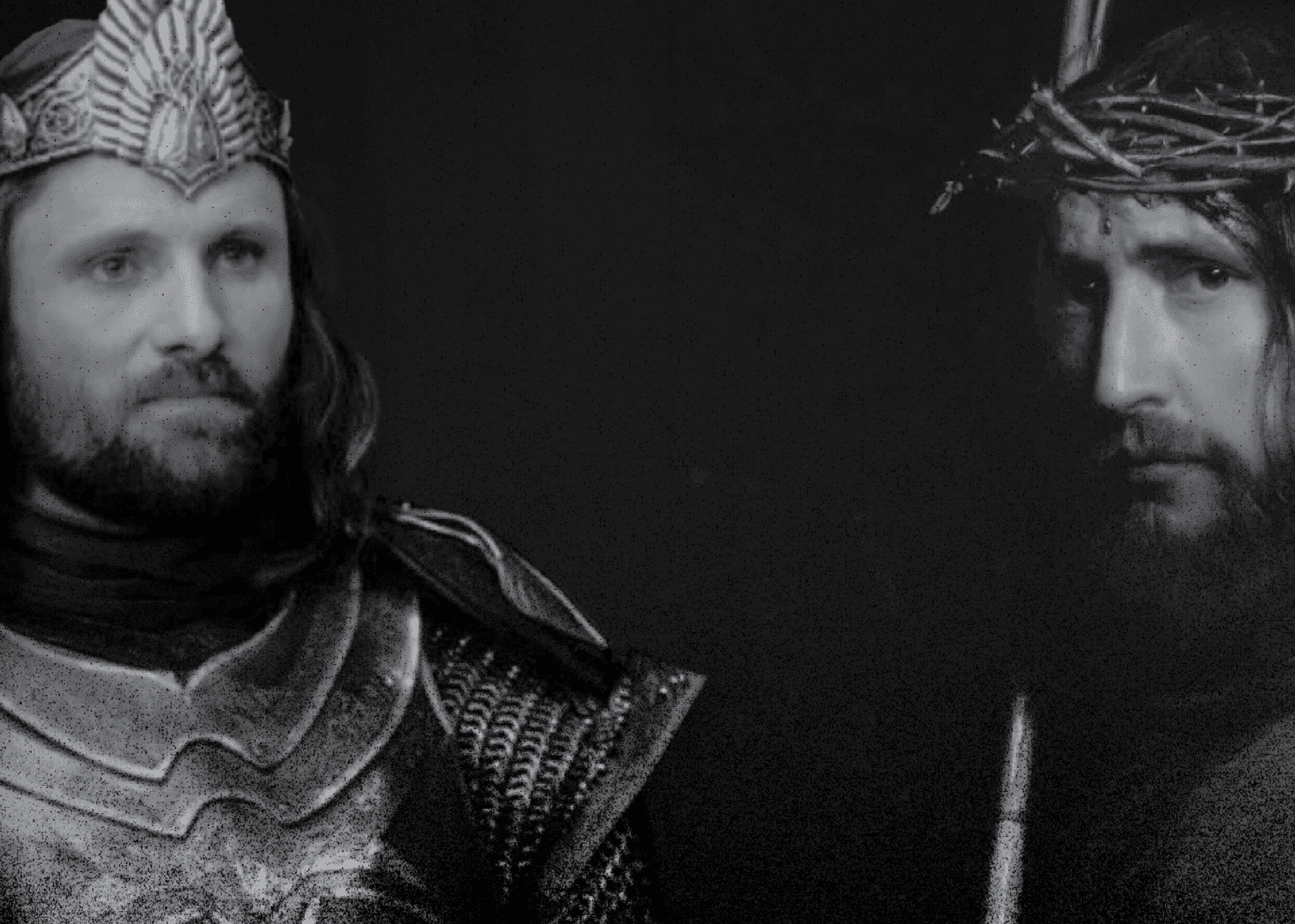
To what extent does Christ influence the character of Aragorn in Tolkien’s The Lord of the Rings? At first glance, it might seem that any influence is quite minimal. As is well known, Tolkien disliked allegory, and there is not a one-to-one correspondence between Christ and Aragorn, as there is, for example, between Christ and C. S. Lewis’s Aslan. Tolkien scholar Tom Shippey has argued that Aragorn, although remarkably virtuous, is not a Christian, and that his death is devoid of any sacramental or Christian symbolism.
Further, David Day, another Tolkien scholar, has noted the similarities between Aragorn and other mythic and literary kings:
If we look at the lives of each of these three, we see certain patterns that are identical: Arthur, Sigurd and Aragorn are all orphaned sons and rightful heirs to kings slain in battle; all are deprived of their inherited kingdoms and are in danger of assassination; all are apparently the last of their dynasty, their lineage ending if they are slain; all are raised secretly in foster homes under the protection of a foreign noble who is a distant relative—Arthur is raised in the castle of Sir Ector, Sigurd in the hall of King Hjalprek, and Aragorn in Rivendell in the house of Elrond.
Day also notes that all three kings “fall in love with beautiful maidens, but must overcome several seemingly impossible obstacles before they can marry . . . by overcoming these obstacles they win both love and their kingdoms.”
As is also well known, however, Tolkien’s deep Catholic faith permeates The Lord of the Rings. In a letter to a Jesuit friend, Tolkien wrote, “The Lord of the Rings is of course a fundamentally religious and Catholic work.” That is to say, while not overtly symbolic, the novel nonetheless contains a wealth of allusions, echoes, and indirect references to Christian faith. In the case of Aragorn, two passages in particular stand out as reflective of Christ: Aragorn’s coronation and “The Houses of Healing.”
Aragorn’s Coronation
First, Aragorn’s coronation scene. Here is how Tolkien describes Aragorn when, against all hope, Aragorn is at last crowned as king:
But when Aragorn arose all that beheld him gazed in silence, for it seemed to them that he was revealed to them now for the first time. Tall as the sea-kings of old, he stood above all that were near; ancient of days he seemed and yet in the flower of manhood; and wisdom sat upon his brow, and strength and healing were in his hands, and a light was about him. And then Faramir cried:
“Behold the King!”
Of particular interest here is Tolkien’s description of Aragorn as “ancient of days.” In the Bible, “the Ancient of Days” is a name for God (Dan 7:9), whose majesty, in the opening chapter of Revelation, is shown to be the majesty of the risen Jesus (Rev 1:14). This name, together with Tolkien’s description of Aragorn in visionary terms (i.e., tall as sea-kings, with wisdom upon his brow, strength and healing in his hand, the light about him) invites a comparison between this passage and John’s vision of Christ in Revelation 1:12–20.
It is as if Aragorn embodies the good shepherd, who is also the true King.
Further, that Aragorn is beheld as if for the first time marks the culmination of passages throughout The Lord of the Rings in which the high dignity and power of Aragorn is briefly revealed to those around him. Such passages show the twofold identity of Aragorn. He is Strider the Ranger, but his authority reveals him to be also the Heir of Elendil.
A good example is the following passage, which recounts the first meeting between Aragorn and Éomer in The Two Towers:
Aragorn threw back his cloak. The elven-sheath glittered as he grasped it, and the bright blade of Andúril shone like a sudden flame as he swept it out. “Elendil!” he cried. “I am Aragorn son of Arathorn, and am called Elessar, the Elfstone, Dúnadan, the heir of Isildur Elendil’s son of Gondor. Here is the Sword that was Broken and is forged again! Will you aid me or thwart me? Choose swiftly!”
Gimli and Legolas looked at their companion in amazement, for they had not seen him in this mood before. He seemed to have grown in stature while Éomer had shrunk; and in his living face they caught a brief vision of the power and majesty of the kings of stone. For a moment it seemed to the eyes of Legolas that a white flame flickered on the brows of Aragorn like a shining crown.
Again, Aragorn is not a duplicate of Christ. Nonetheless, such passages in The Lord of the Rings invite a comparison, a reading-together, with the many Gospel passages that speak of the authority of Christ, by which his identity as something more than the humble carpenter of Nazareth is revealed. Consider the disciples in Mark, for instance: “And they were filled with awe, and said to one another, ‘Who then is this, that even wind and sea obey him?’” (Mark 4:41).
Aragorn in “The Houses of Healing”
Tolkien writes that when Aragorn is crowned king, “strength and healing were in his hands.” The image of the true king as a healer was very important for Tolkien. This motif appears most clearly in the chapter “The Houses of Healing” in The Return of the King, where Aragorn is revealed to be the true king because of his ability to heal the sick. In this chapter, Tolkien is surely influenced by the “royal touch” of the medieval English kings—that is, the belief that the king especially was graced with the gift of healing the sick and diseased.
More remotely, but no less relevant, Aragorn in “The Houses of Healing” is also an image of Christ. Consider Tolkien’s account of Aragorn’s healing of Faramir:
Now Aragorn knelt beside Faramir, and held a hand upon his brow. And those that watched felt that some great struggle was going on. For Aragorn’s face grew grey with weariness; and ever and anon he called the name of Faramir, but each time more faintly to their hearing, as if Aragorn himself was removed from them, and walked afar in some dark vale, calling for one that was lost.
In this passage, it appears that Aragorn goes in search of Faramir, calling, Tolkien writes, “for one that was lost.” To those standing beside him, Aragorn’s voice becomes increasingly remote, as if he walked through a dark vale.
Their hurt is spiritual in nature, demonic in origin, and so they need the healing remedy of grace, which is to say they need the king.
This description invites a comparison with Christ’s parable of the shepherd who leaves the ninety-nine sheep in the wilderness and goes in search for the one that is lost (Luke 15:4). In calling Faramir back from the dark vale, it is as if Aragorn embodies the good shepherd, who is also the true King. Even as the sheep hear the voice of the shepherd (John 10:14–18), so also Faramir hears the authoritative call of Aragorn:
Suddenly Faramir stirred, and he opened his eyes, and he looked on Aragorn who bent over him; and a light of knowledge and love was kindled in his eyes, and he spoke softly. “My lord, you called me. I come. What does the king command?”
“Walk no more in the shadows, but awake!” said Aragorn. “You are weary. Rest a while, and take food, and be ready when I return.”
“I will, lord,” said Faramir. “For who would lie idle when the king has returned?”
Finally, and most poignantly, there is Tolkien’s conclusion to “The Houses of Healing”:
At the doors of the Houses many were already gathered to see Aragorn, and they followed after him; and when at last he had supped, men came and prayed that he would heal their kinsmen or their friends whose lives were in peril through hurt or wound, or who lay under the Black Shadow. And Aragorn arose and went out, and he sent for the sons of Elrond, and together they laboured far into the night. And word went through the City: “The King is come again indeed.” And they named him Elfstone, because of the green stone that he wore, and so the name which it was foretold at his birth that he should bear was chosen for him by his own people.
And when he could labour no more, he cast his cloak about him, and slipped out of the City, and went to his tent just ere dawn and slept for a little. And in the morning the banner of Dol Amroth, a white ship like a swan upon blue water, floated from the Tower, and men looked up and wondered if the coming of the King had been but a dream.
Compare this passage to the first chapter of the Gospel of Mark:
That evening, at sundown, they brought to him all who were sick or possessed with demons. And the whole city was gathered together about the door. And he healed many who were sick with various diseases, and cast out many demons; and he would not permit the demons to speak, because they knew him.
And in the morning, a great while before day, he rose and went out to a lonely place, and there he prayed. And Simon and those who were with him pursued him, and they found him and said to him, “Everyone is searching for you.” And he said to them, “Let us go on to the next towns, that I may preach there also; for this is why I came out.” (Mark 1:32–38)
The juxtaposition of these two texts is not meant to suggest that Tolkien had his Bible open to the first chapter of Mark when he penned the conclusion to “The Houses of Healing” (neither is such a possibility ruled out). In any case, several parallels are worth mentioning.
In the Gospel, Christ is happy to heal all who come to him. This means he will get little, if any, sleep, since Mark tells us that the Lord rose “a great while before day” to pray in a lonely place. Through the words of Simon (Peter), who finds the Lord to tell him, “Everyone is searching for you,” the Gospel of Mark indirectly shows us the admiration and wonder of the city the next morning. Who was the mysterious healer who came among them at night to take away their infirmities and who slipped away unnoticed before the dawn?
In the Gospel of John, Christ says, “I have come down from heaven, not to do my own will, but the will of him who sent me” (John 6:38). The first chapter of Mark is more laconic. Christ simply rises early and finds a lonely place to pray to his Father. He does not seek worldly admiration or influence, and he will not allow the demons to identify him. The time will come when he will be publicly manifest as Messiah and King of Israel, the true Son of God (Mark 15:32, 39), but this will happen, paradoxically, only on Calvary. For now, he must continue on his way, that he may preach also in “the next towns” the advent of the kingdom of God.
Like Christ, Aragorn also has compassion upon a great multitude of the sick. In the novel, Aragorn is dealing with the wounded casualties of the nearly catastrophic siege of Minas Tirith. The wounded are afflicted bodily but also spiritually, as they suffer from the overpowering sway of the Black Shadow. Against this evil, even the wise healers of Gondor found themselves helpless:
But now their art and knowledge were baffled; for there were many sick of a malady that would not be healed; and they called it the Black Shadow, for it came from the Nazgûl. And those who were stricken with it fell slowly into an ever deeper dream, and then passed to silence and a deadly cold, and so died.
Tolkien gives us to understand imaginatively the destructive and deadening effects of evil and sin upon the human soul. Like the sick multitudes who seek Christ in the Gospel, the wounded of Gondor suffer from a hurt beyond the reach of ordinary medicine. Their hurt is spiritual in nature, demonic in origin, and so they need the healing remedy of grace, which is to say they need the king. Only the king would have authority and power to heal the wounds of the soul, since, according to the old lore of Gondor, The hands of the king are the hands of a healer.
Like Christ in Mark’s Gospel, Aragorn also labors “far into the night” healing all in need. And, by healing his people, he receives from them the name Elfstone, foretold at his birth, even as Christ, in Matthew’s parallel but much abridged account, is revealed to be the servant foretold in Isaiah 53. As does Christ, Aragorn also slips away while the city sleeps, and in the morning a banner other than that of the king is displayed, for his time has not yet come. Tolkien shows us the bewildered joy of the people who, upon seeing the banner of Dol Amroth, wondered, as surely did the people in the Gospel, if the coming of the king had been but a dream.
Christ in The Lord of the Rings
The Catholic philosopher Peter Kreeft makes the following comment on the presence of Christ in The Lord of the Rings:
There is no one complete, concrete, visible Christ figure in The Lord of the Rings, like Aslan in Narnia. But Christ is really, though invisibly, present in the whole of The Lord of the Rings. . . . He is more clearly present in Gandalf, Frodo, and Aragorn, the three Christ figures. First of all, all three undergo different forms of death and resurrection. Second, all three are saviors: through their self-sacrifice they help save all of Middle-earth from the demonic sway of Sauron. Third, they exemplify the Old Testament threefold Messianic symbolism of prophet (Gandalf), priest (Frodo), and king (Aragorn).
In the beauty of Aragorn, and the authority of his healing hand, we find something of Tolkien’s love and devotion to Christ. In this way, Tolkien helps us become better readers of Scripture and know better the Christ whom they proclaim.