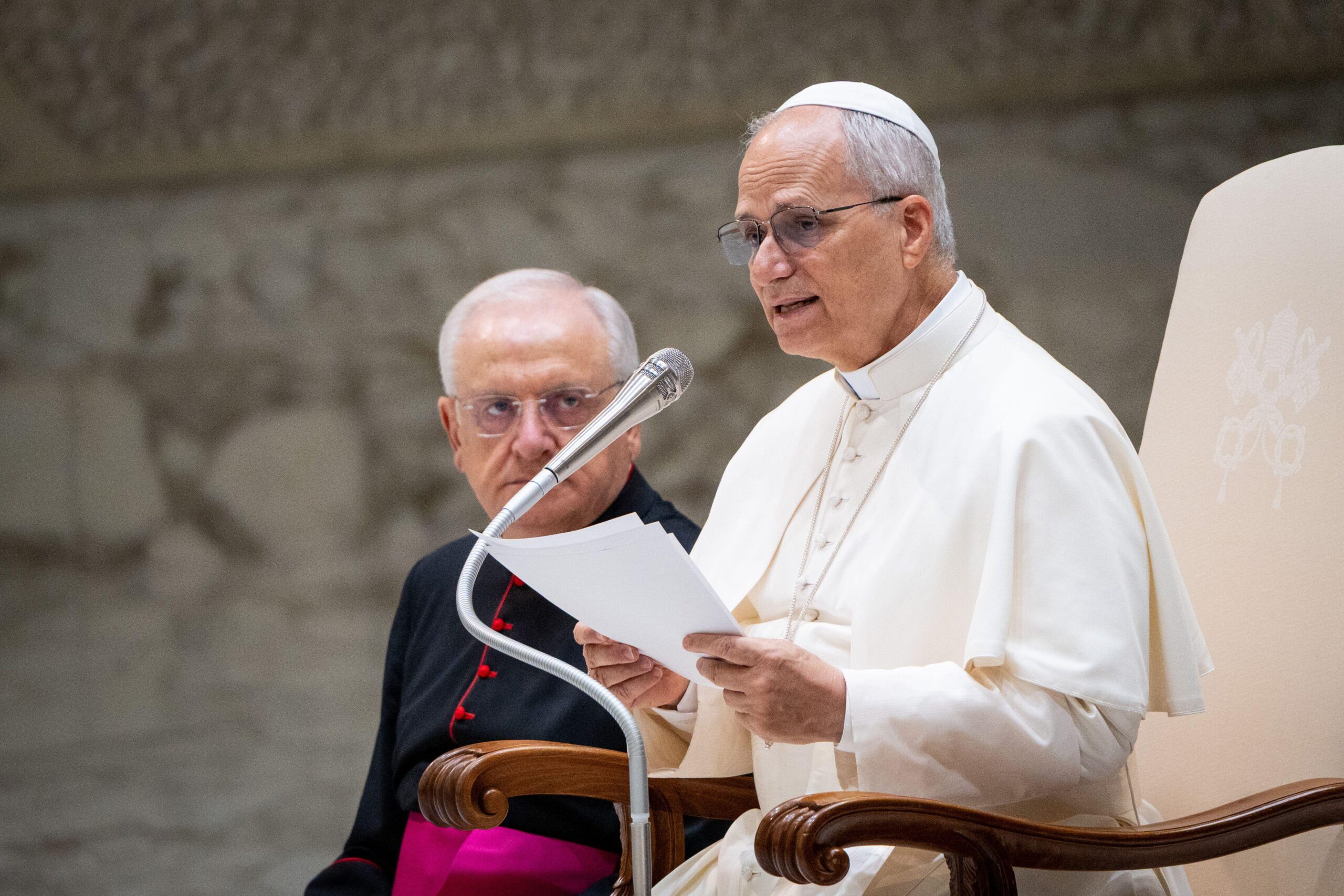
Papal Wednesday audiences, which are now standard events, have their beginnings with Pope Pius XII. Starting in 1939, he delivered “a series of audiences of formation given to newlyweds,” according to EWTN. Unfortunately, World War II led to the practice being suspended for a time. As Hannah Brockhaus reports, the Wednesday audiences were revived under the pontificate of Pope St. John XXIII, with the target demographic broadening to be more generally catechetical and no longer specifically aimed at recently married couples.
It has become customary for the reigning pontiff to choose a theme to cover over the course of a series of Wednesday audiences. While many of these audiences might go relatively unnoticed by the majority of Catholics, others have become famous beyond their immediate and original context. Perhaps the prime example is a series of Wednesday audiences by Pope St. John Paul II, which became even more widely known as the Theology of the Body. There might be many, in fact, who have heard of the Theology of the Body but did not know its origin is found in these weekly addresses, given between 1979 and 1984.
Recently, Pope Leo XIV announced the new theme for his current series of Wednesday audiences: the Second Vatican Council. This is a timely topic given that December 8, 2025, was the sixtieth anniversary of the close of Vatican II. While talk about that twenty-first ecumenical council is fairly common, it still remains a rather contentious and often misunderstood council. Accordingly, this new catechetical series is an opportunity for the pope—in the first year of his pontificate—to make a significant contribution to the average person’s comprehension of the conciliar documents themselves.
Most notably—and quite welcome on my part—is Pope Leo’s planned approach, which he explained during his January 7, 2026, audience: “It will be important to get to know [the Second Vatican Council] again closely, and to do so not through ‘hearsay’ or interpretations that have been given, but by rereading its documents and reflecting on their content.”
This new series of papal Wednesday audiences is a great opportunity for Pope Leo to produce a catechetical series as lasting, memorable, and impactful as the Theology of the Body.
I think this is a prudent decision, as many online keyboard and webcam warriors continue to make dubious claims about what Vatican II taught or decreed for implementation. Focusing on the documents’ actual words will help, especially if the more controversial aspects can be explained or addressed appropriately.
Word on Fire has long been an advocate for Catholic literacy about the Second Vatican Council. Our award-winning publishing team issued a two-volume collection of the documents accompanied by excerpts from papal documents that cite and expound upon key passages. They also contain commentary by Bishop Barron. The first volume of The Word on Fire Vatican II Collection (published February 2021) contains the four major constitutions. The second volume (published February 2023) contains the remaining twelve declarations and decrees.
Around the same time these volumes were being prepared, I recorded a series of six presentations on the Second Vatican Council, which is available on the Word on Fire Institute’s YouTube channel under the title Authority & Continuity. Therein, I took a salvation history–based approach to presenting major doctrinal themes present in the texts in order to show more clearly how the various topics relate to one another. Concomitantly, I did my best to explain some of the more controversial and challenging aspects of the council, including responding to some frequent criticisms. Needless to say, I am excited about Pope Leo’s choice of topic.
On January 14, 2026, Pope Leo XIV started his catechesis on the Dogmatic Constitution on Divine Revelation, Dei Verbum. His decision to start with this document is significant. The documents were promulgated in batches over the course of a few years. Alongside the Decree on the Apostolate of the Laity, Apostolicam Actuositatem, Dei Verbum was issued in the second to last batch of conciliar texts on November 18, 1965, less than three weeks before the council concluded. Although it is relatively short—the shortest of the four constitutions—it underwent an extensive revision process after strong criticism was levied against the original preparatory schema, De fontibus revelationis (“On the sources of revelation”), at the start of the council in October 1962. Despite all this, to many theologians, Dei Verbum provides the logical foundation for the council’s teaching as a whole. In fact, as Ronald Witherup notes, “The Doctrinal Commission of Vatican II . . . underlined the primary importance of Dei Verbum by stating that it was ‘in a way the first of all the constitutions of this council, so that its Preface introduces them all to a certain extent.’” Through his choice to cover it first, Pope Leo demonstrates his awareness of the fundamental importance of this constitution.
This new series of papal Wednesday audiences is a great opportunity for Pope Leo to produce a catechetical series as lasting, memorable, and impactful as the Theology of the Body. I will be following this series with hopeful expectation, and I hope you will too.