
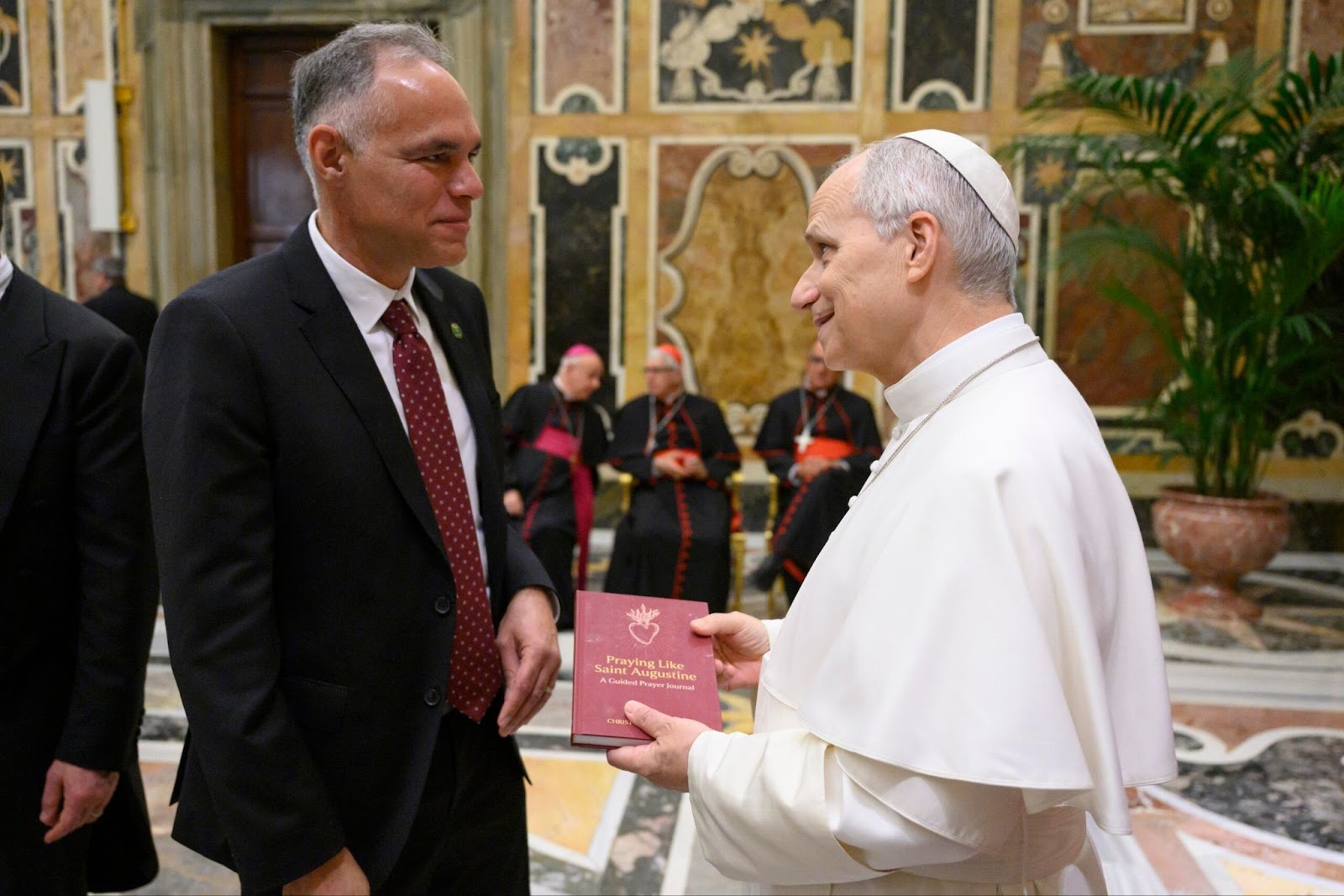
I doubt I’m the first person to be overwhelmed by the gorgeous Renaissance frescoes by Italian and Dutch masters in the Clementine Hall in the heart of the Vatican. They are surprisingly powerful. Perhaps that’s why the Clementine Hall is frequently used for state visits, such as by Presidents Barack Obama and George W. Bush.
As I waited for the arrival of the Holy Father, someone in the row behind asked, “What language will Pope Leo use?” A couple of us who had been in multiple previous papal audiences replied with confidence. He’d speak in Italian. It’s the working language of the Vatican and what he uses for most of his speeches. That seemed like a sure bet to me.
From a side door, in walked the pope. He began his address, in English, “In the name of the Father, and the Son, and the Holy Spirit. Blessed be the name of the Lord. Now and forever. Our help is in the name of the Lord. Who made heaven and earth.” I assumed he would then turn to Italian, but I was wrong again as he continued in his mother tongue.
Since most of us in the room were professors, the pope thanked us for our academic research and underscored the importance of using our expertise as scholars to work for the well being of others. He said, “It has never been more important to dedicate time, people, and expertise to safeguarding life and health.” Life and health are not just abstract goods but concrete aspects of the flourishing of individual human beings.
Pope Leo also emphasized, “It has become clear how much reciprocity and interdependence underpin our health and our very lives. Studying this interdependence requires dialogue between different fields of knowledge: medicine, politics, ethics, management, and others.” No man, no woman, no child is an island. No field of study can be ignored in the pursuit of human flourishing.
We are all together in the same leaky boat of fragile humanity.
The pope also called our attention to the sad reality that “despite declarations and statements to the contrary, all lives are not equally respected and health is neither protected nor promoted in the same way for everyone.” Human rights are not actually enjoyed by all human beings. In many circumstances, the powerful dominate the most dependent, vulnerable, and defenseless humans.
The Holy Father told us, “We need to rediscover the fundamental attitude of care as support and closeness to others, not only because someone is in need or is sick but because they experience vulnerability, the vulnerability that is common to all human beings.” To be human, at all stages of development from womb to tomb, is to be subject to disease, death, and disability. We are all together in the same leaky boat of fragile humanity.
Pope Leo concluded the address, as he began, with prayer. We prayed the Our Father together. Finally, the Holy Father gave a blessing to each one of us, our loved ones, and the work we do.
There is always some drama at this point. Some popes in the past have just finished their address and left the room. Other popes greet just the first row of participants. What would the new pope do? Pope Leo made time to greet each and every one of us in the Clementine Hall that day.
We got in line, something like a single file communion line, and waited for our turn to greet the Holy Father personally. People plan carefully what they will say in their few moments together. They typically say something like, “Holy Father, my name is Christopher Kaczor. I’m president of the American Catholic Philosophical Association, a professor at Loyola Marymount, and I collaborate with Bishop Barron’s Word on Fire. Thank you for your wonderful work reminding the Church regularly about St. Augustine.”
What was I planning to say? I didn’t plan it out. I figured in the moment I’d just say something meaningful, important, perhaps even a conversation starter. My previous plans of saying something meaningful to Pope Francis didn’t work, so I thought I’d try a new way. Rather than memorize a script, I’d let my spontaneous thoughts guide me. So what did I say?
In the spirit of Oscar Wilde or G. K. Chesterton, my words to the Holy Father were sophisticated, deep, and impossible to forget. I said, “Nice to meet you.” That’s it. Period.
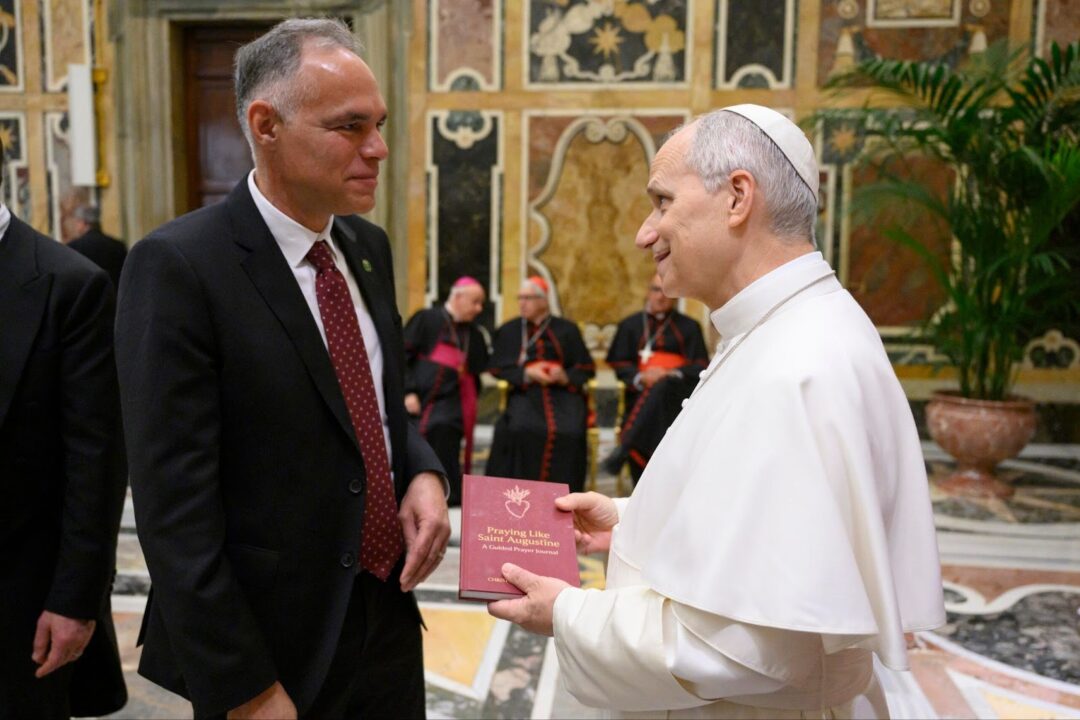
I’m sure the pope is still contemplating my profound message. His first encyclical may well be entitled Bene Salve Te.
But although my mind only produced words that were maximally banal, my hand did manage to give Pope Leo a copy of my book Praying Like St Augustine. The Holy Father seemed genuinely pleased and said to me, “Augustine! Very good.” Warm words about St. Augustine from Pope Leo were no surprise at all.