
Is modernity a problem to be solved or a mystery to be lived? Every age retains its own share of solvable problems and unsolvable mysteries, but the question seems more urgent given the uniqueness of the contemporary era. Only in the twentieth century did humanity reach a stage when perfect solutions to perennial problems began to seem physically realistic, regardless of whether the problems were actually problems: The problem of unschooled populations could be solved by the legislative application of one universal standard dictated purely by reason; the problem of undesirable communities could be solved with total extermination of races perceived to be inferior; and the problem of unendurable disagreements between nations could be solved by mutually assured destruction. That the concept of “final solutions” took hold in the same generation as the attainment of power sufficient to destroy the world suggests that there is now very little patience for mystery.
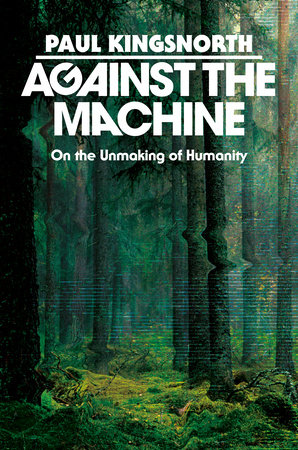
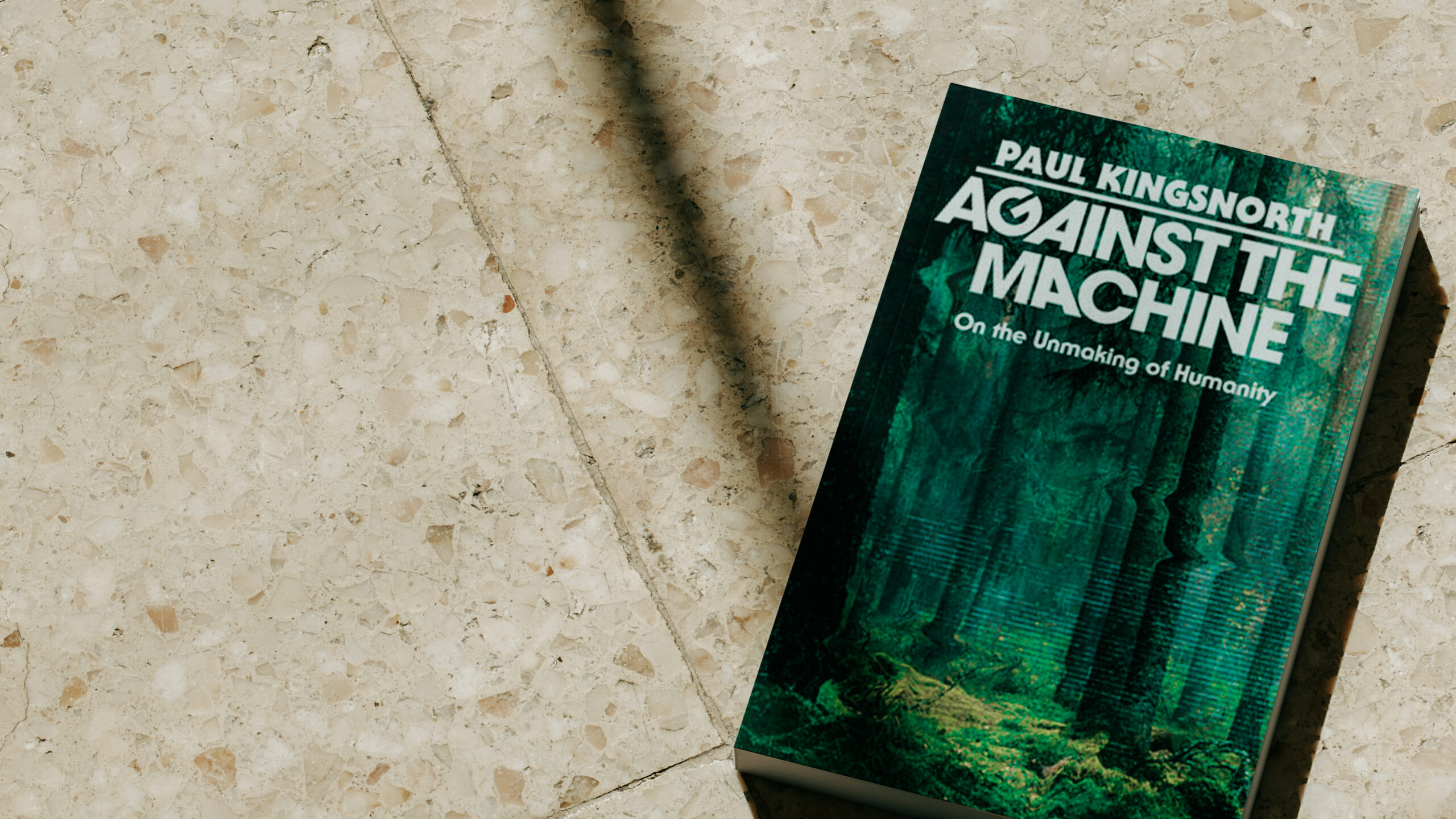
Paul Kingsnorth has spent much of his own life trying to solve problems. As he writes in the introduction to his new book, Against the Machine, he had taken to the habit of activism from an early age, when he realized that there were, in fact, problems with the world: “Those suspicions or intuitions I had as a child—that something was off about the world I lived in, about its values and its direction—morphed as I grew older into a way of life, or perhaps an obsession.” In the beginning it was resistance to the ecological crisis, “chaining myself to bulldozers, living in treehouses and turning up to any protest site I could find.” The focus shifted later to other larger concerns like globalization that swallowed what he was already privy to: “The name was different, but the values were the same—the values of money and numbers and profit and growth—and as usual I was against them.” Now, thirty years into his hunt, Kingsnorth believes he has found the root problem that he has opposed all along, and he has conceived an adequate metaphor, “the Machine,” to characterize it.
Kingsnorth defines the Machine in myriad ways and never settles for one description. “I find myself still circling the monster, like Ahab pursuing the whale. . . . This book is an attempt—a final attempt, I hope—to circumscribe this thing with words.” One thing is for certain from the start: The Machine is grounded in the very foundations of modernity and is coming to particular fruition in the twenty-first century. “Some force has been unleashed in our world which we are struggling to contend with. A huge change is birthing itself; a change in our human relationship with nature, with each other, with our past, with our tools.” The problem of the Machine, in other words, is a problem of modernity.
This is not a battle of left versus right: It is a battle of humanity versus inhumanity, and Kingsnorth believes that it is irresponsible not to act.
More and more writers in recent decades seem to be taking their own swing at constructing a genealogy of modernity, and for a reason that Kingsnorth himself gives: Human history is accelerating, and it is becoming more and more difficult to keep pace both with the rapid shifts in society and with their causes. An updated analysis every few years is almost mandatory at this point, and for popular readership in post-COVID society, Kingsnorth has provided a new edition, offering a laudable synthesis of the most fundamental literature on the nature of modernity and weaving it into his central metaphor of the Machine.
Kingsnorth generally presents the Machine as an exercised impulse of the human spirit that seeks the achievement of supernatural human existence through the comprehension, subjugation, and demolition of natural human existence. It is, he writes, “a tendency within us, made concrete by power and circumstance, which coalesces in a huge agglomeration of power, control and ambition.” This impulse originates in the origin of mankind; Kingsnorth locates it in the Garden of Eden at the fall of Adam and Eve, who sought to become like gods, and characterizes it as a universal element of human experience. In effect, the Machine is a structure of sin, with individual and communal implications, that forms habits, coopts human customs and traditions, and destroys nature. This structure is a totalizing act, one that has infected all peoples throughout history but became intellectually justified, economically and politically practiced, and culturally systematized in modern Western civilization. As it is perceived now, the Machine is synonymous with modernity itself. “We in the West invented this thing called ‘modernity,’ and then we took it out into the world, whether the world wanted it or not.” The presence of Machine modernity grows more and more obvious in the 2020s:
The Machine manifests today as an intersection of money power, state power and increasingly coercive and manipulative technologies, which constitute an ongoing war against roots and against limits. Its momentum is always forward, and it will not stop until it has conquered and transformed the world. To do that, it must raze or transmute many older and less measurable things: rooted human communities, wild nature, human nature, human freedom, beauty, faith and the many deeper values which we all adhere to in some way or another but find difficult to describe or even to defend. Its modus operandi is the abolition of all borders, boundaries, categories, essences and truths: the uprooting of all previous ways of living in the name of pure individualism and perfect subjectivity.
Now, the Machine aims at all of human reality for the first time and can attempt to consummate its final end: “the replacement of nature with technology, in order to facilitate total human control over a totally human world.”

This objective permeates the cultural milieu: Existence is fundamentally a problem, and the goal of life is to remove that problem. This drives the social, cultural, economic, and political impulses to create or identify problems of any kind, eradicate them, and then create or identify new problems. Anything, from spending time procuring groceries to existing within one’s own given body, must be treated as a potential inconvenience, and technological systems must be in place to alleviate the inconvenience definitively once it is recognized. Relying on Jacques Ellul, Kingsnorth calls this worldview “technique,” which seeks “the translation into action of man’s concern to master things by means of reason, to account for what is subconscious, make quantitative what is qualitative, make clear and precise the outlines of nature, take hold of chaos and put order into it.” Technique rapidly snowballs into a vicious habit the more that we apply it: “Once it is set in motion, through the technological network it itself brings into being, technique will inevitably move towards the construction of a whole society framed by its values.” This envisioned society, and the notion of personhood that it cultivates, has certainly materialized; simply consider how the majority of people in Western cultures spend every waking moment not given to work or sleep using their smartphone, and how institutions mandate this degree of technological participation in the form of QR codes, mobile menus, airplane tickets, digital credit cards, and so forth, while laborers in third-world countries are forced to mine the resources that make it all possible. We cannot understand ourselves without the devices in our pockets. And the medium is certainly the message even in primitive cultures; when Starlink was recently introduced to remote tribes in the Amazon, the immediate result was habitual smartphone use, chiefly of YouTube, social media, and pornography.
Kingsnorth is right to point out that many pressing topics in the 2020s result logically from a philosophy of technique: enthusiasm for artificial intelligence, artificial gestation, transgenderism, and transhumanism affirm an escalating preference of digital and virtual reality over and against physical reality. The meaning of humanity has no ground in the real; in fact, what we’re made to understand to be real, even when it comes to our bodies, is only what we can achieve through progress in technological advancement. This situation exceeds political party lines and culture wars; people on both sides of the spectrum seek this transcendence-by-technopoly by escaping bodies, escaping minds, and even escaping the planet. It is “the fruit . . . of a particular notion of what it means to be human: one which, in the final reckoning, moves us into the realm of humanity-as-god.” This is not a battle of left versus right: It is a battle of humanity versus inhumanity, and Kingsnorth believes that it is irresponsible not to act.
* * *
“Ultimately,” Kingsnorth states in a recent interview, “Against the Machine is a book of stories.” In his chronicle of modernity, Kingsnorth gives a penetrating evaluation of various sectors of civilization affected by the Machine. But Against the Machine does not scrutinize the theoretical scope of the Machine; by his own admission in the same interview, “I don’t like theoretical books—I can’t read them or write them.” He consequently fails to account adequately for topics of massive import, like education, and the principles that drive them. A “spiritual manual for dissidents in a technological age” should include more, for example, than a simple recommendation that parents homeschool their kids if the stakes are as high as the integrity of their own personhood.
The book is more like a manifesto than a manual, giving a name to the preeminent crisis of our age and bringing it into the light. Kingsnorth’s calls for a “reactionary radicalism,” “technological askesis,” and a renewed moral economy are, in the end, mere gestures toward a thorough response, a response that Kingsnorth also admits that he cannot articulate fully. In a Q&A accompanying the book, he says that for a true movement against the Machine to become visible, it will have to be personal and local: “We all need to decide in our own lives, according to our own capabilities, what we stand for and what we will not stand for. We need to think about how we want to live, and what we want to see in our societies.” In a way, the position resembles Joseph Ratzinger’s response to the question of how many ways there are to God (“As many as there are people”), though it nevertheless seems unsatisfactory, because it lacks a concrete, positive vision.
Could it be that the key to the renewal of humanity lies within modernity, not fleeing from it but discovering the palpable good that haunts below the surface?
That gap perhaps explains the hint of uncertainty and resignation that attends even his most determined propositions for opposing the Machine. “This is long, hard work: intergenerational work. It is myth work. We don’t really want to begin, and we don’t really know how to. Does any child want to grow up? But there is nothing else for it; no other path is going to get us home.” Kingsnorth desperately wants to solve the problem of the Machine, but his book reads as one massive realization that the Machine, and modernity generally, is more than a material phenomenon. Over and over he insists on the spiritual essence of the Machine, citing St. Paul and asserting that “we wrestle not against flesh and blood, but against principalities, against powers, against the rulers of the darkness of this world.” The chief virtue of Against the Machine might be this honest submission, likely drawn from his newfound faith, before the true gravity of the situation, a world of sin.
But where is the grace? Where can Kingsnorth apply that other adage of the apostle to the Gentiles to the age of the Machine, that “where sin abounded, grace did much more abound” (Rom. 5:20 KJV)? He is adamant that, even though the West has been lost to the Machine that it produced, it should nevertheless provide the source of rebirth: “We started the revolution, so we need to start the restoration. We understand the Machine better than anyone, because it’s in us. We unmade the world. Now we are going to have to remake it again.” Could it be that the key to the renewal of humanity lies within modernity, not fleeing from it but discovering the palpable good that haunts below the surface? Could it be that, as he opines in the story of his conversion, the “ancient faith” he stumbled into, even in the throes of the Machine, is the “way through”?
Perhaps, however, the reason why faith is the way through is not because it is ancient but because it is new. I once asked a Benedictine abbot, who had been a monk for decades, when he decided to become a monk. His reply was simple: “This morning, when I woke up.” Faith is as new as the dew in the grass, newer than modernity, newer even than the Machine and the spells it casts every day. It springs up through a person whom the Scriptures call the “dawn from on high” that breaks upon us (Luke 1:78), one who, in the words of Bishop Erik Varden, a former abbot, “carries constitutionally the freshness of morning dew. Christianity is of the dawn.” The culture of the Machine carries the clue to its own subversion, and it may just be the culture of faith nurtured by those in its clutches, who bear in themselves the new creation.
There is a centuries-old folk song from Kingsnorth’s homeland about a fictional figure named Barbara Allen. A man is ill, physically ill, with love for her, and beckons her to his bedside. When she arrives, she refuses him, and he dies. When he is dead and buried and she hears the church bells, she is struck ill with grief, regret, and heartbreak at the loss of him who loved her. She dies the next day, and is buried beside her lover. From her dead heart grows a briar, and from his grows a rose. The rose and the briar grow higher and higher in the churchyard, until they meet and form a true lover’s knot, in which the rose grows around the briar.
The love poured out in the age of the Machine might be choked, unrequited, or simply rejected. It might result in nothing more than death for those who pour it out. Kingsnorth insists that “we are going to have to be crucified.” It is good news, then, that the sacred mystery of the cross is the path to the transformation of the cosmos and the flowering of humankind.