
Joy is an ever-present theme of J. R. R. Tolkien’s The Lord of the Rings. As the darkness and despair increase, especially in the novel’s third volume, The Return of the King, moments of joy unexpectedly shine forth. One of the most memorable passages concerning joy is a description of the face of the wizard Gandalf by Pippin the hobbit. As the two are awaiting what is likely to be a fatal siege upon the city of Minas Tirith, Pippin looks upon the face of Gandalf:
“Are you angry with me, Gandalf?” he said, as their guide went out and closed the door. “‘I did the best I could.”’
“You did indeed!” said Gandalf, laughing suddenly; and he came and stood beside Pippin, putting his arm about the hobbit’s shoulders, and gazing out of the window. Pippin glanced in some wonder at the face now close beside his own, for the sound of that laugh had been gay and merry. Yet in the wizard’s face he saw at first only lines of care and sorrow; though as he looked more intently he perceived that under all there was a great joy: a fountain of mirth enough to set a kingdom laughing, were it to gush forth.
Gandalf’s joy is surprising. Given the great sorrows and evil that have already passed, and the further trials that await, his joy seems out of place. Yet Pippin can see that the wizard’s joy is not the nihilistic hilarity of despair. Rather, it is a profound joy, something more interior even than the cares and sorrows that Gandalf bears. It is a sustaining joy, the interior strength and foundation by which the wizard guides and shepherds those entrusted to his charge. Gandalf is happy, even when happiness has no apparent exterior source.
Is such joy possible? Can joy really be somehow more interior than care and sorrow?
Where Arnold denies joy, Tolkien, even in harrowing circumstances, affirms it.
One answer, very influential in the modern world, is given by Matthew Arnold in his famous poem “Dover Beach.” Joy is not a possibility in the face of hardship and sorrow, but this is because joy itself is no longer a true possibility in a world that has turned its back on faith. Arnold wrote as part of the Romantic response to the perceived excesses of the Enlightenment’s withering critique of religion and faith. Human reason has at last freed itself from the shackles of faith, but, when we look out upon the world with faithless eyes, says Arnold, we see not progress and flourishing but rather darkness, confusion, and irrational violence. The world of faith is gone. But then, so also is joy.
Tolkien offers another answer. In the midst of even a hopeless situation, joy is not only possible but somehow shines forth from a source beyond despair and sadness. In one of the darkest and most hopeless scenes in The Lord of the Rings, the hobbit Samwise Gamgee suddenly begins to sing. His song is also a poem, and is worth comparing to that of Arnold. Sam’s song, “In Western Lands Beneath the Sun,” affirms what the modern world denies: There is another and greater perspective, one that holds and sustains all things and is untouched by any shadow, and so is the source of an ever-flowing fountain of mirth.
Dover Beach
“Dover Beach” is a beautiful poem, and one of the great examples of modern poetry. Insofar as it is possible to read a poem, what is Arnold telling us? The poem can be divided into three parts.
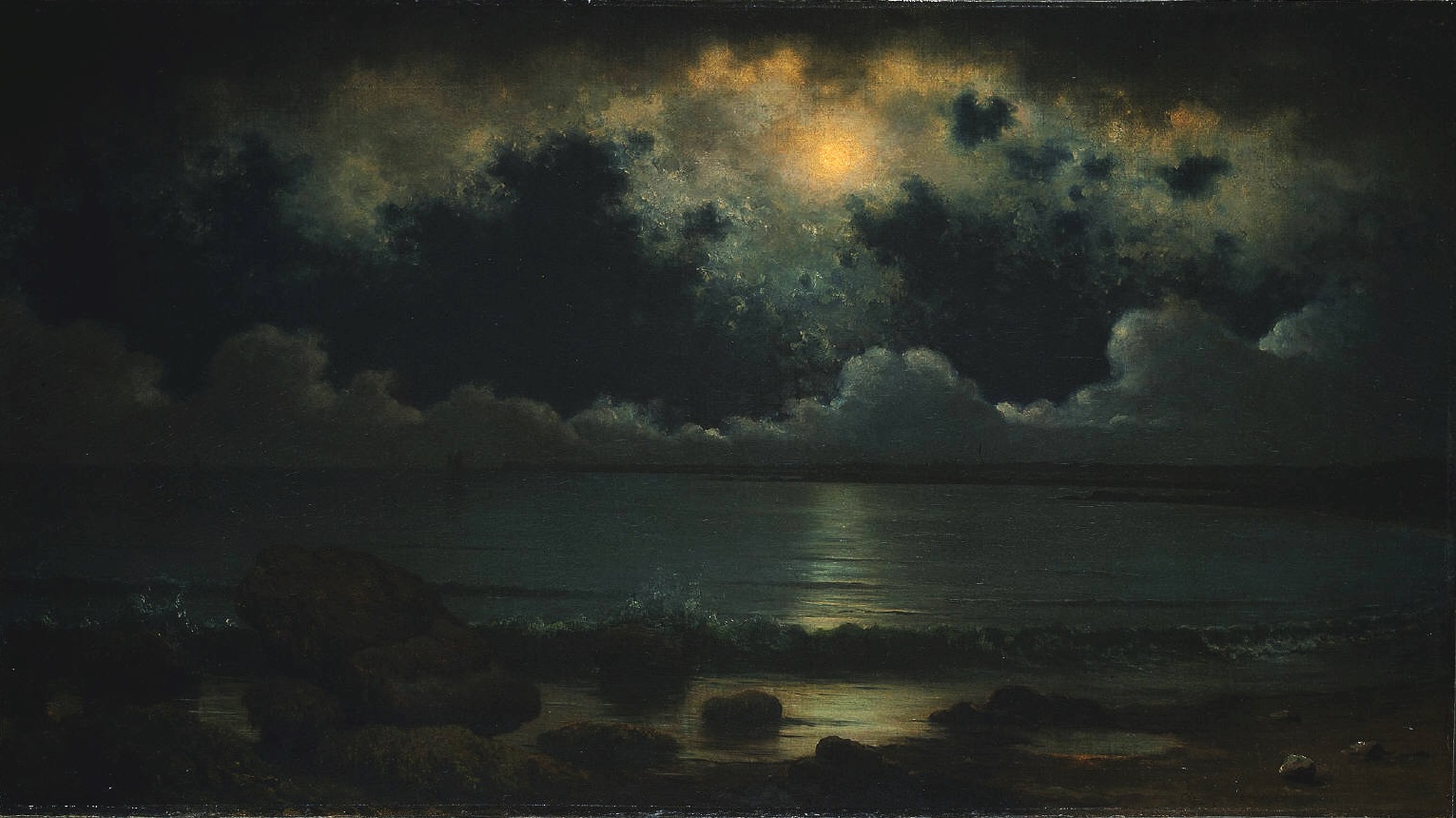
The first part opens with a deceptive serenity, one that we know to be deceptive by the last lines of the poem. Arnold evokes a night of calm sea, full tide, and fair moon. The moon is in the heavens as it should be, and the twinkling lights from France confirm that the poet is indeed where he thinks he is, and the serene coast upon which he stands appears the same as ever. “Come to the window, sweet is the night-air!” he cries.
This leads to the second part of the poem. Arnold has not been the first to hear sadness in the eternal rhythm of the sea. So also did Sophocles, for whom the “turbid ebb and flow” recalled human misery. As the tide always retreats from the full, so human life is characterized by departure and loss. The spell of apparent peace, then, had been broken long before Arnold, who now also finds “in the sound a thought.” In the retreat of the sea, Arnold recognizes that we moderns have also lost something precious.
What have we lost? We have lost faith. Once at high tide, it has receded. Once encompassing all the world, faith has departed. Now, however, Arnold can only hear the last vestiges of faith, and in the grating of pebbles upon the beach he hears, so to speak, the last gasp of a once strong and proud faith, of a faith that is now but a faint echo of its former strength and glory.
In a way, and to change Arnold’s metaphor, the receding of faith can be compared to entering a church that has been bombed out, as would happen so often in the century that was to follow. The empty shell of a church is still there, and perhaps also the basic architectural frames. But it can no longer function as a church.
Hence the third and last part of the poem. The poet is now in a position to look upon the world with faithless eyes—that is, with eyes that no longer see the world through any structure of faith. And he sees a sinister and deceptive world. The harsh and unforgiving glare of Enlightenment rationalism has exposed the world for what it really is. Hence the “Romantic turn” of the poem’s famous line: perhaps there is no longer any fidelity “out there” in the world, but subjectively, fidelity can still be possible, or so we hope. If the externals of faith have all but vanished, perhaps we can find a way to be faithful to one another: “Ah, love, let us be true / To one another!” “Dover Beach” wants to show us that the receding of faith has peeled back, as it were, the veneer of truth and beauty, so that reality is at last laid bare and exposed, and ignorant armies clash in the night.
Sam’s Song
In The Lord of the Rings, Tolkien offers a radically different view of things. Tolkien’s worldview can be contrasted with that of Arnold because, as a veteran of the First World War and the Battle of the Somme, Tolkien speaks with the authority of someone who knew intimately the senseless clash of armies by night. Where Arnold denies joy, Tolkien, even in harrowing circumstances, affirms it.
One of the clearest and most moving examples comes from Sam Gamgee. In The Return of the King, Sam finds himself in a hopeless situation, and, on the brink of despair, he begins to sing. His song takes the form of a poem, in which a vision of the world quite different from “Dover Beach” is affirmed.
Here is Sam’s song:
In western lands beneath the Sun
the flowers may rise in Spring,
the trees may bud, the waters run,
the merry finches sing.
Or there maybe ‘tis cloudless night
and swaying beeches bear
the Elven-stars as jewels white
amid their branching hair.Though here at journey’s end I lie
in darkness buried deep,
beyond all towers strong and high,
beyond all mountains steep,
above all shadows rides the Sun
and Stars for ever dwell:
I will not say the Day is done,
nor bid the Stars farewell.
Sam sings this song in the tower of Cirith Ungol, as his search for Frodo has, he thinks, come to a vain end. In the novel, Sam is alone in one of the most evil places in Middle-earth. The tower of Cirith Ungol is a place of hopeless dark and unsleeping vigilance. Sam searches this dark and horrible tower-prison in vain, until at last grief and weariness start to overcome him.
In a weak voice, Sam begins to recite bits of rhymes from his home in the Shire. But then his voice strengthens:
And then suddenly new strength rose in him, and his voice rang out, while words of his own came unbidden to fit the simple tune.
“In Western Lands Beneath the Sun” is unbidden—that is, it comes to Sam as an unexpected grace. Sam’s song begins by evoking what, as a gardener, he knew and loved so well: the beauty of nature. His song affirms that, without doubt, flowers rise in spring in the lands beneath the sun, even as the trees put forth their buds and the waters run and “the merry finches sing.” The assurance of spring is paralleled by the song’s evocation of a “cloudless night” in those same lands, where the light of “the Elven-stars as jewels white” shine and are borne up by the “swaying beeches,” held aloft “amid their branching hair.”
Arnold looks out upon the beauty of the world and concludes to its irrationality. Sam looks upon the darkness and shadows that surround him and sees beyond them a light and beauty untouched by any passing shadow.
Such gentle beauty and light stand as a bulwark against final despair. Sam is in a bad spot, and it seems to him that all hope has gone. Nevertheless, he does not despair, “though here at journey’s end I lie / in darkness buried deep.” He thinks he has reached the bitter end of his journey, and he has been unable to save Frodo. Even so, the words that come unbidden to him affirm a power greater than the darkness and evil that surround him. There is something beyond the evil that oppresses and seeks mastery. “Beyond all towers strong and high, / beyond all mountains steep, / above all shadows rides the Sun / and Stars for ever dwell,” he says. The sun and stars are not held captive by the artifacts of instrumentalized reason, for they are beyond and so greater than all such products of war. Indeed, the sun and stars are “above all shadows” whatsoever, and untouched by them. For this reason, although Sam thinks he is going to die, he will not despair: “I will not say the Day is done, / nor bid the Stars farewell.”
Sam’s song affirms a primordial light and beauty that no shadow, no matter how powerful and complete it may seem, can touch. In this way, the sorrow and grief that seem so absolute are relativized against the backdrop of an ever-greater goodness and beauty. Even though it seems certain that he himself will perish, a final despair is not Sam’s decision to make. Miraculously, he does not perish, for Frodo hears him singing, and the two are reunited and able to escape the tower.
“Dover Beach” and “In Western Lands Beneath the Sun” offer two distinct ways to look upon the world. Arnold looks out upon the beauty of the world and concludes to its irrationality. Sam looks upon the darkness and shadows that surround him and sees beyond them a light and beauty untouched by any passing shadow. In this way, Sam Gamgee affirms what Arnold, in “Dover Beach,” denies.
For Christians, joy will at last be unmixed with sorrow only in the glory of the life of heaven. At the end of The Return of the King, Tolkien gives us a glimpse of such joy—beyond all hope—Sam at last sees Gandalf again:
“Gandalf! I thought you were dead! But then I thought I was dead myself. Is everything sad going to come untrue? What’s happened to the world?”
“A great Shadow has departed,” said Gandalf, and then he laughed, and the sound was like music, or like water in a parched land; and as he listened the thought came to Sam that he had not heard laughter, the pure sound of merriment, for days upon days without count. It fell upon his ears like the echo of all the joys he had ever known. But he himself burst into tears. Then, as a sweet rain will pass down a wind of spring and the sun will shine out the clearer, his tears ceased, and his laughter welled up, and laughing he sprang from his bed.
Tolkien was in no way naive to the senseless violence of a faithless world. He simply knew of a deeper hope, the hope of martyrs, displayed in characters like Samwise Gamgee, who call us to a deeper hope and so to a more profound joy.