
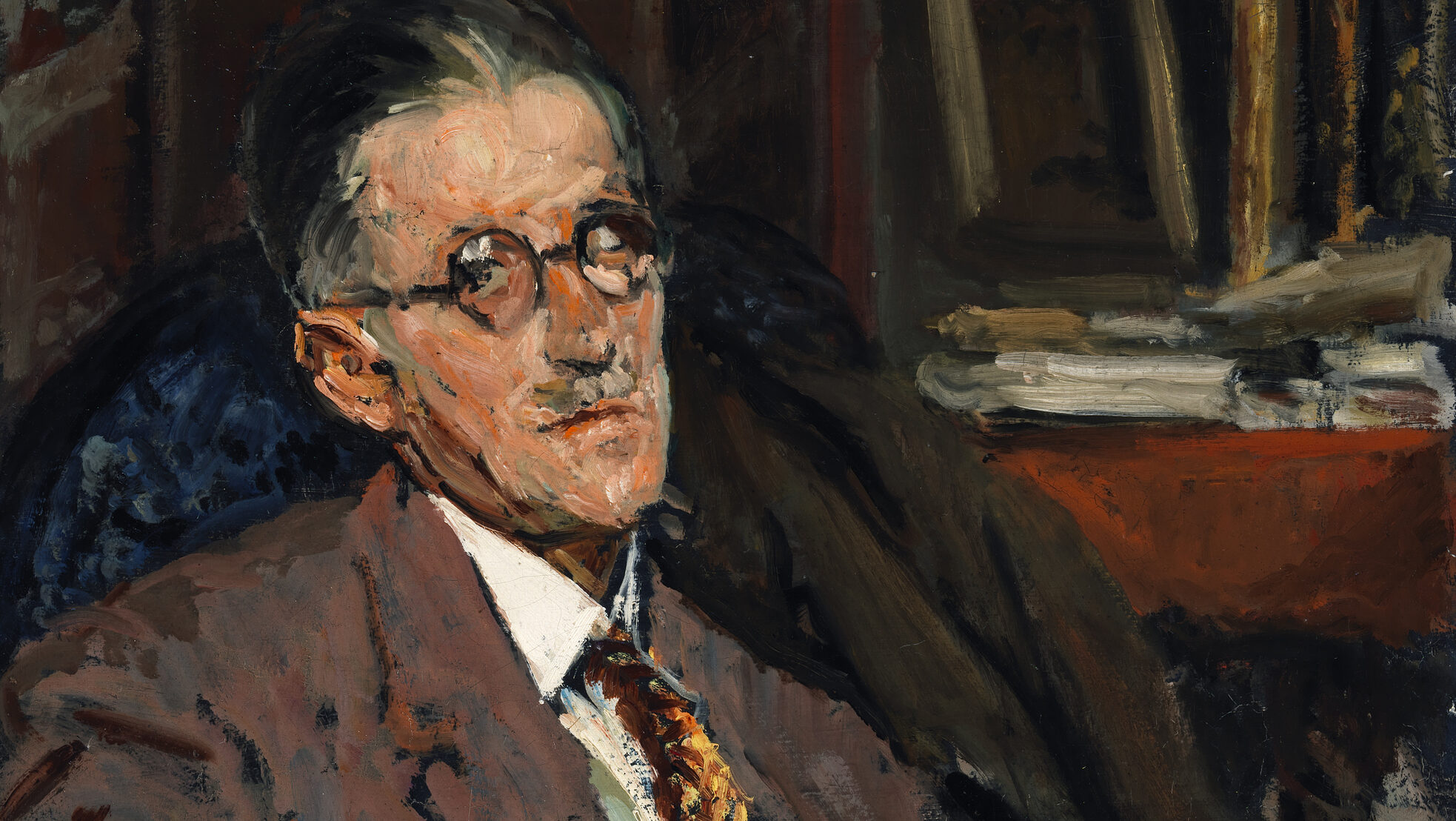
James Joyce is widely regarded as one of the greatest and most enigmatic writers of the twentieth century. Through groundbreaking works, such as Ulysses (1922) and Finnegans Wake (1939), Joyce irreversibly transformed literature by pioneering techniques using stream of consciousness, linguistic experimentation, and complex narrative structures. He arguably created some of the most elegant and beautiful prose in human history, and his innovations revolutionized fiction, reshaping the English language for the modern era. Yet for all Joyce’s profoundly modernist literary contributions, his contemporary, T. S. Eliot, described his work as “penetrated with Christian feeling” with his close friend, Mary Colum, observing, “I have never known anyone with a mind so fundamentally Catholic in structure as Joyce’s own, or one on whom the Church, its ceremonies, symbols, and theological declarations had made such an impression.” Here is a sketch of James Joyce’s biography and his paradoxical relationship with Catholicism.
James Augustine Aloysius Joyce was born on February 2, 1882, to John Stanislaus and Mary Jane Joyce. James was baptized three days later in St Joseph’s Church in Terenure, a suburb of Dublin. He began his education in 1888 and attended the Jesuit-run Belvedere College in Dublin. As a nine-year-old, James composed his first independently printed work, a short poem called “Et Tu Healy” about the death of Irish nationalist, Charles Stewart Parnell. In 1895, he was elected as a member of the Marian society, Sodality of Our Lady, and was taught a Jesuit education. The young Joyce was educated in Catholic theology, classical philosophy (particularly the work of Aristotle), Latin, and Greek, winning an award for English in his final years at the college.
In 1898, he enrolled at University College to study languages. He became immersed in the work of St. Thomas Aquinas, who would be formative and significant to Joyce for the rest of his life. In a poem “The Holy Office” (1905) Joyce wrote, “Those souls that hate the strength that mine has, steeled in the school of old Aquinas,” and in a lecture titled “Ireland: Island of Saints and Sages”(1907), Joyce expressed uncharacteristically high acclaim for Aquinas, stating “Two or three illustrious names shine here like the last few stars of radiant night that wanes as dawn arrives. . . . St. Thomas Aquinas, perhaps the keenest and most lucid mind known to human history.”
Joyce irreversibly transformed literature by pioneering techniques using stream of consciousness, linguistic experimentation, and complex narrative structures.
In his University College years, Joyce had begun to sincerely question and reject his Catholic faith. His repudiation culminated with the death of his devout mother in August 1903 when she was forty-four. She implored the rebellious James to kneel and pray beside her sick bed, to which the young Joyce refused, marking a pivotal psychological and spiritual moment. Joyce carried the guilt for the remainder of his life, with the scene cropping up repeatedly in his fiction and letters. In June of the following year, Joyce met Nora Barnacle. She became his muse, companion, and lifelong partner. He wrote to her with an obsessive passion throughout his life. In an early letter, Joyce reflected on his break from Catholicism and the Church:
Six years ago I left the Catholic Church, hating it most fervently. I found it impossible for me to remain in it on account of the impulses of my nature. I made a secret war upon it when I was a student and declined to accept the positions it offered me. By doing this I made myself a beggar but I retained my pride.
Yet as he declared his rejection of Catholicism, he instinctively reached for Biblical language, imagery, and symbolism when expressing his deepest emotions. Writing to Nora six years later, he described his love in an unmistakably Christian vocabulary:
I too have felt at moments the burning in my soul of that pure and sacred fire which burns forever on the altar of my love’s heart. I could have knelt by that little bed and abandoned myself to a flood of tears. . . . I could have knelt and prayed there as the three kings from the East knelt and prayed before the manger in which Jesus lay. They had travelled over deserts and seas and brought gifts and wisdom and royal trains to kneel before a little new-born child and I had brought my errors and follies and sins and wondering and longing to lay them at the little bed in which a young girl had dreamed of me.
This tension between renunciation and inheritance characterized a major thread for Joyce in his life and work. Joyce may have rejected Catholicism, but Catholicism had not rejected him. The Catholic intellectual and imaginative tradition remained intrinsic to the grammar of his artistic vision.
Joyce’s first major work, A Portrait of the Artist as a Young Man (1916), follows the spiritual and intellectual development of his fictional alter ego, Stephen Dedalus. The novel traces Stephen’s journey from childhood to early adulthood as he confronts faith and doubt, passing through phases of intense religious devotion and reckless hedonism. A key component of the novel is Stephen’s struggle between Catholic priesthood and an artistic vocation. Stephen defines the artist as “the priest of the eternal imagination transmuting the daily bread of experience into the radiant body of everliving life.” The language is undeniably sacramental just as the priest transforms ordinary bread into the Body of Christ through Eucharistic consecration, the artist transforms the ordinary material of human life into art. In A Portrait, Stephen also adapts Aquinas’s three conditions of beauty—integritas, consonantia, and claritas— into his own aesthetic theory as the fundamental principles through which the artist understands, orders, and reveals the eternal nature of reality.
The struggle between priest and artist culminates in a scene where the Jesuit Director of Belvedere asks Stephen to consider a priestly vocation:
A flame began to flutter again on Stephen’s cheek as he heard in this proud address an echo of his own proud musings. How often had he seen himself as a priest wielding calmly and humbly the awful power of which angels and saints stood in reverence! His soul had loved to muse in secret on this desire. He had seen himself, a young and silent-mannered priest, entering a confessional swiftly, ascending the altarsteps, incensing, genuflecting, accomplishing the vague acts of the priesthood which pleased him by reason of their semblance of reality and of their distance from it. In that dim life which he had lived through in his musings he had assumed the voices and gestures which he had noted with various priests. He had bent his knee sideways like such a one, he had shaken the thurible only slightly like such a one, his chasuble had swung open like that of such another as he turned to the altar again after having blessed the people. . . . No touch of sin would linger upon the hands with which he would elevate and break the host; no touch of sin would linger on his lips in prayer to make him eat and drink damnation to himself not discerning the body of the Lord. He would hold his secret knowledge and secret power, being as sinless as the innocent: and he would be a priest forever according to the order of Melchisedec.
Joyce rejected the Catholic priesthood, but retained its deepest structure, recasting the artist as the witness and mediator between God and the fallen world. The host, chalice, and altar give way to the pen, page, and book as the path to reveal the divine in the ordinary. Throughout A Portrait, there are countless examples of Catholic contemplation and ambiguous feelings toward the Church. One moving example is the passage when Stephen goes to confession. Few authors have captured the feeling with such psychological honesty and elation as Joyce:
He knelt to say his penance, praying in a corner of the dark nave: and his prayers ascended to heaven from his purified heart like perfume streaming upwards from a heart of white rose. The muddy streets were gay. He strode homeward, conscious of an invisible grace pervading and making light his limbs. In spite of all he had done it. He had confessed and God had pardoned him. His soul was made fair and holy once more, holy and happy. It would be beautiful to die if God so willed. It was beautiful to live in grace a life of peace and virtue and forbearance with others. He sat by the fire in the kitchen, not daring to speak for happiness. Till that moment he had not known how beautiful and peaceful life could be. The green square of paper pinned round the lamp cast down a tender shade. On the dresser was a plate of sausages and white pudding and on the shelf there were eggs. They would be for the breakfast in the morning after the communion in the college chapel. White pudding and eggs and sausages and cups of tea. How simple and beautiful was life after all! And life lay all before him.
For Dedalus, the sacrament of confession is a moving encounter with grace. Joyce illustrates the experience with astonishing sincerity, painting the moment when grace transfigures the world, elevating the most mundane details—from the “muddy streets” of Dublin to a breakfast of “sausages and white pudding”—with levity, beauty, and hope. It also reminds us that sacramental action has the power to inspire faith amid doubt. The scene also suggests that while the feeling may be momentary, grace leaves a permanent impression upon the human heart. The faith, formation, and sacramental imagination that Joyce experienced left an unalterable imprint upon his mind and soul that continued to inform, shape, and frame his artistic and intellectual vision long after he had verbally rejected the Church. Perhaps this is revealed most convincingly in his follow-up work, Ulysses, described by Joyce’s friend Mary Colum as “one of the most Catholic books ever written.”
The Catholic intellectual and imaginative tradition remained intrinsic to the grammar of his artistic vision.
Ulysses tells the story of Leopold Bloom through a single day in Dublin, June 16, 1904, whilst Joyce’s alter-ego Stephen Dedalus wanders the city. The book is shaped by Homer’s The Odyssey with Bloom functioning as an everyday Odysseus who goes about his day of eating, drinking, arguing, and encountering strangers confronting themes of mortality, sexuality, religion, exile, and the fundamental search for meaning. Ulysses is littered with Catholic references and concerns. Early in the novel, Joyce recounts through Dedalus his refusal to kneel and pray at his mother’s bedside, establishing from the outset the theme of guilt and conflict with Catholicism:
A cloud began to cover the sun slowly, shadowing the bay in deeper green. It lay behind him, a bowl of bitter waters. . . . Silent with awe and pity I went to her bedside. She was crying in her wretched bed. For those words, Stephen: love’s bitter mystery. . . . Memories beset his brooding brain. Her glass of water from the kitchen tap when she had approached the sacrament. . . . Her eyes on me to strike me down. Liliata rutilantium te confessorum turma circumdet: iubilantium te virginum chorus excipiat / May the lilied throng of radiant confessors surround you: may the choir of jubilant virgins welcome you. . . . No mother. Let me be and let me live.”
One of the most memorable Catholic episodes in the novel is when Joyce takes us into Bloom’s stream of consciousness as he stumbles into Mass. Unlike Dedalus, who has internalized the Church’s theology, Bloom is a Jewish outsider observing Catholic ritual with wonder and skepticism:
He approached a bench and seated himself in its corner, nursing his hat and newspaper. . . . Yes, bread of angels it’s called. There’s a big idea behind it, kind of kingdom of God is within you feel. . . . Thing is if you really believe in it. Lourdes cure, waters of oblivion, and the Knock apparition, statues bleeding. Old fellow asleep near the confession box . . . Blind faith. Safe in the arms of the kingdom come. . . . He saw the priest stow the communion cup away . . . letters on his back I.N.R.I.? No: I.H.S. Molly told me one time I asked her. I have sinned: or no: I have suffered, it is. And the other one? Iron nails ran in.
The two central characters, Catholic-formed Dedalus and middle-class Jew Bloom, converge in a penultimate episode, engaging in a question and answer style conversation, described by Joyce as written in “catechism (impersonal)” technique and as the “mathematico-astronomico-physico-mechanico-geometrico-chemico sublimation of Bloom and Stephen.” The dialogue unites the characters in an interplay between the mundane and the transcendent as they discuss the microcosm of the day and the macrocosm of the cosmos.
Throughout Ulysses, Joyce repeatedly substitutes traditional religious experience with ordinary human life, illuminating the spiritual dimensions within it. In this way, Joyce recalls Caravaggio, who brought contemporary life into his paintings, using ordinary Romans, street people, and prostitutes as models for saints. For Caravaggio as for Joyce, the sacred is not in some remote idealized world; it is within the gritty imperfections of human life.
In many respects, this echoes the Gospel scenes of Christ walking and talking amongst the ordinary people amidst the mundanity of daily life, sanctifying their reality by his presence. Jesus eats with sinners, touches the unclean, speaks with the marginalized, and takes unleavened bread and offers it as his body. The Incarnation itself is the ultimate elevation of the ordinary—God entering human history, assuming our flesh, and living amongst us. Through an encounter with Christ, the world is transfigured and imbued with profound meaning, beauty, and luminosity, reminding us that creation can become a medium through which the divine is encountered. This is the artistic principle Joyce inherits and transforms, the artist finds within the seemingly mundane world the possibility of revelation.
James Joyce died on January 13, 1941, at the age of fifty-eight. There were rumors abounding as to whether Joyce had gone back to his Catholicism upon his deathbed, with Joseph Walshe, secretary at the Department of External Affairs in Dublin, writing, “Please wire details of Joyce’s death. If possible find out, did he die a Catholic?” Nora Barnacle declined the offer for a Catholic burial and even though Joyce renounced the Church, it is reported that he occasionally went to Mass on Holy Thursday and Good Friday throughout his life. Joyce remained an enigma until the end.
James Joyce was a deeply complex and paradoxical talent who appeared to reject Catholicism yet retained its sacramental imagination, transposing it into a secular literary context. He adapted the Catholic conviction of the Incarnation and revealed it in the whole of human experience. He resented the institution of the Church, yet the institutional formation he received from the Jesuits gave Joyce the intellectual freedom and framework through which he would create. This is the crux of the Joyce paradox: The Catholicism he rejected furnished the very imagination through which he would continue to explore the eternal. Whether conscious or not, Joyce bears a remarkable resemblance to the Catholic vision he inherited—the extraordinary discovered within the ordinary, the sacred within the profane, beauty within the mundane, and the transcendent glimpsed through the mortal. He rejected the priesthood, but the sacramental imagination remained. The altar gave way to the page, the liturgy to literature, and the priestly act of mediation to the artist’s attempt to reveal the eternal within the everyday.