
For more than four centuries, Caravaggio has remained one of the most influential and compelling artists in Western and Catholic history. His controversial life continues to inspire a steady stream of books, film adaptations, and popular fascination. His sublime paintings have captivated the imagination of countless viewers, historians, and critics for their unparalleled dramatic intensity and profound convergence of light and darkness, beauty and violence, life and death, drawing onlookers into some of the most visceral and transcendent encounters with grace ever committed to canvas. Here is a brief sketch of Caravaggio’s profane life and sacred art, illuminating their relationship to the central Catholic drama of sin, suffering, and redemption.
Michelangelo Merisi was born on September 29, 1571, in Milan and baptized the following day in the parish of St. Stephen in Brolo. Both his parents, Fermo Merisi and Lucia Aratori, were born in the nearby town of Caravaggio, with which their son would be famously associated. The family moved from plague-ravaged Milan back to Caravaggio in 1576, where Michelangelo’s father fell victim to the epidemic in 1577. His mother continued to raise and support the five children through severe financial hardship until her death in 1584 when Michelangelo was only thirteen years old.
That same year, he began his apprenticeship to local painter Simone Peterzano, who claimed to be a pupil of the master Titian. The young Caravaggio was exposed to Titian, Giorgione, and da Vinci and was shaped by the art and culture of his Lombard background. The Archbishop of Milan, Carlo Borromeo, exerted a huge influence over the area, and his appeal to metaphysical naturalism in art undoubtedly seeped into the brushstrokes of the young Caravaggio.
In 1592, the twenty-year-old Caravaggio left Milan for the papal states of Rome after supposedly wounding a police officer in a street brawl, foreshadowing his propensity for violence. Like so many artists who came to Rome seeking riches and celebrity, he had to fight for his place in the Roman art scene; he spent many years in financial hardship, confronting further poverty, homelessness, and little artistic freedom. He eventually began working with Mannerist painter Cavaliere d’Arpino, with whom he was commissioned to paint flowers, fruits, or heads in an assembly line workshop for minimal pay. Caravaggio was ambitious and resented being made to paint such lowly subject matter, subsequently creating his own work: Boy Peeling Fruit (1592), Boy with a Basket of Fruit (1593), and Young Sick Bacchus (1594).
Caravaggio reflected the heart of the gospel: Christ walking among the poor, outcast, and downtrodden to reveal grace, redemption, and unspeakable beauty in the least expected places.
His relationship with d’Arpino ended in a heated argument, resulting in Caravaggio’s hospitalization after being reportedly kicked by a horse. During his time with d’Arpino, he developed some pivotal friendships with the architect Longhi, painter Orsi, and artist Minniti, who was to become a model for much of Caravaggio’s early work. At night he wandered the Roman streets with his friends, frequenting taverns, visiting courtesans, and gambling tables, often getting into violent altercations and street fights. His early interest in depicting the seedier aspects of Roman life can be seen in The Cardsharps (1595), revealing an early display of the psychological complexity that would trademark his later work.
The Cardsharps and The Fortune Teller (1594) were purchased by Cardinal Francesco Maria del Monte, a key agent and collector in the Roman art world, who became a major benefactor and patron of Caravaggio in the years to come. Del Monte had a wide range of interests, from art, poetry, music, and alchemy to new science. He commissioned many works from the volatile upcoming artist, including The Musicians (1595) and The Lute Player (1596). Aside from these depictions of gamblers and musicians, Caravaggio had already displayed an interest in religious themes with his earliest explicitly spiritual work, Penitent Magdalene (1595).
The painting was deeply unconventional, straying from traditional Magdalene iconography by depicting an unmistakably contemporary setting for the forlorn penitent. Scholars believe the model for Mary Magdalene to have been the young courtesan Anna Bianchini, who appeared in several works, including Rest on the Flight into Egypt (1597) and The Death of the Virgin (1606). It was the first painting in what would be a signature combination for Caravaggio—the unification of sacred subjects with the realities of contemporary life, often using prostitutes, street people, laborers, and ordinary people as models for biblical figures. This transformation of contemporary sinner into saint, tavern into place of conversion, and shadowy city street into a setting for an encounter with angels and mercy became a hallmark of his work. In so doing, Caravaggio reflected the heart of the gospel: Christ walking among the poor, outcast, and downtrodden to reveal grace, redemption, and unspeakable beauty in the least expected places.
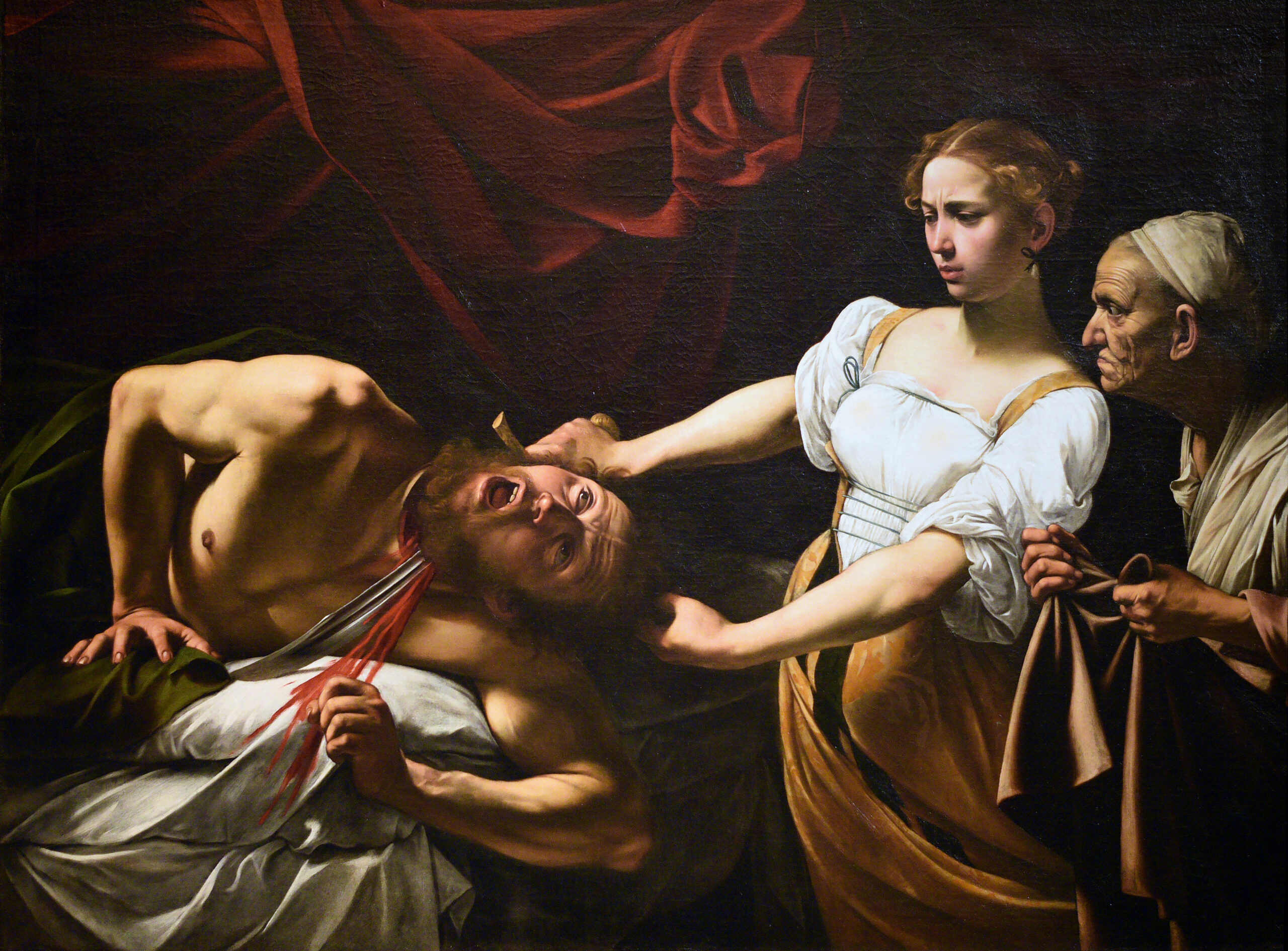
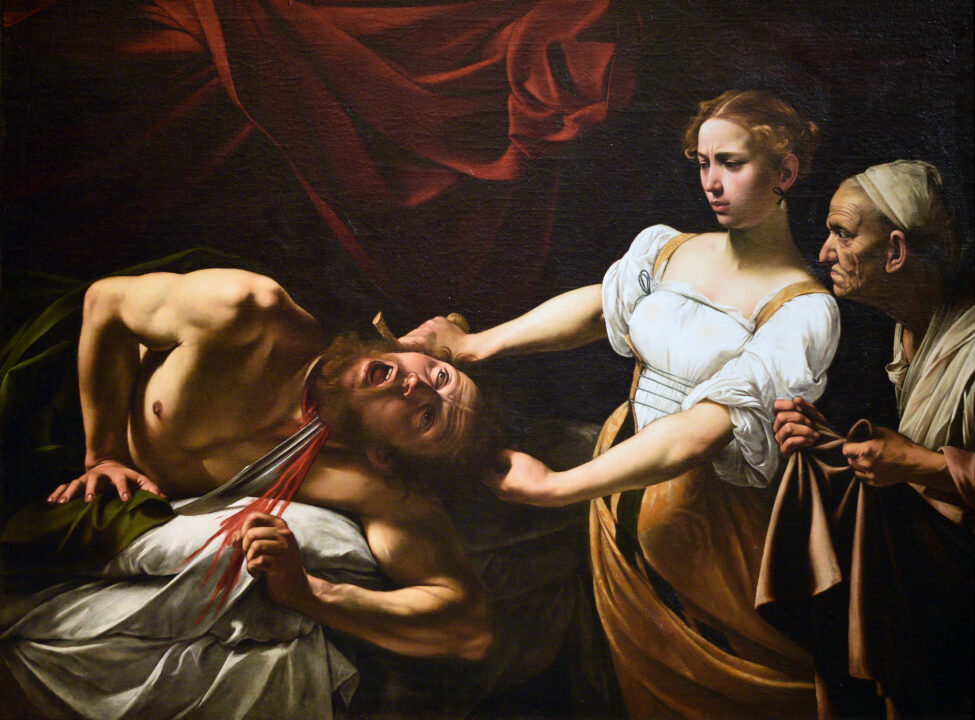
Caravaggio’s most recognizable muse was the seventeen-year-old courtesan Fillide Melandroni. She was a famous Roman prostitute who counted Italian banker and Caravaggio patron Vincenzo Giustiniani as a frequent client. She is the face of St. Catherine (1598), Mary in Martha and Mary Magdalene (1598), and, most famously, Judith in Judith Beheading Holofernes (1599). The last is a remarkable example of Caravaggio’s developing tenebrism, or chiaroscuro, characterized by bold contrasts between light and dark, visceral realism, emotional intensity, and masterful compositional technique. Caravaggio painted directly onto the canvas, often in dark spaces with singular light sources to create dramatic effect, here outlined by his early biographer Bellori in his work The Lives of the Modern Painters, Sculptors, and Architects (1672):
[Caravaggio] never showed any of his figures in open daylight, but instead found a way to place them in a closed room, placing a lamp high so the light would fall straight down, revealing the principal part of the body and leaving the rest in shadow so as to produce a powerful contrast of light and dark.
Judith Beheading Holofernes depicts the biblical episode in which Judith, a beautiful and charming Jewish widow, kills an Assyrian general and saves Jerusalem from destruction (Judith 13:7–8). Caravaggio chose to paint the moment of decapitation. It is extraordinary in its combination of horror, violence, and profound elegance.
On July 23, 1599, through the help of his patron Cardinal del Monte, Caravaggio was commissioned to paint the Contarelli Chapel in San Luigi dei Francesi. The resulting three works on St. Matthew—The Calling of St. Matthew (1600), The Inspiration of St. Matthew (1602), and The Martyrdom of St. Matthew (1600)—cemented Caravaggio’s reputation as a formidable artistic force in Rome and ignited both acclaim and controversy. The paintings were praised by the public but dismissed by his artistic rivals, including Baglione, who deemed the archangels to be “close to life” (ritratti dal naturale), meaning that he hadn’t sufficiently idealized his models to look angelic or otherworldly.
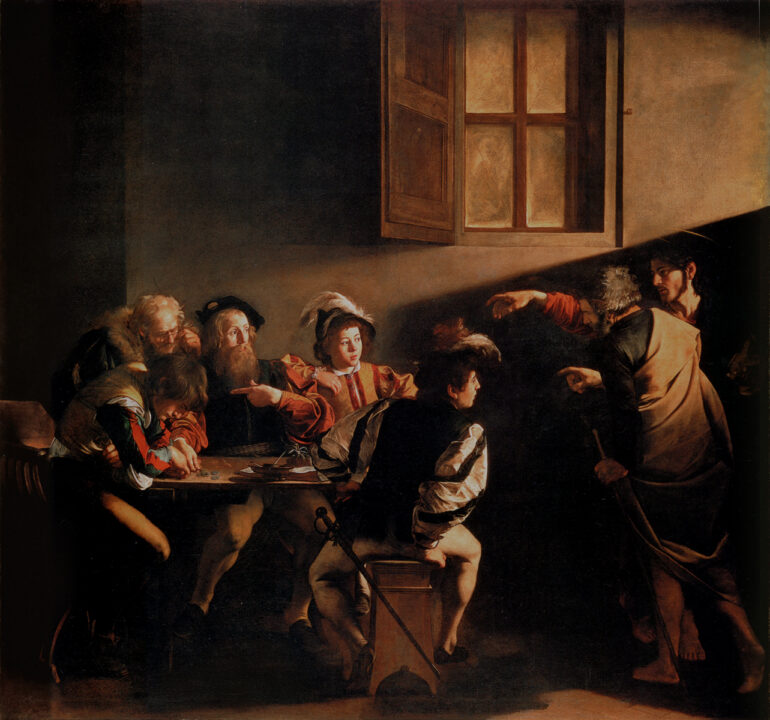
The three paintings take Caravaggio’s chiaroscuro technique to a heightened and masterful level. Perhaps the most striking of the three is The Calling of St. Matthew, where once again the viewer is taken out of the typical biblical context of first-century Judea and into the modernity of late sixteenth-century Italy. Matthew and his counterparts are dressed in the fashionable clothes of the day and have an aesthetic kinship with The Cardsharps painted a few years prior. A soft, luminous light beams like a theater spotlight from above Christ’s head as he looms with arm outstretched from the right-hand frame, authoritatively pointing at the seemingly confused Matthew. The painting is one of Caravaggio’s most striking and influential. Pope Francis detailed its importance in his own spiritual journey:
I often visited the Church of St. Louis of France, and I went there to contemplate the painting of The Calling of St. Matthew by Caravaggio. That finger of Jesus, pointing at Matthew. That’s me. I feel like him. Like Matthew. It is the gesture of Matthew that strikes me: He holds on to his money as if to say, “No, not me! No, this money is mine.” Here, this is me, a sinner on whom the Lord has turned his gaze. And this is what I said when they asked me if I would accept my election as pontiff. “I am a sinner, but I trust in the infinite mercy and patience of our Lord Jesus Christ, and I accept in a spirit of penance.”
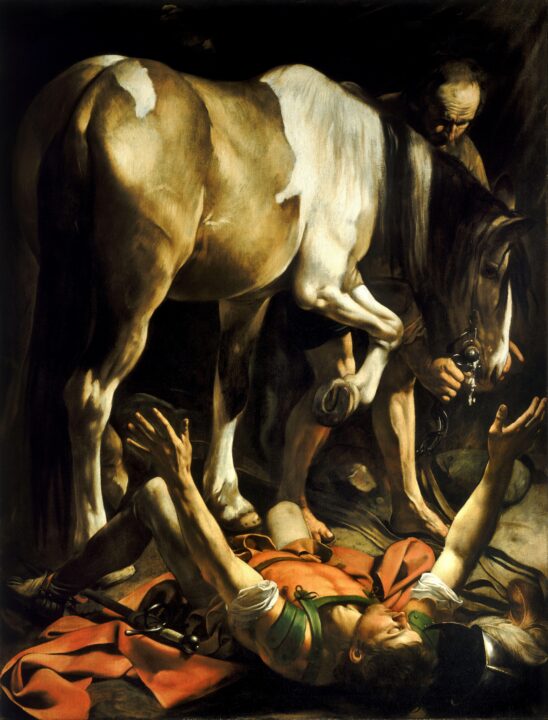
Caravaggio’s triumph in the Contarelli Chapel soon led to further prestigious commissions. He was invited to paint the Cerasi Chapel, producing two works: The Conversion of St. Paul (1601) and The Crucifixion of St. Peter (1601). Caravaggio pushed his chiaroscuro technique further, discarding crowded compositions and elaborate settings, favoring dramatic simplicity that reduced each scene to its psychological and spiritual essence. The Conversion of St. Paul is particularly revealing of Caravaggio’s unorthodox approach to biblical subjects. Famously, Paul’s horse dominates the composition, towering above the fallen convert. The horse even presents its hindquarters to the viewer, a striking example of Caravaggio’s combination of sacred subject matter with earthy realism. Rather than portraying Paul traditionally as a triumphant apostle, Caravaggio shows him lying on the ground with his arms outstretched in an attitude of vulnerable surrender and wonder as Caravaggio’s signature soft, luminous light falls upon his awestruck face. The result isn’t an idealized public spectacle of conversion but rather a personal encounter with the power of grace.
Caravaggio had achieved the artistic success he had sought as a young apprentice in Milan, securing his reputation as one of Rome’s most sought-after painters. Yet his uncompromising realism and unorthodox treatment of sacred subjects frequently courted criticism, with several commissions being either rejected or replaced. His private life was equally controversial. Court records reveal an endless litany of disputes, arrests, and brawls, ranging from sword clashes with mercenaries, fights with landlords, and assaults on fellow artists, with one recalling: “I was knocking at the candlemaker’s door to get some candles, the defendant [Caravaggio] came up with a stick and began to beat me. He gave me a good many blows. I defended myself as best I could . . . and then Michelangelo drew his sword and made a thrust at me.”
The violence that had long shadowed Caravaggio’s life and career came to a climax on May 29, 1606, when he killed Ranuccio Tomassoni in a duel. The cause of the confrontation remains clouded and uncertain. Contemporary accounts and biographers offer conflicting explanations, ranging from a gambling dispute to a heated argument over a woman. Tomassoni is believed to be the pimp of Caravaggio model Fillide Melandroni, leading many biographers to speculate that jealousy may have been the source of conflict. Nevertheless, the duel ended with Tomassoni dead and Caravaggio fleeing Rome with a papal death sentence.
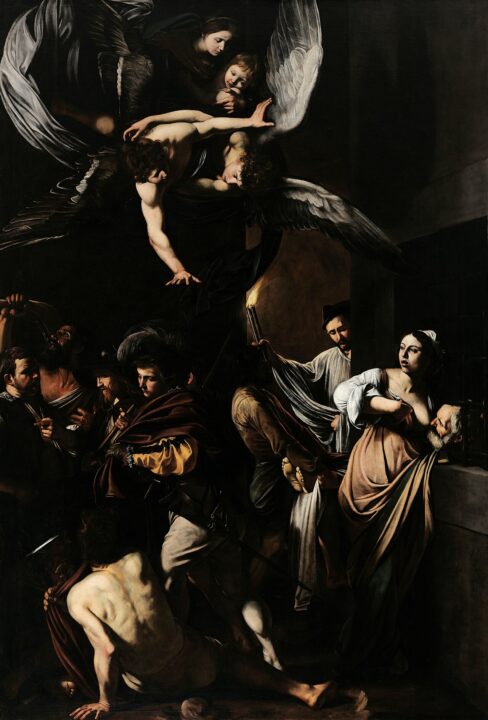
During his years in exile, Caravaggio continued to paint some of the most ambitious works of his career, including The Seven Works of Mercy (1607), produced shortly after his arrival in Naples. Commissioned by the Pio Monte della Misericordia, the central altarpiece combines all seven corporal works of mercy within a single composition. The acts depicted include feeding the hungry, giving drink to the thirsty, clothing the naked, sheltering the homeless, visiting the sick and imprisoned, and burying the dead. Despite the complexity and epic nature of the subject, the painting exudes a remarkable cohesion and unity, elevating everyday acts of compassion into a powerful vision of Catholic charity. Once again, Caravaggio demonstrates his unparalleled capacity to create images at once modern and eternal, heavenly and worldly, acting as windows and bridges between mortality and immortality. In this sense, his work seems like a forerunner for modernity, anticipating the art of later figures like James Joyce, Pablo Picasso, and Pier Paolo Pasolini, who all sought transcendence within the faces and contradictions of everyday human experience.
During his final years, Caravaggio briefly became a Knight of Malta and traveled between Naples, Malta, and Sicily, painting some of the most haunting works of his career, including The Beheading of St. John The Baptist (1607), The Denial of Saint Peter (1610), and David with the Head of Goliath (1610). The paintings convey a deeper sense of Caravaggio’s material and psychological desolation, with figures often set in vast canvases of darkness and shadow, confronting mortality, suffering, and betrayal. The psychological and spiritual intensity that always informed and radiated from Caravaggio’s art became imbued with the uncertainty and desperation of an increasingly paranoid man on the run. Perhaps the most personal of these is David with the Head of Goliath, in which the severed head is believed to be a self-portrait of the beleaguered artist. The painting transforms a biblical scene into a macabre and haunting meditation on guilt and judgment, offering a rare and profound window into Caravaggio’s despair-marred inner world.
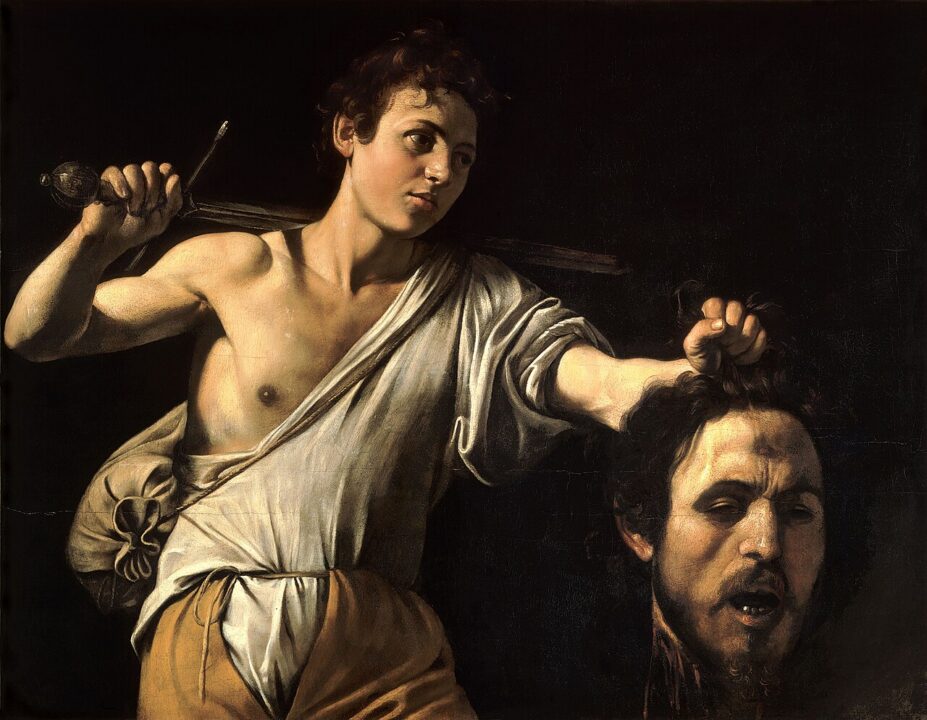
The psychological and spiritual intensity that always informed and radiated from Caravaggio’s art became imbued with the uncertainty and desperation of an increasingly paranoid man on the run.
Caravaggio’s death and decline remain shrouded in mystery. Some historians have suggested he may have been killed by the Knights of Malta or by Ranuccio Tomassoni’s family in revenge. Others suggest that he died of syphilis, sepsis, or malaria, which may explain his increasingly paranoid and disturbed condition. What is relatively certain is that he died in Porto Ercole on July 18, 1610, at the age of thirty-eight.
In the aftermath of his death, Caravaggio’s work was diminished by his artistic rivals, and unfortunately, unlike many of his contemporaries, he left behind no workshop or school to impart his revolutionary methods to a new generation. However, historians have traced his influence in the works of Rubens, Rembrandt, Vermeer, Delacroix, and Manet, with art critic Robert Hughes stating, “There was art before him and after him, and they were not the same.”
In 2005, Martin Scorsese expressed Caravaggio’s immense influence on him and the modern medium of cinema:
If Caravaggio were alive today, he would have loved cinema. . . . His paintings take a cinematic approach. We filmmakers became aware of his work in the late 1960s and early 1970s, and he certainly was an influence on us. . . . In many cases he painted religious subject matter but the models were obviously people from the streets; he had prostitutes playing saints. There’s something in Caravaggio that shows a real street knowledge of the sinner—his sacred paintings are profane.
Perhaps there has never been another artist who embodied such extremes—fugitive, street brawler, hedonist, and murderer—and yet created the most intense, sublime, and transcendent images in Catholic history. His life and work are a testament to the Catholic conviction that no one is beyond the reach of God’s grace, and even the greatest sinners can participate in the story of redemption. Caravaggio’s profane life and sacred art become a crucible through which to view the profound mystery of God, human existence, suffering, and the power of love.
It is the redemptive encounter between grace and sin that underlies the incarnational heart of Caravaggio’s art. He illuminates the divine within a fallen world, inviting the viewer to recognize themselves and consider their own need for redemption. It is Caravaggio’s elevation of the ordinary and recognition of the saint within the sinner that places his work at the center of the Catholic artistic imagination. His incarnational vision calls us to see light in vast darkness, to allow grace to penetrate the depths of our sin, and lead us to the hope of everlasting life.